

On this page
Deep inside your ear lies a bony labyrinth that has nothing to do with hearing. While the cochlea handles sound—a system famously bypassed by Graeme Clark and the multichannel cochlear implant—the vestibular system acts as your body's internal motion sensor. Its most striking feature is a set of three fluid-filled tubes called the semicircular canals.
The three loops of balance
Each ear has three semicircular canals: the superior (anterior), posterior and lateral (horizontal) canals. According to a physiological review in StatPearls, they are oriented at roughly right angles to one another, matching the three dimensions of space. This orthogonal arrangement allows them to detect angular acceleration, or rotational movement of the head, in any direction.
If you nod your head "yes", the superior canal detects the pitch. If you shake your head "no", the lateral canal picks up the yaw. If you tilt your head toward your shoulder, the posterior canal registers the roll. Visualising how these three planes intersect can be tricky. If you are revising the anatomy of the ear or the physics of rotational motion, you will find lessons mapping out every detail in the Fermi Concept Library.
The canals are housed within a rigid bony shell hollowed out of the skull. Suspended inside is a delicate membrane filled with endolymph. This unique fluid has a high potassium concentration, which provides the electrical gradient needed to fire nerve signals to the brain.
How do the semicircular canals detect motion?
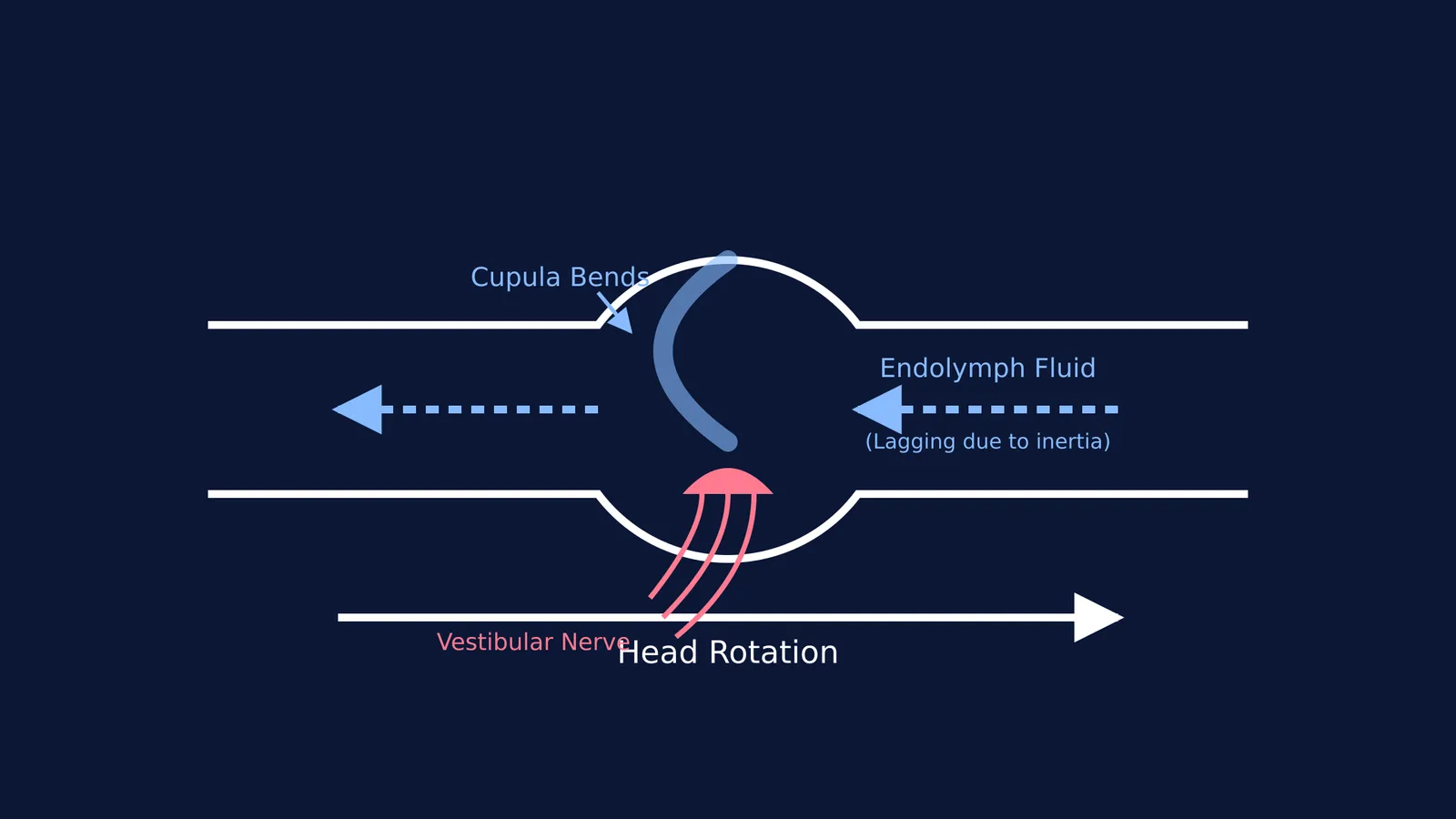
At the base of each canal is a bulbous swelling called the ampulla. Inside the ampulla sits the crista ampullaris, a mound of sensory hair cells covered by a gelatinous dome known as the cupula. The cupula spans the entire width of the ampulla, acting as a flexible barrier.
The system relies entirely on the physics of inertia. When you turn your head, the bony canals move immediately with you. However, the endolymph fluid inside has mass, so it resists this change in motion and lags behind. This relative fluid motion pushes against the cupula, bending it like a sail catching the wind.
As the cupula bends, it deflects the tiny stereocilia of the hair cells embedded within it. Bending these stereocilia in one direction opens ion channels, triggering an electrical signal that travels down the vestibular nerve. Bending them the opposite way stops the signal. Because the canals on the left and right sides of your head are mirror images, they work in a push-pull system: turning your head left excites the left horizontal canal while simultaneously inhibiting the right one.
These signals feed directly into the vestibulo-ocular reflex (VOR). When you walk, your head bounces. The VOR detects these movements and automatically rotates your eyes in the exact opposite direction. This keeps your gaze locked on your target, ensuring your vision does not blur with every step.
Why does spinning make you dizzy?
If you spin around in a chair, you experience a severe sensory conflict dictated by momentum.
When you first start spinning, the endolymph lags and pushes the cupula, correctly signalling rotation. If you continue spinning at a steady speed, friction eventually causes the endolymph to catch up with the canal walls. The fluid and the canal are now moving at the exact same speed, so the cupula springs back to its upright, resting position. At this point, your inner ear tells your brain that you have stopped rotating, even though you are still spinning.
The real confusion happens when you suddenly stop. Your head and the canals halt immediately, but the endolymph has angular momentum. It continues to slosh forward, pushing the cupula in the opposite direction. Your inner ear now sends a powerful signal that you are spinning in the reverse direction, even though your muscles and eyes confirm you are sitting perfectly still.
This severe mismatch between your inner ear, your eyes and your body is what causes vertigo and the feeling of dizziness. The world will seem to spin until the fluid's momentum finally dissipates through friction.
How can you test the physics yourself?
You can observe this mechanism safely at home with a swivel chair. Have a friend sit in the chair and spin them steadily for a while so their endolymph catches up to the canal speed. Then, stop the chair abruptly and ask them to look straight at your nose. You will see their eyes darting rapidly back and forth as their brain responds to the sloshing fluid. (As with any circular motion problems, ensure the area is clear before you start spinning!)
When the vestibular system malfunctions without spinning, the results are deeply disorientating. The most common cause of peripheral vertigo is Benign Paroxysmal Positional Vertigo (BPPV). This occurs when tiny calcium crystals (otoconia) break loose from another part of the ear and float into the semicircular canals. When you change head position, these heavy crystals drag the fluid with them, bending the cupula and causing brief but intense spells of dizziness.


