On this page
For most of history, a person who lost the hair cells of the inner ear had no way back to hearing speech. Many experts in the 1960s believed electrical stimulation could never carry something as complex as speech. Graeme Clark set out to prove them wrong, partly because of his father. This post covers his story, the physics and biology of how a multichannel implant works, and what his first patient heard.
Who is Graeme Clark?
The Australian Academy of Science interview records that Graeme Milbourne Clark was born in Camden, New South Wales, in 1935. He graduated in medicine from the University of Sydney in 1957 and trained as an ear, nose and throat surgeon in Australia and England. He returned to Sydney for an MS (1968) and a PhD (1969), and in 1970 became the first William Gibson professor of otolaryngology at the University of Melbourne, a post he held until 2004.
His motive started at home. His father, a pharmacist in Camden, was going deaf. Clark remembers customers being asked, "Speak up. What would you like?", so that the whole shop heard what they wanted. "I was ten when I wanted to be an ear doctor," he says.
At 31 he wrote to the Nobel laureate John Eccles for advice about research. Clark recalls the reply: "I think you're too old to embark upon a career in research". He did not take the advice, and moved his young family to Sydney on a much smaller income to do his PhD.
How does the ear sort sounds by pitch?
The Lasker Foundation's account of the award explains the biology. Sound waves move through the fluid-filled cochlea and bend thousands of hair cells, which produce electrical signals in the auditory nerve. Most severe deafness comes from damaged or missing hair cells, while the nerve fibres often survive.
The hair cells do not respond uniformly to a given pitch; their position matters. High pitches excite cells near the cochlea's opening and low pitches excite cells deeper along the spiral. The Lasker essay compares the unrolled cochlea to a piano. This is called place coding. The nerve also fires in time with sound waves, called time coding.
Early implants from the 1960s used one electrode. Work by Blair Simmons suggested that a single electrode could convey pitch only up to a certain frequency, so time coding alone would not be enough.
What did Clark's multichannel implant do?
Clark, and independently Ingeborg Hochmair and Erwin Hochmair, placed multiple electrodes at different sites along the cochlea and routed different parts of incoming sound to different sites. According to the Lasker account, patients first received the Hochmair and Clark devices in December 1977 and August 1978 respectively.
In the Academy interview, Clark describes the first operation, on Rod Saunders on 1 August 1978. When the device was first switched on, Saunders heard nothing, and again at the second try. Engineers then found a loose connection. On the third visit he heard sound. Tests showed that stimulating different electrodes gave him different pitch sensations, which was the whole premise of the multichannel design. Near the end of the year, Saunders heard real speech sounds through electrical signals alone, and Clark says he went into the next lab and "burst into tears of joy".
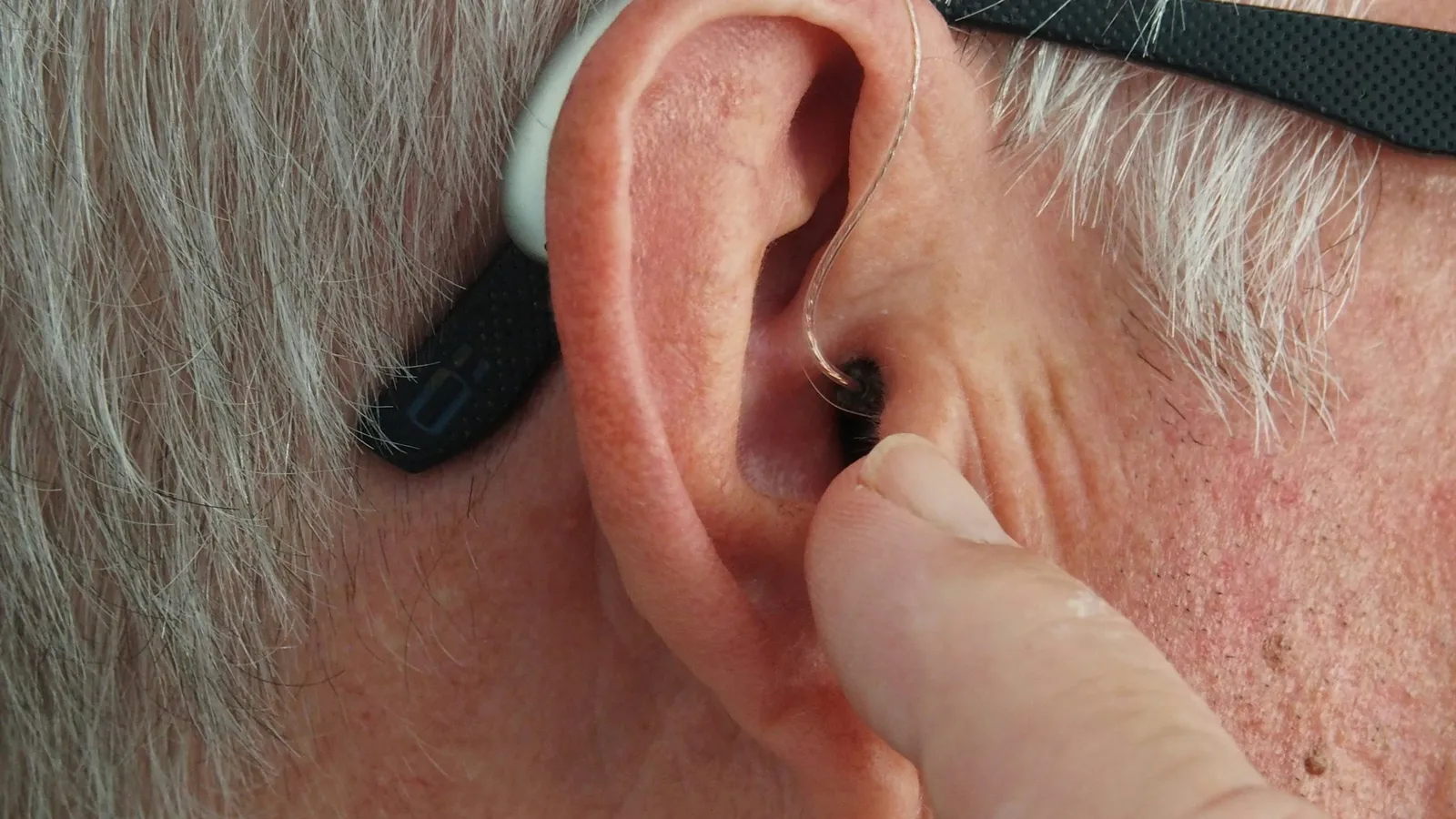
Clark's team published how to place a multiple-electrode array in the cochlea in The Journal of Laryngology & Otology in 1979. Modern implants keep the same plan. The US National Institute on Deafness and Other Communication Disorders describes the parts: a microphone, a speech processor that selects and arranges sounds, a transmitter and receiver that turn them into electrical impulses, and an electrode array. Unlike a hearing aid, which makes sounds louder, an implant bypasses the damaged part of the ear and stimulates the auditory nerve directly, and hearing through it takes time to learn.
How did the implant spread?
The Lasker account records that the US Food and Drug Administration first approved a multichannel cochlear implant in 1985, for adults who had lost their hearing after learning to speak. In 1991 Blake Wilson reported a speech-processing strategy, continuous interleaved sampling, that let most users understand words without visual cues.
Worked example. The Lasker essay says about 219,000 people had received implants by 2010, with more than 80% of them fitted since 2000.
80% of 219,000 = 0.80 × 219,000 = 175,200.
So more than about 175,000 implants were fitted between 2000 and 2010, and fewer than about 44,000 before 2000.
By mid-2013 the essay gives more than 320,000 users. Growth from 2010: 320,000 − 219,000 = 101,000 in about three years.
A common slip is to read "more than 80%" as exactly 80%; the numbers give a minimum, not an exact count.
Our guides to sound in Class 9 and neural control and coordination cover the waves and the nerves behind this. For waves that are hard to picture, the Fermi Simulation Lab has interactive simulations for ideas that are easier to see than read.
What recognition did the work receive?
The Lasker Foundation gave its 2013 Lasker~DeBakey Clinical Medical Research Award to Clark, Ingeborg Hochmair and Blake Wilson for developing the modern cochlear implant. The award essay says their work, for the first time, substantially restored a human sense with a medical intervention. Clark founded the Bionic Ear Institute in 1984, the Academy notes, and directed it until 2005.
If you or someone in your family has trouble hearing, an ear, nose and throat doctor or an audiologist can test hearing and explain the options.
What can a student learn from how Clark worked?
Clark took a personal problem, his father's deafness, and spent decades on it against expert doubt. He also went beyond his own training: the Academy interview describes his study leave at a speech science lab at Keele University in England, because he felt that understanding speech, not physiology alone, was the key.
Try it now: using the piano picture, explain in three sentences why a single electrode cannot tell a listener the difference between a high and a low note.