

On this page
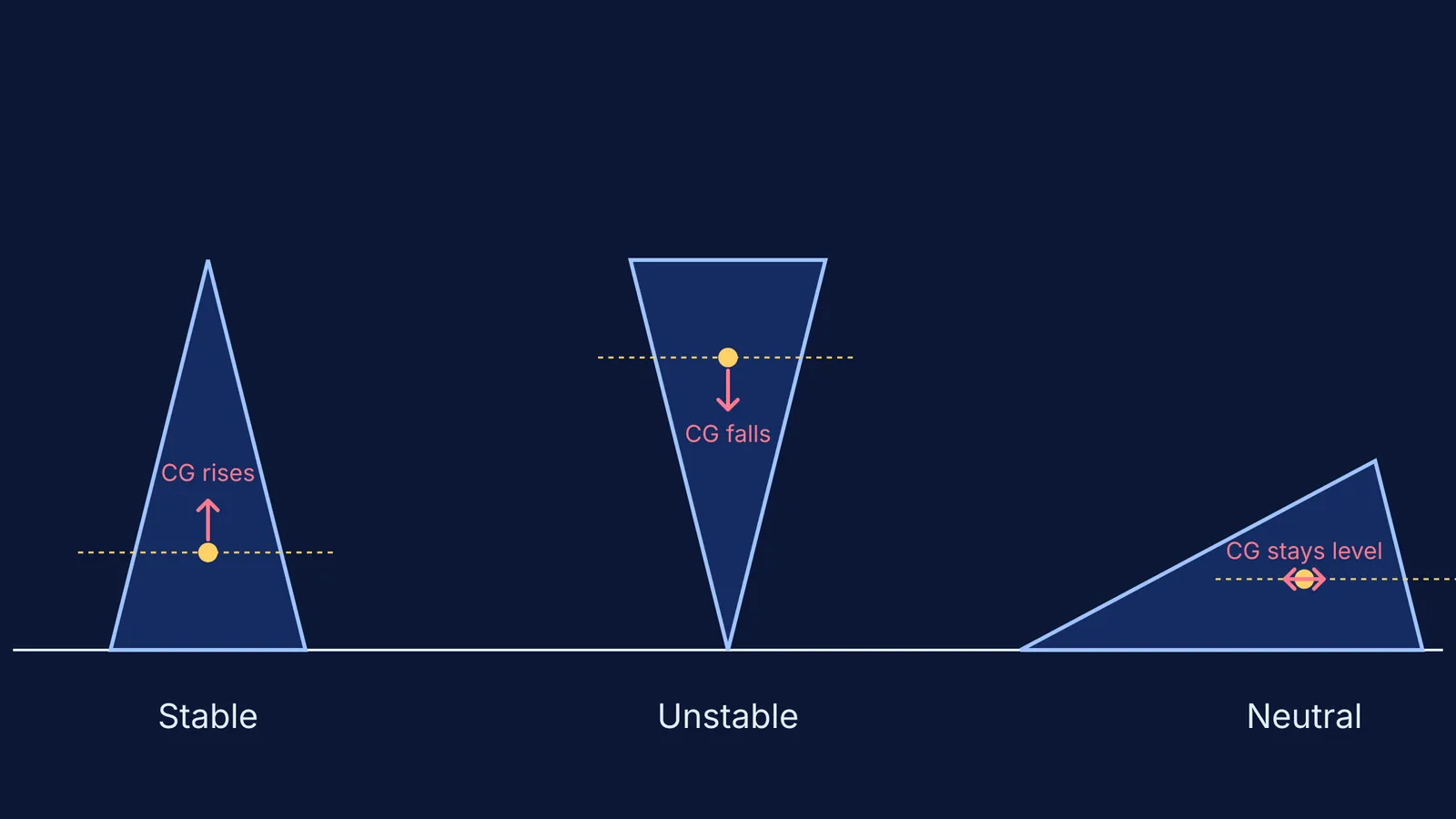
In mechanics, the state of an object's equilibrium depends entirely on what happens to its center of gravity when it is slightly disturbed. A cone is the classic test case because you can place it in three distinct orientations—on its base, on its tip, or on its side—to demonstrate all three types of equilibrium.
Yet, simply reading about forces and turning moments in a textbook is often not enough to master them. A major study published in the *Proceedings of the National Academy of Sciences* found that students in traditional science lectures are 1.5 times more likely to fail than those in active learning environments (PNAS). Across STEM disciplines, the average failure rate dropped from 33.8% to 21.8% when students actively engaged with the material. To truly grasp equilibrium—a foundational topic in the Fermi Concept Library—you need to mentally, or physically, tip the cone and track the center of gravity yourself.
What is stable equilibrium?
A cone standing flat on its broad, circular base is in stable equilibrium (A Star Maths and Physics). In this orientation, its center of gravity is relatively low to the ground and lies directly above the geometric center of its base.
When you push the cone to tilt it slightly, the center of gravity rises. Because the force of gravity always pulls straight down from this center, the raised center of gravity creates a restoring torque (a turning force). As long as the vertical line dropped from the center of gravity remains safely within the area of the base, this restoring torque pulls the cone back down into its original, upright position. The object resists the change and naturally corrects itself.
What is unstable equilibrium?
A cone balanced precisely on its sharp tip, or apex, is in unstable equilibrium (A Star Maths and Physics). In this inverted position, the center of gravity is high in the air, directly above a tiny, single point of contact with the ground.
If you give the cone even a microscopic nudge in any direction, its center of gravity falls. As the center of gravity immediately moves outside the narrow point of support, gravity creates a toppling torque. This force pulls the cone further away from its balanced state, accelerating its fall until it hits the ground. It cannot return to its original position on its own, because any movement lowers its potential energy and makes the situation worse.
What is neutral equilibrium?
A cone lying perfectly flat on its slanted side is in neutral equilibrium (A Star Maths and Physics). Its center of gravity is now supported along the entire straight line of contact with the surface.
If you push the cone so that it rolls across the table, the height of its center of gravity remains exactly the same. Because the center of gravity neither rises nor falls during this motion, the line of action of the weight always passes through the line of support. As a result, gravity creates neither a restoring torque nor a toppling torque. The cone simply stops rolling when you stop pushing, and it stays perfectly balanced in whatever new position you leave it in.
Why does active learning work better for equilibrium?
The steep drop in failure rates for active learning—which represents a 55% relative increase in failure when students only listen to lectures (PNAS)—shows why physics cannot be treated as a spectator sport. When you passively read that a cone on its tip is unstable, you are merely memorizing a fact. When you actively trace the force vectors and see exactly how the center of gravity falls, you are building a rigorous mental model that you can apply to any physical shape.
If you are struggling to visualize how the center of gravity shifts during a tilt, you can use the Fermi Simulation Lab. It provides interactive simulations for the ideas that are easier to see than to read, allowing you to interact with the object, apply a virtual nudge, and see exactly why it returns to its base or topples over.
How do you test for equilibrium?
Whenever you face a mechanical equilibrium problem in an exam—whether it involves a cone, a block sliding down a rough incline, or a completely irregular shape—use this active-learning framework to systematically find the answer:
Locate the center of gravity: Find the exact point where the object's entire weight can be assumed to act.
Apply a virtual tilt: Imagine displacing the object by a few degrees. Does the center of gravity move vertically up, move vertically down, or stay completely flat?
Check the resulting torque:
If the center of gravity went up, gravity will pull it back down to lower its potential energy (Stable).
If the center of gravity went down, gravity will pull it further down (Unstable).
If the center of gravity stayed level, gravity has no turning effect (Neutral).
This straightforward test works for any rigid body in mechanics. Whether you are finding the minimum force to drag a block on a rough floor or solving advanced radius of gyration problems, tracking the center of gravity is the most reliable way to find the right answer.


