On this page
Open any bar magnet diagram in your textbook and the arrows do the same thing: out of the north pole, around the outside, into the south pole. It is a convention plus one physical fact, and once you see both, you can check the direction yourself with a pocket compass.
Why do magnetic field lines go from north to south outside a magnet?
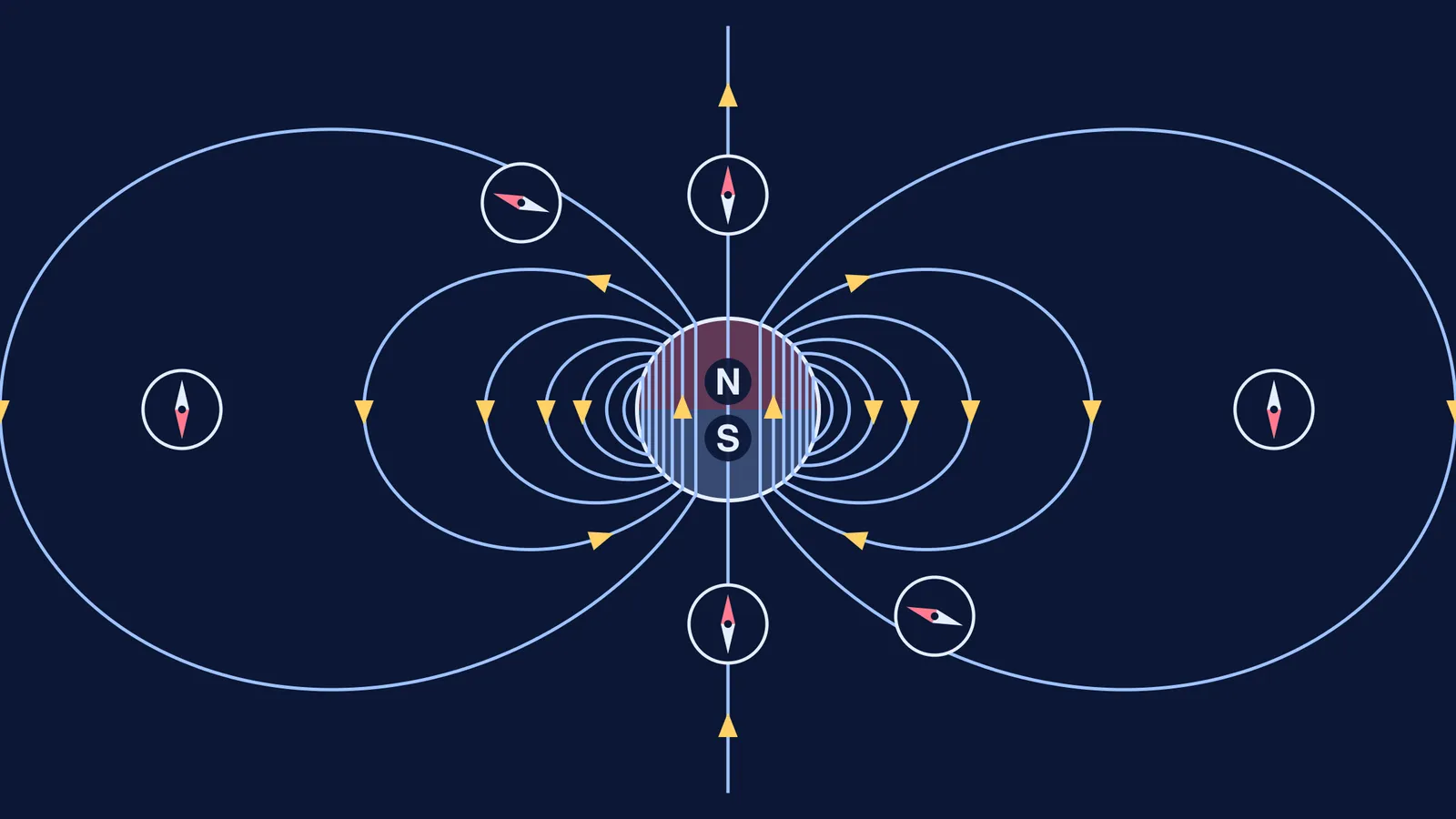
Because of how “direction” is defined. NCERT's Class 12 chapter Magnetism and Matter says magnetic field lines show the direction, at every point, along which a small magnetised needle aligns. In other words, the field points the way a compass needle's north end points.
The same chapter lists a fact you already know: like poles repel and unlike poles attract. Hold a compass near a magnet's north pole and the needle's north end is pushed away. Hold it near the south pole and the needle's north end is pulled in. So outside the magnet, the needle's north end, and therefore the field, points away from N and towards S.
This also explains the Earth. The NCERT chapter notes that the Earth's magnetic field points approximately from the geographic south to the geographic north. A compass needle's north end points north, so the magnetic pole near the geographic North Pole is, magnetically, a south pole.
Why do magnetic field lines form closed loops?
Because there is nowhere for them to start or stop. Magnetic field lines would need a lone north or south pole to start or end on, and the NCERT chapter notes that isolated magnetic poles, called monopoles, are not known to exist.
So a line that leaves the north pole carries on inside the magnet, running from south to north, and joins up with itself. The textbook puts it plainly: “The magnetic field lines of a magnet (or a solenoid) form continuous closed loops.”
This is Gauss's law for magnetism: the net magnetic flux through any closed surface is zero, so every line that enters a surface also leaves it. Our explainer on why net magnetic flux through a closed surface is always zero works through the maths.
How can you check the direction with a compass?
NCERT notes that one way to plot field lines is to place a small compass needle at various positions and note its orientation. You need a bar magnet, a small compass, paper and a pencil.
Find the north end of your compass needle. It is usually red or arrow-shaped; with no magnet nearby, it points roughly to geographic north.
Keep phones and anything iron away; they bend the needle.
Put the magnet in the middle of the paper, draw its outline and label N and S.
Place the compass beside the N end. Mark a dot at the needle's north tip, move the compass so its south tip sits on that dot, and mark again.
Repeat until you reach the S end. Join the dots and add arrows in the direction the needle's north end pointed.
If your arrows leave N and arrive at S, the convention checks out. For common mistakes, see our guide to plotting bar magnet field lines with a compass.
Predict first: a worked example
Lay a bar magnet east-west with its N end facing east, and keep the compass close enough that the magnet's pull beats the Earth's.
Just east of the N end: the needle's north tip points east, away from the magnet.
Just west of the S end: the north tip points east again, this time towards the magnet.
Beside the middle of the magnet, on either side: the north tip points west, from the N end towards the S end.
Inside the magnet, where no compass can go: the field points east, from S to N, which closes the loop.
If your compass disagrees, the magnet's labels may have worn off: the end that attracts the needle's north tip is its south pole.
How do you draw magnetic field lines correctly in exams?
NCERT's Example 5.3 in Magnetism and Matter shows several wrongly drawn field-line diagrams. Check yours against these points from the chapter:
Lines never cross; the field cannot point two ways at once.
Lines never spread out from a single point; magnetic lines close on themselves.
Inside the magnet, the arrows point from S to N.
Lines crowd together where the field is stronger, near the poles.
Lines at the ends of a solenoid, or between two pole pieces, curve outwards rather than staying perfectly straight.
Electric field lines break the second rule, so our post on the differences between electric and magnetic field lines is worth a look.
The Fermi Simulation Lab has interactive simulations for ideas that are easier to see than to read, so you can test predictions instead of only memorising arrows. If flux or Gauss's law still feels shaky, each concept has its own lesson in the Fermi Concept Library.
Tonight, take one magnet and one compass and test the four predictions above.