On this page
Plotting field lines with a compass lets you build the textbook diagram yourself, one dot at a time.
What does a compass actually show you?
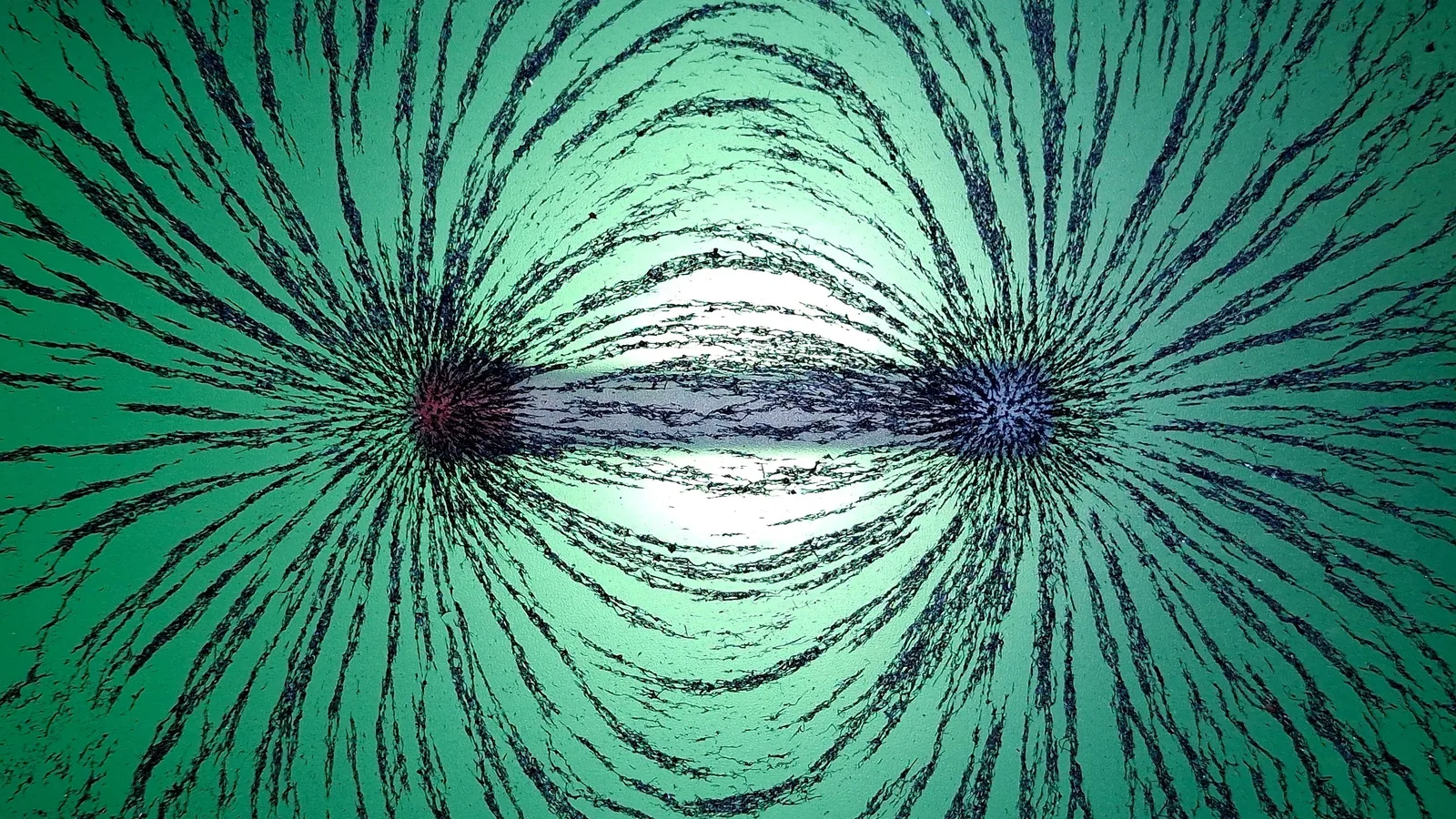
A compass needle lines up with the field at the spot where it sits. In the words of the OpenStax College Physics textbook, "a small compass will point in the direction of the field line", and the field direction is tangent to the field line at every point. A field line, then, is just the path you get when you keep stepping in the direction the needle points.
The same OpenStax page gives three more rules worth knowing before you start. The strength of the field is proportional to how close together the lines are. Field lines never cross. And outside the magnet they run from the north pole to the south pole.
How do you plot magnetic field lines of a bar magnet using a compass?
This is the dot-to-dot method. It follows the same steps as the National MagLab's drawing activity, with a few classroom details added.
Pin a sheet of white paper to a wooden table and put the magnet in the middle. Trace its outline and mark N and S.
Put a small plotting compass close to the N end, near one corner of the magnet.
Make a pencil dot right at the tip of the needle's north end.
Slide the compass along until the tail of the needle sits exactly on that dot. Make a new dot at the tip.
Keep going until you reach the S end or run off the paper.
Take the compass away and join the dots with one smooth curve, not with straight segments.
Draw an arrow on the curve pointing away from N and towards S.
Start again from a different point near N. Six to eight lines, spread evenly on both sides, give a clear pattern.
Why are field lines crowded near the poles?
The field is strongest at the poles. The MagLab page puts it simply: "The magnetic force is strongest near the poles, where the magnetic field lines come together". Because line spacing stands for field strength, your lines should fan out like rays from each end and bunch up there.
Near a pole, a small shift of the compass swings the needle a long way, so take short steps. Next to the middle of the magnet, the needle lies almost parallel to the magnet and points from the N end towards the S end. Inside the magnet the lines carry on from S back to N, closing each loop; a compass can't plot that part.
Far from the magnet, Earth's field starts to matter. According to NOAA's geomagnetism FAQ, Earth's field is roughly 25,000 to 65,000 nanotesla (0.25 to 0.65 gauss). It also says a compass points along the horizontal component of the field where it sits. At the edge of your sheet the magnet's field has become weak, so the needle starts turning towards magnetic north. That combined field is what produces the neutral points of a bar magnet, where the two fields cancel and the needle has no preferred direction.
What are the common mistakes in this activity?
Iron nearby. Steel tables, geometry boxes, phones and other magnets all pull the needle. Our post on why a compass points wrong near iron explains how far away to move things.
A big compass or big gaps. A long needle or widely spaced dots cut corners on the curves, worst of all near the poles. Use the smallest compass you have.
Moving the magnet. One nudge shifts every line. Tape it inside the traced outline.
Missing or reversed arrows. Outside the magnet, every arrow points from N to S.
Crossing lines. Since lines never cross, two crossing lines mean a dot is wrong. Re-plot that line.
Lines that stop in mid-air. A line should end at a pole or at the edge of the paper, never in empty space.
How do you check your diagram before handing it in?
Run this quick check out loud:
Does every line start near N and end near S, or run off the page?
Is there an arrow on every line, pointing from N to S?
Are the lines closest together at the poles and furthest apart at the sides?
Is the pattern roughly the same above and below the magnet?
Do any lines cross?
If the pattern is lopsided, look for iron near the sheet. Exam questions often ask you to compare the field at different points, and our guide to the bar magnet's field on the axial and equatorial lines does that with numbers.
If you want to revise the theory behind field lines, the Fermi Concept Library has a lesson for every physics concept, including magnetism. For questions that ask you to sketch or compare fields, the Fermi Problem Library has worked problems with a step-by-step solver that explains the reasoning rather than printing an answer.