On this page
If you are studying nitrogen fixation, you will meet two ideas that are easy to memorise and easy to mix up: how a nodule is built, and why the inside of a nodule needs its own haemoglobin. Here is the chain in order, the evidence for the oxygen story, and an exam checklist.
How does a root nodule form, step by step?
A clear open-access account of these steps is Daniel Gage's review in Microbiology and Molecular Biology Reviews (2004). For revision, the route from soil to nodule can be split into six steps.
The plant signals. The legume root releases compounds such as flavonoids and betaines, and rhizobia respond by switching on their nod genes.
The bacterium signals back. The nod genes direct the making of Nod factor, a lipooligosaccharide with a chitin backbone four to five N-acetylglucosamine units long and a lipid attached at one end.
Attachment and curling. Rhizobia attach to root hairs, and under Nod factor the hairs deform and curl into tight hooks called shepherd's crooks, usually the sites where bacteria enter.
The infection thread. The bacteria grow and divide inside a tube called an infection thread, which carries them from the root hair towards the inner root.
Cortical cell division. Meanwhile, cells in the inner cortex start dividing again, and this cell mass forms the nodule primordium, the young nodule.
Release and bacteroids. Bacteria leave the infection thread, enter nodule cells and differentiate into bacteroids that make the proteins needed for nitrogen fixation.
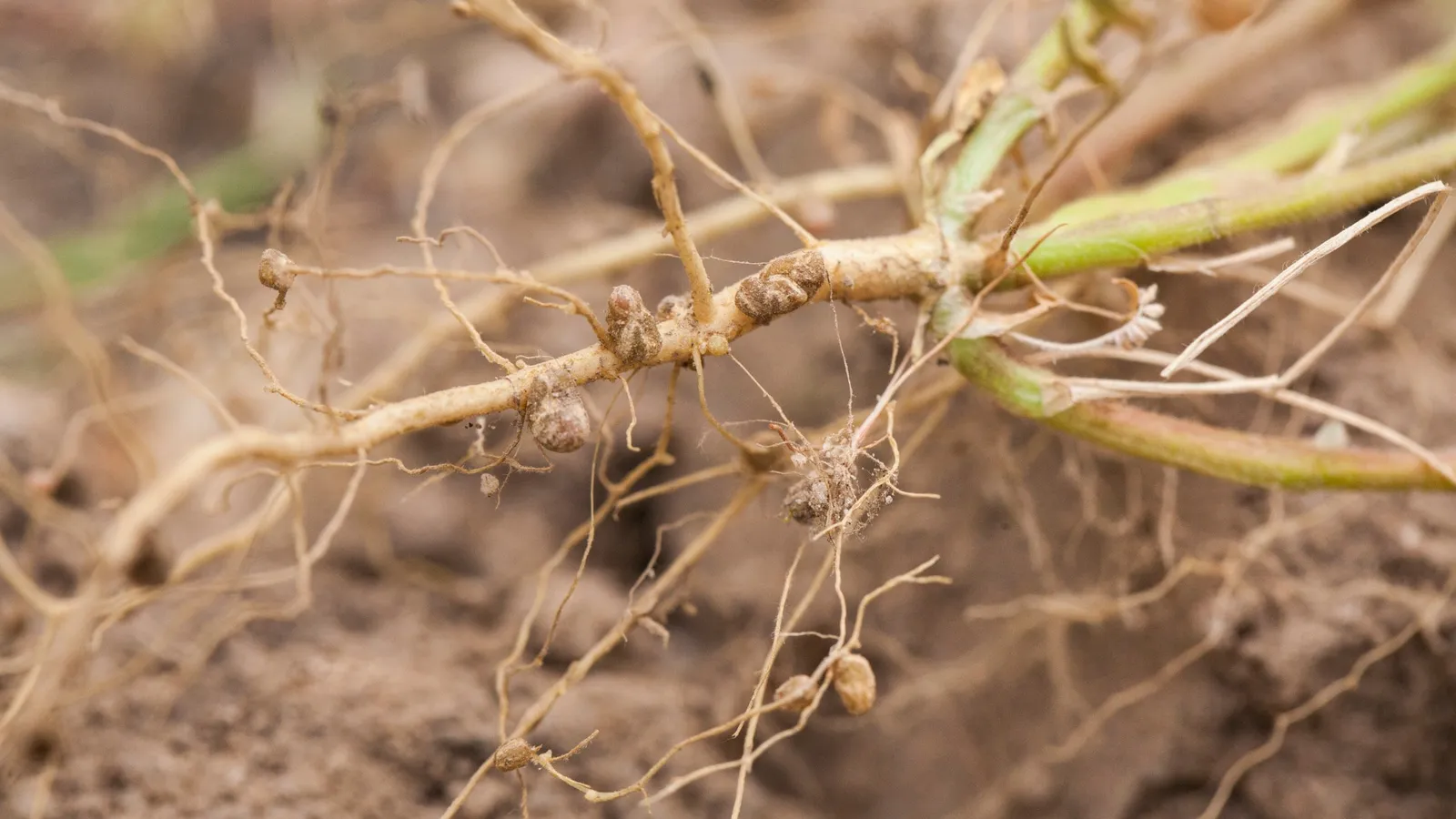
The same review describes two nodule types. Indeterminate nodules are elongated with a persistent meristem; pea and alfalfa are the classic models. Determinate nodules lack a persistent meristem and are usually round, as in soybean.
Why does nitrogenase need protecting from oxygen?
Nitrogenase, the enzyme complex that reduces nitrogen gas, "is irreversibly inactivated by oxygen", as Gage's review puts it.
The catch is that fixing nitrogen costs a lot of energy. The limiting reaction, given by Hoffman and colleagues in Chemical Reviews (2014), is N2 + 8 e-/H+ + 16 MgATP → 2 NH3 + H2 + 16 MgADP + 16 Pi. That is 16 ATP for every N2 molecule, and the bacteroids make that ATP by respiration, which uses oxygen. So the nodule has a real conflict: plenty of oxygen must flow to the bacteroids, but very little can sit free near the enzyme.
How does leghaemoglobin protect nitrogenase?
Leghaemoglobin eases that conflict by holding oxygen rather than removing it. A 2020 review by Estíbaliz Larrainzar and colleagues in New Phytologist states that leghaemoglobins deliver oxygen to the bacteroids and act as oxygen buffers, preventing nitrogenase inactivation.
Leghaemoglobin is encoded by nodule-specific plant genes, while nitrogenase is a bacterial protein, as Thomas Ott and colleagues (Current Biology, 2005) describe. Their paper also notes that leghaemoglobins build up to millimolar concentrations in infected cells before fixation begins and are thought to buffer free oxygen in the nanomolar range while keeping a high oxygen flux for respiration.
In intact detached pea nodules, nitrogenase activity was highest when leghaemoglobin was 25% oxygenated, corresponding to a calculated free oxygen concentration of 45 nanomolar in infected cells (Monroe, Owens and LaRue, Plant Physiology, 1989).
What happens to a nodule without leghaemoglobin?
The Ott study tested the idea directly. Using RNAi, the team stopped leghaemoglobin being made in nodules of the model legume Lotus japonicus. The result, from the 2005 paper: free oxygen in the nodule rose, the ATP/ADP ratio fell, bacterial nitrogenase protein was lost and nitrogen fixation was absent. Yet the same plants grew normally when given mineral nitrogen, so leghaemoglobin matters for fixation, not for general growth.
How should you write this in an exam answer?
Learn the chain as one sentence you can expand: flavonoid, Nod factor, curl, thread, divide, bacteroid, then leghaemoglobin buffers oxygen so nitrogenase can fix N2. Before you submit an answer, run this checklist.
Who makes what: plant genes encode leghaemoglobin and the plant releases flavonoids; the bacterium makes Nod factor and nitrogenase.
Leghaemoglobin is a buffer and carrier, not an oxygen remover.
The nodule is not simply anaerobic: free oxygen is kept very low, but bacteroids still respire with oxygen.
Oxygen damage to nitrogenase is irreversible, so low free oxygen must be kept, not restored.
One example each: indeterminate (pea), determinate (soybean).
Then try a prediction question. A mutant legume forms nodules but makes no leghaemoglobin: what happens to free oxygen, ATP/ADP, nitrogenase and growth with and without mineral nitrogen? Check your answer against the Ott results above.
If one link in the chain feels shaky, the Fermi Concept Library gives every biology concept its own lesson and its place in the map, so you can revisit the idea on either side of the gap. For practice, the Fermi Problem Library has worked problems with a step-by-step solver that explains the reasoning rather than printing an answer.
Next time you see a legume root, look for the nodules and say the six steps out loud.