On this page
If you have ever struggled with a chapter at night and found it clearer the next morning, there is research behind that feeling. Sleep is when the brain consolidates what you learned during the day.
Does sleep help you remember what you studied?
Yes. A 2013 review in Physiological Reviews by Björn Rasch and Jan Born, drawing on more than a century of research, describes sleep as a brain state that favours memory consolidation, while waking favours taking in new information (Rasch and Born, 2013).
Consolidation is the process that turns a fresh, fragile memory into a stable, long-term one. In Rasch and Born's account, deep (slow-wave) sleep reactivates what you recently learned and reshapes it for long-term storage, and REM sleep may help stabilise it.
In two experiments with high school students learning vocabulary, Steffen Gais, Brian Lucas and Jan Born found that memory was better when sleep came within a few hours of learning, whatever the time of day (Gais, Lucas and Born, 2006, Learning and Memory). Losing that night of sleep hurt recall, and the loss was still there after a night of recovery sleep.
Why do all-nighters before exams backfire?
An all-nighter costs you twice. First, whatever you cram that night gets no sleep to consolidate it. Second, a brain that has missed a night of sleep is worse at taking in anything new.
In a 2007 brain-imaging study, Seung-Schik Yoo, Matthew Walker and colleagues kept one group awake for a night before a learning session. The sleep-deprived group showed less activity in the hippocampus, the brain region that forms new memories, while learning, and retained less later (Yoo et al., 2007, Nature Neuroscience). The authors conclude that sleep before learning is critical in preparing the brain to form new memories.
So the extra hours buy weaker learning and a tired exam morning. We cover the exam-eve choice in more detail in why sleep before an exam beats an all-nighter, and what cramming can and cannot do in cramming versus spacing the night before an exam.
Should you study a hard chapter right before bed?
Study it in the evening, sleep on it, and come back to it in the morning.
Stéphanie Mazza and colleagues had 40 people learn foreign vocabulary in two sessions 12 hours apart (Mazza et al., 2016, Psychological Science). One group learned in the morning and relearned the same evening; the other learned in the evening, slept, and relearned the next morning. The group that slept between sessions needed about half as much practice to relearn the words, and remembered more when tested one week and six months later.
Two cautions. Right before bed does not mean until you fall asleep at the desk: the Yoo study is a reminder that a sleep-deprived brain learns poorly. And the night has to be long enough. The American Academy of Sleep Medicine recommends 8 to 10 hours of sleep in 24 hours for teenagers aged 13 to 18 (Paruthi et al., 2016), the same 8 to 10 hours the CDC lists for ages 13 to 17.
A plan for tonight: tough chapter, then sleep
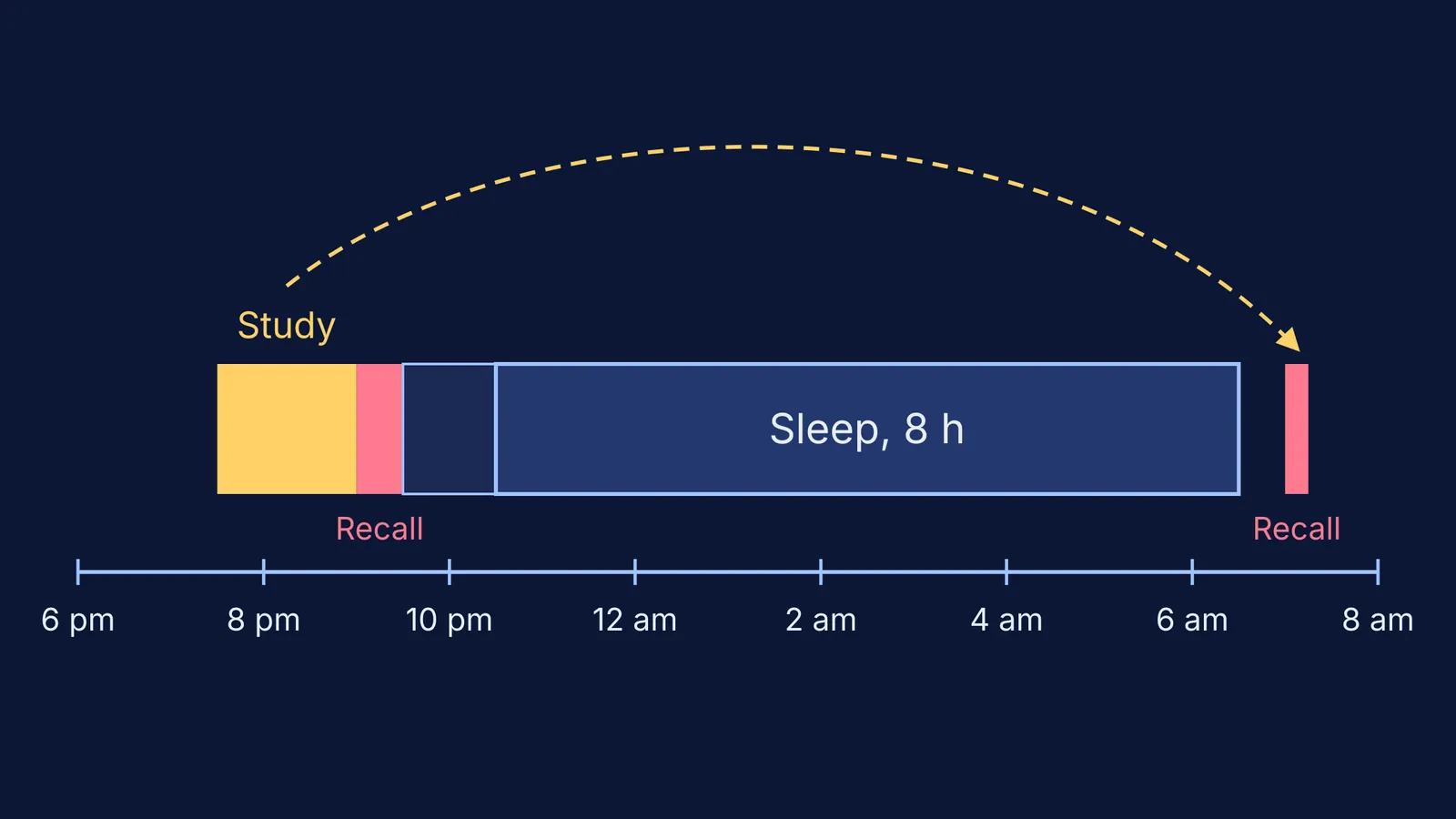
Here is how a Class 12 student with lights out at 10:30 pm might place a hard topic such as electromagnetic induction or electrochemistry.
7:30 to 9:00 pm: the hardest new material while you are still fresh. Work three or four problems instead of only reading.
9:00 to 9:30 pm: close the book and write, from memory, the key ideas and one solved problem. Mark anything you could not recall.
9:30 to 10:30 pm: something easy. Dinner, a familiar chapter, packing your bag.
10:30 pm: lights out, so that you get eight hours before a 6:30 am alarm, the low end of the AASM's 8 to 10 hours for teenagers.
7:00 am: fifteen minutes recalling the chapter before you open your notes, then fix only the gaps you marked.
If step 2 shows a real concept gap rather than forgetting, it needs a lesson first: the Fermi Concept Library covers every concept in physics, chemistry, biology, mathematics and computing, each with its own lesson. If you are not sure where to start on a chapter, Fermi's AI tutor works out what you already know and builds a plan for the session.
How can parents help a teenager sleep on what they study?
Protect the night rather than policing the evening. Keep it to a short, calm line instead of a lecture, for example: You studied the hard part tonight. Sleep now is part of learning it, and tomorrow morning you can test yourself before school.
If afternoon naps are pushing bedtime late, our post on what sleep research says about daytime naps can help you plan around them. If your child regularly cannot fall asleep, wakes tired after a full night, or seems anxious about exams, talk to a doctor. For stress, Tele MANAS offers free, round-the-clock counselling on 14416 or 1800-891-4416 (Tele MANAS details).
Tonight, try it with one chapter: study it in the evening, write what you remember, sleep, and test yourself before breakfast.