On this page
You have an exam tomorrow and a chapter you have barely opened. Research gives a two-part answer: cramming can get you through tomorrow, but much of it is gone within a week, and how you use the final night matters more than how long you stay up.
Is cramming the night before an exam effective?
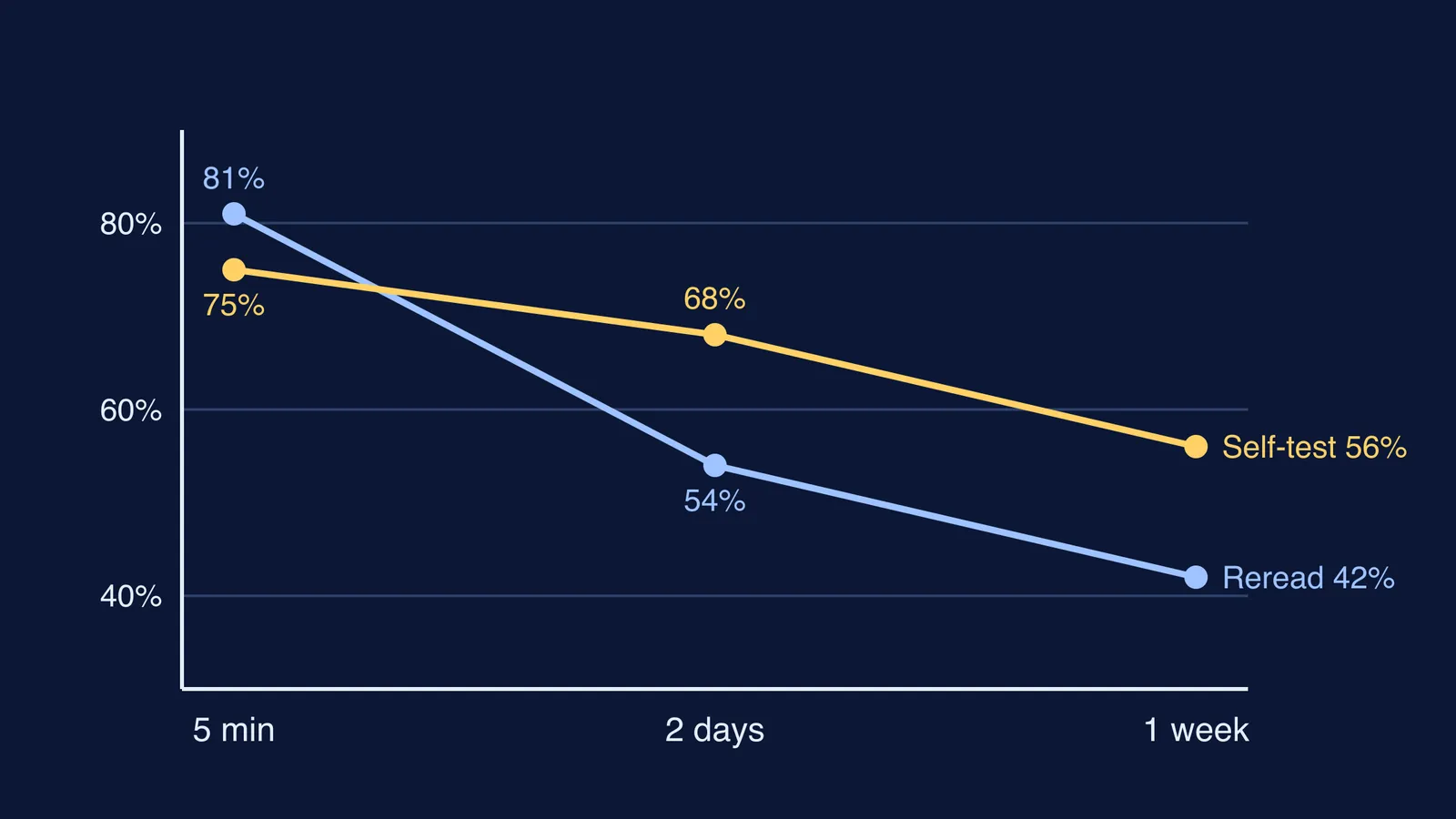
For a test the next morning, partly yes. The clearest picture comes from Roediger and Karpicke's 2006 study of university students learning short prose passages. Students who read a passage and then reread it recalled 81% of it five minutes later, compared with 75% for students who read it once and then wrote down everything they could remember on a blank sheet.
Two days later the order had flipped: 68% for the self-testers against 54% for the rereaders. After one week, the self-testers recalled 56% and the rereaders 42%. That is cramming in miniature: rereading pays off quickly, then drains away.
Cramming also loses to spreading the same work out. In a 2009 flashcard study by Nate Kornell, spaced study beat cramming, meaning packing study into the last day before the test, and spacing beat massing for 90% of participants. Yet after the first session, 72% of them believed massing had worked better.
Why does crammed material fade so fast?
Rereading makes the page feel familiar, and familiarity feels like knowing. In the second experiment of the Roediger and Karpicke study, students who studied a passage in four reading sessions were more confident about remembering it a week later than students who read it once and took three recall tests. A week later they recalled 40%, against 61% for the self-testers, even though they had read the passage about 14 times and the self-testers about 3 times.
A meta-analysis by Cepeda and colleagues covering 317 experiments found that the gap between study sessions that gives the best retention grows as the time until the test grows. That makes one night a poor fit for anything you need to remember in a month, such as board exams or JEE Main. A review of ten study techniques by Dunlosky and colleagues rated practice testing and distributed practice as high utility, and rereading and highlighting as low utility.
The all-nighter has its own cost. Gillen-O'Neel, Huynh and Fuligni followed 535 high-school students through 14 days of diaries in three different school years. On nights when students gave up sleep to study more than usual, they had more trouble understanding class the next day and were more likely to struggle on a test or assignment. More on why sleep before an exam beats an all-nighter.
What should you do the night before an exam?
Swap rereading for rounds of self-testing, and protect your bedtime. A plan of about two and a half hours:
Blank-page dump (15 minutes). Close the book and write every heading, formula, definition and diagram you remember.
Mixed question set (40 minutes). Pick 15 to 20 questions from past papers or back-of-chapter exercises, shuffled across chapters. Answer from memory, no notes.
Mark and sort (15 minutes). Check every answer and tag it solid, shaky (right but slow or guessed) or blank.
Reteach only the shaky and blank items (40 minutes). Open the book for these alone, then close it and redo each question from scratch.
Retest after a break (20 minutes). Do something else for ten minutes, then retry every item you missed.
Make a last-look sheet (10 minutes). Half a page, only the items you missed twice.
Sleep at your usual time. In the morning, cover the sheet and test yourself on it once.
If you use flashcards, keep them in one shuffled stack rather than drilling small piles one at a time: in Kornell's study, one large stack, which puts more space between repeats of each card, beat four small stacks.
A worked example
Say tomorrow is a Class 10 chemistry test on acids, bases and salts. Your blank-page dump catches the pH scale but misses the formulas of baking soda and bleaching powder. On twenty mixed questions, twelve are solid, five shaky and three blank, so your reteach list is eight items, not the whole chapter.
If the shaky items are numericals where you keep choosing the wrong method, the Fermi Problem Library has worked problems with a step-by-step solver that explains the reasoning rather than printing an answer.
How can parents help on the night before an exam?
Be a quiz partner, not a supervisor. Instead of "Have you finished revising?", try "Shall I read out questions while you answer without the book?" Agree on a stop time early so bedtime is not a midnight negotiation.
How do you avoid cramming next time?
Spread the same self-tests over weeks with a 4-week spaced revision schedule for any chapter, and see how the two methods compare in our one-week rereading vs practice testing experiment. If you do not know where to start, Fermi's AI tutor can work out what you already know and build a plan for the session, so you sit down to a clear next step.