On this page
Most students revise by reading the chapter again. It feels productive: the pages look familiar and nothing surprises you. The research says that feeling is a poor guide to what you will remember on exam day, and you can check it on two of your own chapters in eight days.
Does rereading or practice testing work better?
In 2006, Henry Roediger and Jeffrey Karpicke at Washington University in St. Louis put the question to students directly (Roediger and Karpicke, Psychological Science, 2006). In their second experiment, 180 undergraduates learned a prose passage in one of three ways: read it four times, read it three times and then recall it once, or read it once and recall it three times. A recall test was a blank sheet: write down everything you remember. There was no feedback and no answer key.
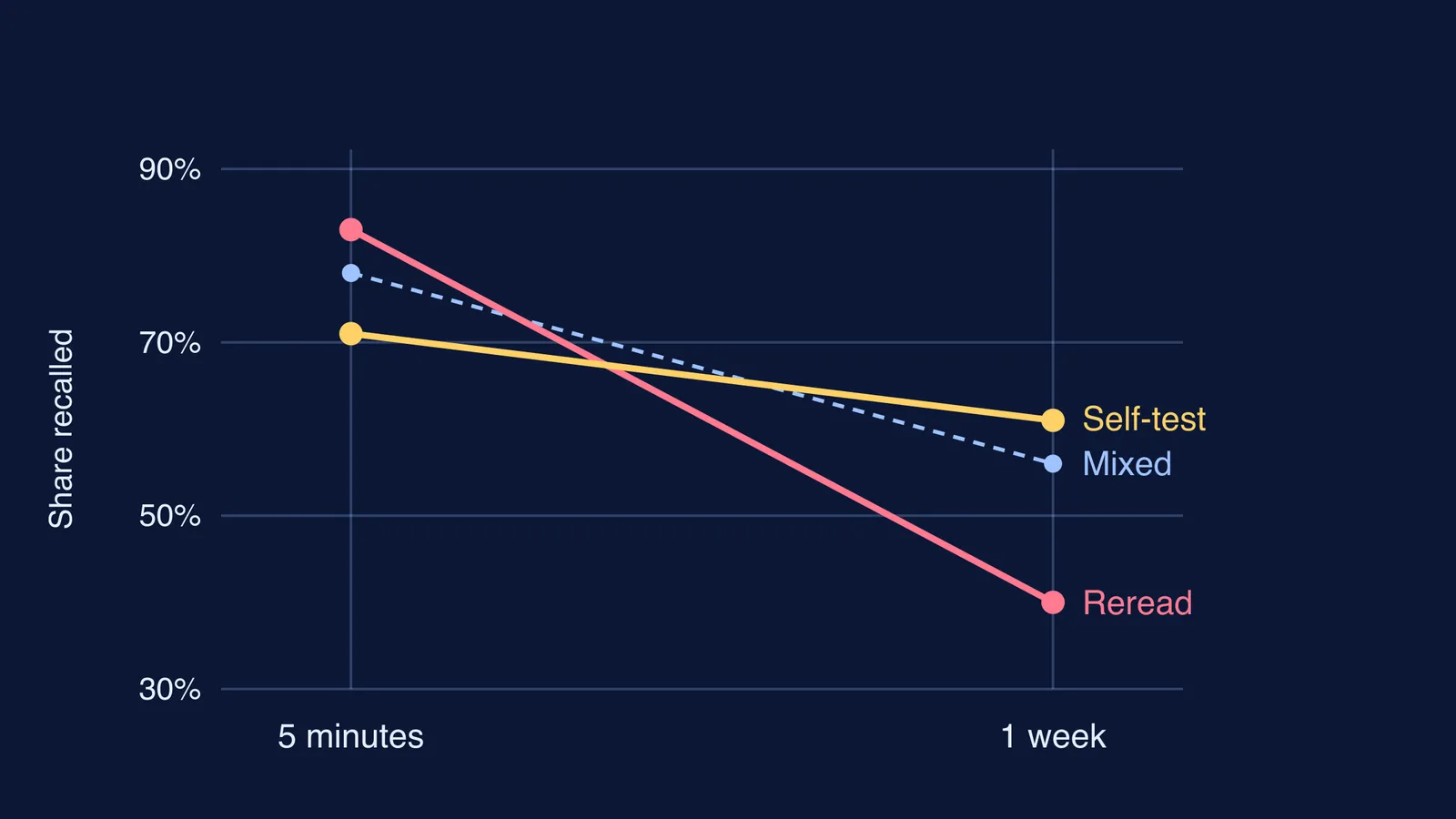
Half the students took a final test five minutes later. There the rereaders were ahead, recalling 83% of the passage against 71% for the group that tested itself three times.
The other half came back a week later, and the order flipped: the rereaders recalled 40%, the mixed group 56% and the repeated testers 61%, according to the same paper.
The repeated testers had read the passage only 3.4 times on average during the session; the rereaders had read it 14.2 times. More reading bought them less memory a week on.
Why does rereading feel like it works?
The same study asked students, before the final test, how well they expected to remember the passage in a week (Roediger and Karpicke, 2006). The rereaders were the most confident, and they did the worst. Reading a page again makes it familiar, and familiarity feels like knowing. We unpack that trap in why rereading gives you an illusion of fluency.
This is not one lucky result. A 2013 review by John Dunlosky and colleagues rated ten common study techniques and gave practice testing and distributed practice a high utility rating, while rereading, highlighting and summarising got a low one (Dunlosky et al., Psychological Science in the Public Interest, 2013). Our plain-language guide to the Dunlosky review of learning techniques walks through all ten.
How do you run the experiment on yourself?
Pick two chapters from the same subject, of similar length and difficulty, that you have not revised yet. Two NCERT Class 11 Biology chapters, or two physics chapters with similar maths, work well.
Day 0: make two tests first. Ask a parent or friend to pick 20 questions per chapter from the exercises, or write them yourself. Seal them away. Do not look again.
Day 1: Chapter A, reread. Read it, then read it again, for a fixed time, say 45 minutes. Highlight if you usually do.
Day 1: Chapter B, self-test. Read it once. Close the book and write everything you remember on a blank page. Check against the book, then do it again. Same 45 minutes in total.
Before you stop, predict. Write down the score out of 20 you expect on each chapter a week from now.
Days 2 to 7: leave both chapters alone. No peeking, no class notes on them.
Day 8: take both sealed tests, with the same time limit, and mark them strictly.
If the questions in your book come without answers, here is how to practise testing without an answer key. For physics or chemistry, the Fermi Problem Library has worked problems with a step-by-step solver that explains the reasoning rather than printing an answer, which helps when you go over a question you got wrong on Day 8.
How do you read your results?
Put four numbers side by side: your predicted and actual scores for each chapter. Say you predicted 15 for the reread chapter and 12 for the self-tested one, then scored 9 and 13. That gap between prediction and result is the whole lesson: the method that felt stronger was the weaker one.
Self-test chapter clearly higher: switch your revision to closing the book and recalling, then checking.
Roughly equal: your chapters may have differed in difficulty. Swap the methods on two new chapters and repeat.
Reread chapter higher: check whether you secretly self-tested while rereading, or whether that chapter was easier. One run is a sample of one.
Parents can help most by holding the sealed tests and doing the marking, not by checking hours spent.
Once you know which method works for you, the next step is a plan that uses it every week. Fermi's AI tutor works out what you already know and builds a plan for the session, so you start each sitting with questions to answer rather than pages to reread.
Run the experiment this week, and let your own Day 8 scores decide how you revise for the rest of the term.