On this page
You read the chapter on chemical kinetics a second time and it feels smooth. The equations look familiar and the explanations make sense, so it feels as if you have learned it. Then a test question asks you to use the rate law in a new situation and your mind goes blank. That gap between feeling and knowing has a name in research: an illusion of fluency.
Why does rereading feel so effective?
Familiar material is easy to process, and the brain treats ease as a sign of learning. Researchers have shown this in surprisingly simple experiments.
Matthew Rhodes and Alan Castel had people study words printed in large or small fonts and predict how well they would remember each one. In their 2008 study in the Journal of Experimental Psychology: General, people predicted better memory for large-font words, although font size had little relationship with what they actually recalled. The effect persisted even after participants were explicitly warned that font size has little effect on memory.
Nate Kornell and colleagues extended this in Psychological Science in 2011. Type size affected predicted memory but not actual memory, while extra study opportunities affected actual memory but barely changed predictions. Their summary of the ease-of-processing heuristic: "Information that is easy to process is judged to have been learned well."
Rereading produces exactly this kind of ease. The second reading is fluent because you have seen it before, not because you can use it.
What do students actually do, and what works better?
Jeffrey Karpicke, Andrew Butler and Henry Roediger surveyed 177 college students in 2009. A majority repeatedly read their notes or textbook, while relatively few tested themselves. The authors proposed that many students experience "illusions of competence" while studying.
The cost shows up later. In a 2006 study in Psychological Science, Roediger and Karpicke had students either restudy prose passages or take recall tests on them. On a test five minutes later, restudying did better. On tests two days and one week later, prior testing produced substantially greater retention, even though repeated studying had made students more confident.
When John Dunlosky and colleagues reviewed ten study techniques in 2013, they rated rereading as low utility and recommended other techniques in its place, giving "practice testing instead of rereading" as the example.
Five swaps for rereading
Each one replaces a reread with a test. Use the same time you would have spent reading.
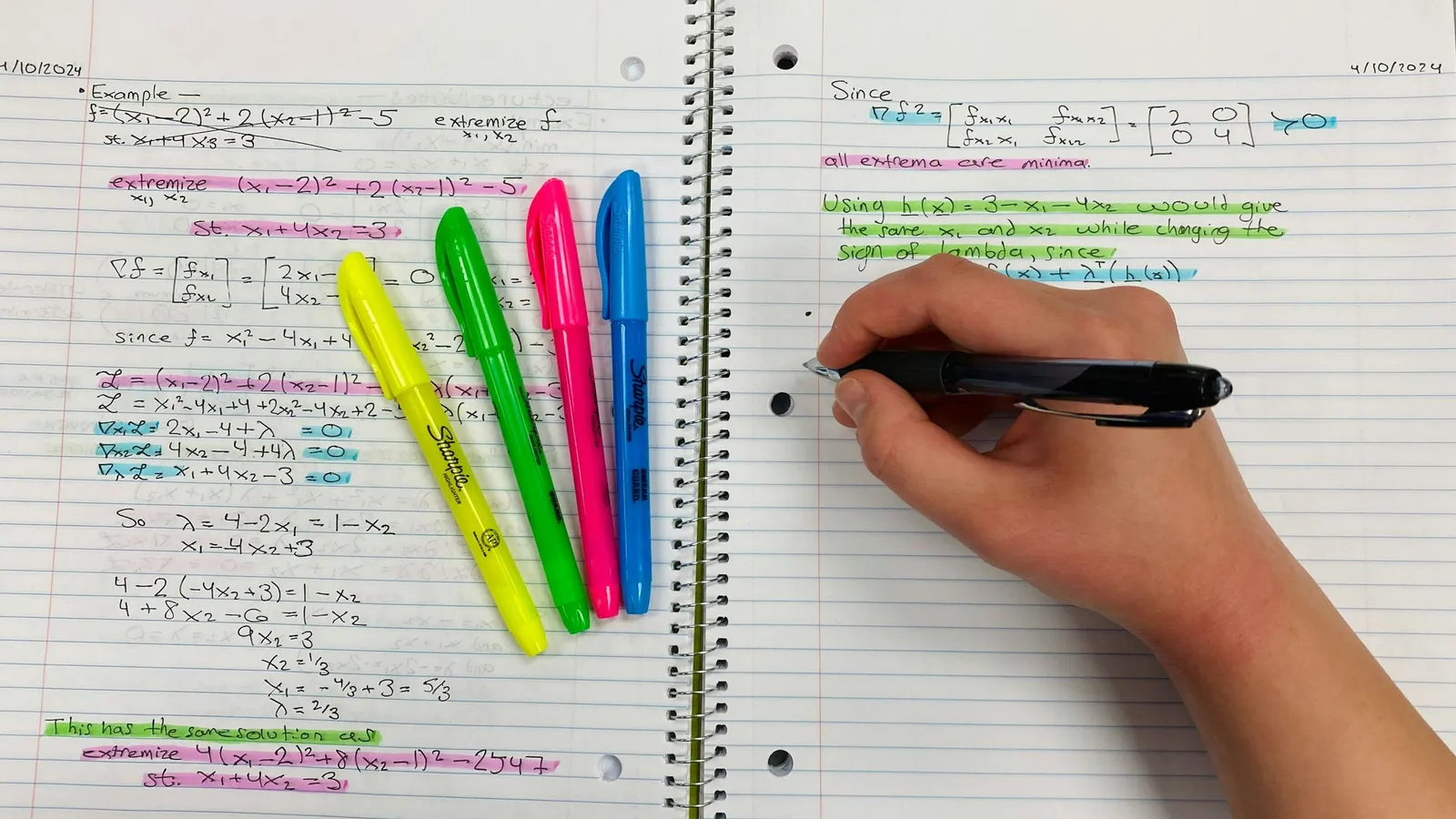
Blank-page recall. Close the book and write everything you remember about the topic. Then open the book and fill gaps in a different colour.
Headings into questions. Turn each heading into a question ("What does the order of a reaction tell you?") and answer it from memory.
Cover and solve. Cover the worked solution, attempt the problem, then compare line by line.
Explain it aloud. Explain the idea to an imaginary classmate without notes. Stumbles show you where the gaps are.
Predict, then check. Before a self-test, write the score you expect. Compare afterwards. Over time this trains you to trust tests more than feelings.
Worked example: a 30-minute kinetics session
Old plan: reread the chapter for 30 minutes.
New plan: 8 minutes of blank-page recall of rate laws, order and half-life. 5 minutes checking against the book. 12 minutes on four numerical problems with the solutions covered. 5 minutes writing down what you got wrong and why.
The new plan feels harder and slower. In the Roediger and Karpicke study, the method that left students less confident was the one that held up after a week. Our post on desirable difficulties explains why effortful study often pays off.
Getting someone, or something, to test you
Self-testing is easier when something else asks the questions. Flashcards help; see how to make flashcards that work. So can a chatbot set up properly, as in our guide to making an AI quiz you.
Fermi's AI tutor teaches through a topic and checks understanding as it goes, so a session tests what you know instead of only showing you material you will recognise.
Next time you reach for the chapter to read it again, close it and do a blank-page recall first.