On this page
Many good question banks, older reference books and school worksheets have no solutions at the back. That is not a reason to stop testing yourself. A 2013 review of ten study techniques by Dunlosky and colleagues rated practice testing as high utility, because it helped learners of different ages and abilities across many kinds of tests, including in real classrooms.
What the missing key takes away is feedback, and feedback is worth getting back. In a study of 258 people learning word pairs, Pashler and colleagues found that being shown the correct answer after a wrong response increased retention on a final test a week later by 494%, while feedback after correct responses made little difference. So the job is simple: find your wrong answers without a key.
How do you know if your answer is right without solutions?
Use checks that come from the question itself.
Back-substitution. Put your answer into the original equation or condition. If you solved for x, the equation should balance.
Units and dimensions. Both sides must have the same units, and anything inside sin, log or exp must have none. Our guide to using dimensions to check physics answers walks through this.
Extreme cases. Set an angle to 0 or 90 degrees, a mass to zero, or time to infinity. Your formula should give something sensible.
Rough estimate. Round the numbers and work it out in your head. If your answer is 100 times off, something is wrong.
A second method. Solve it another way: energy instead of forces, a graph instead of algebra. Two methods that agree are strong evidence.
What does a self-check look like on a real question?
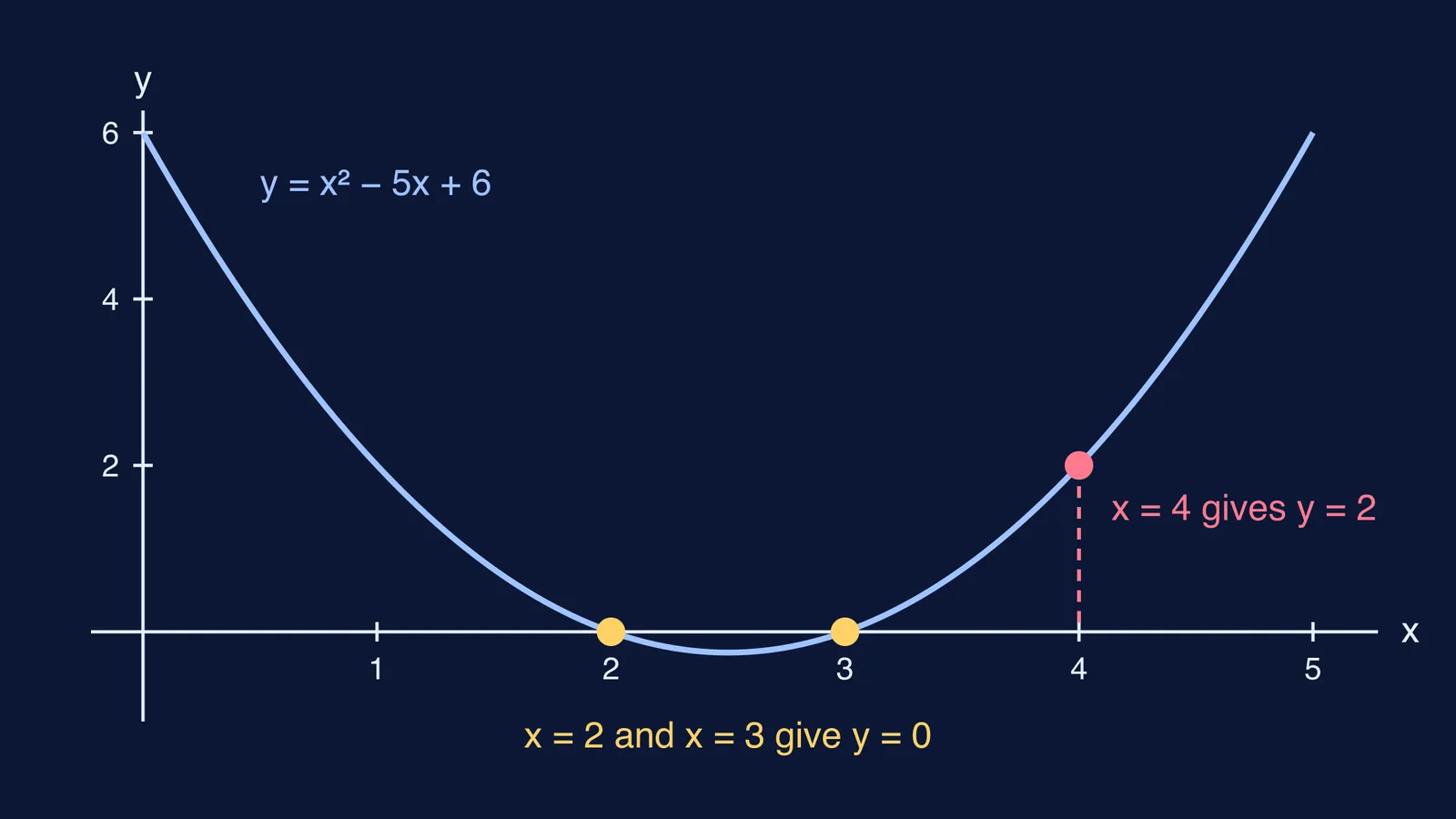
Take a maths question: solve x² − 5x + 6 = 0. Say you got x = 2 and x = 4. Back-substitute: 4 − 10 + 6 = 0, so x = 2 works. Then 16 − 20 + 6 = 2, not 0, so x = 4 is wrong. Factorising again gives (x − 2)(x − 3), and 9 − 15 + 6 = 0 confirms x = 3.
Now a physics one: a ball is thrown at 20 m/s at 30 degrees; find its range on level ground using R = u² sin 2θ / g, with g = 9.8 m/s².
Units: m²/s² divided by m/s² leaves metres. Good.
Number: 400 × sin 60° / 9.8 = 400 × 0.866 / 9.8, about 35.3 m.
Extreme case: at θ = 0 the ball never leaves the ground, and sin 0 = 0 gives R = 0. Good.
Comparison: at 45 degrees the range is 400 / 9.8, about 40.8 m, which should be the largest. 35.3 m is smaller, as expected.
How can friends, teachers and worked examples help?
Some mistakes, such as using the wrong idea from the start, pass every check.
Study partners. Swap answers; where you disagree, each explain your reasoning first. Reporting on ten years of introductory physics courses at Harvard, Crouch and Mazur found that Peer Instruction, where students discuss questions with each other in class, improved both conceptual reasoning and quantitative problem-solving. Our guide to making a class WhatsApp group useful for studies has ground rules that keep this from turning into answer-copying.
Teachers. Bring the attempt, not just the question. A short script works: "I got 35.3 m. My units check out and θ = 0 gives zero, but I am not sure I used the right formula. Could you look at line three?" That takes a teacher a minute.
Worked examples. Find a solved example of the same type and compare steps, not just final numbers. Studying solved mechanics examples, Chi and colleagues found that stronger students explained each step to themselves and linked it to a principle, while weaker students did less of this.
If the problem is that you keep picking the wrong method, the Fermi Problem Library has worked problems with a step-by-step solver that explains the reasoning rather than printing an answer, so you can compare your route, not only your final number.
Should you check answers you got right?
Yes, if you guessed. In two experiments by Butler, Karpicke and Roediger, feedback doubled the retention of correct answers that people had given with low confidence, compared with no feedback. A simple habit captures this: next to each answer, write S (sure) or G (guess). Check every G as carefully as a wrong answer.
A routine for a no-key worksheet:
Attempt every question without notes, and mark each S or G.
Run the five checks on each answer.
Circle anything that fails a check or is marked G.
Take the circled questions to a worked example, then a partner, then a teacher, in that order.
Redo the circled questions two or three days later, from a blank page.
For more on using solutions well when you do have them, read how to use solution books without copying the answers.