

On this page
Most class groups end up as good-morning stickers, forwarded "important questions" and hundreds of unread messages the night before a test. The problem is not the app; nobody agreed what the group is for. Four rules fix most of it.
Why do class WhatsApp groups stop being useful?
Two things go wrong. Useful messages get buried: "Q12 how?" sits between memes and a forwarded PDF, and nobody knows which book. And the group keeps interrupting the people it is meant to help.
That second cost is bigger than it looks. In a 2015 experiment by Stothart, Mitchum and Yehnert, 166 college students did an attention task while some received a call or text notification, and the students who got notifications made more mistakes even though they did not answer or read them. The Association for Psychological Science summary of the study reports that notified students had about three times the probability of making a mistake, and that the attention cost was comparable to what other studies found when people actually picked up their phones.
What rules should a study WhatsApp group have?
Keep it to four; longer lists get ignored.
Doubts come with an address. Name the book or sheet, page and question number, what you tried, and where you got stuck.
No forwards. Post only what you wrote, or a link from an official source such as your school or the exam body's website.
One question challenge a week. One person posts one question; everyone answers on paper before reading replies.
Muted during study blocks. Everyone mutes the chat during agreed study hours, and doubts are cleared in short open windows.
Here is rule 1 in practice.
Before: "sir's sheet Q7 how?? answer not matching"
After: "Friction sheet 4, page 3, Q7. Block on a 30° incline, μ = 0.2. I took friction as μmg and my answer doesn't match. Should the normal force be mg cos 30°? Why?"
The second gets answered in one reply.
For rule 2, WhatsApp itself marks messages that have been forwarded many times with double arrows, to show they did not originate from a close contact. In a study group, that label is your cue to delete, not share. If your phone is already full of PDFs, here is how to cut down to a few study channels.
Why does a weekly question challenge help you learn?
Answering from memory is itself a way of learning. In Roediger and Karpicke's 2006 experiments, students who took recall tests on prose passages remembered more on a test a week later than students who restudied the passages the same number of times, even though restudying made them feel more confident.
Discussing the answer afterwards adds more. A 2009 study in Science by Smith and colleagues found that peer discussion of a concept question improved understanding even when nobody in the discussion group knew the correct answer at the start.
Run your challenge the same way:
Sunday, 6 pm: this week's setter posts one question from the week's chapter.
Everyone solves it alone on paper and posts only a final answer, or "stuck at step 2".
At 6:30 pm, people post their working and talk through the differences.
The setter posts a similar question to try alone. Next week, someone else sets.
What does a week in a useful study group look like?
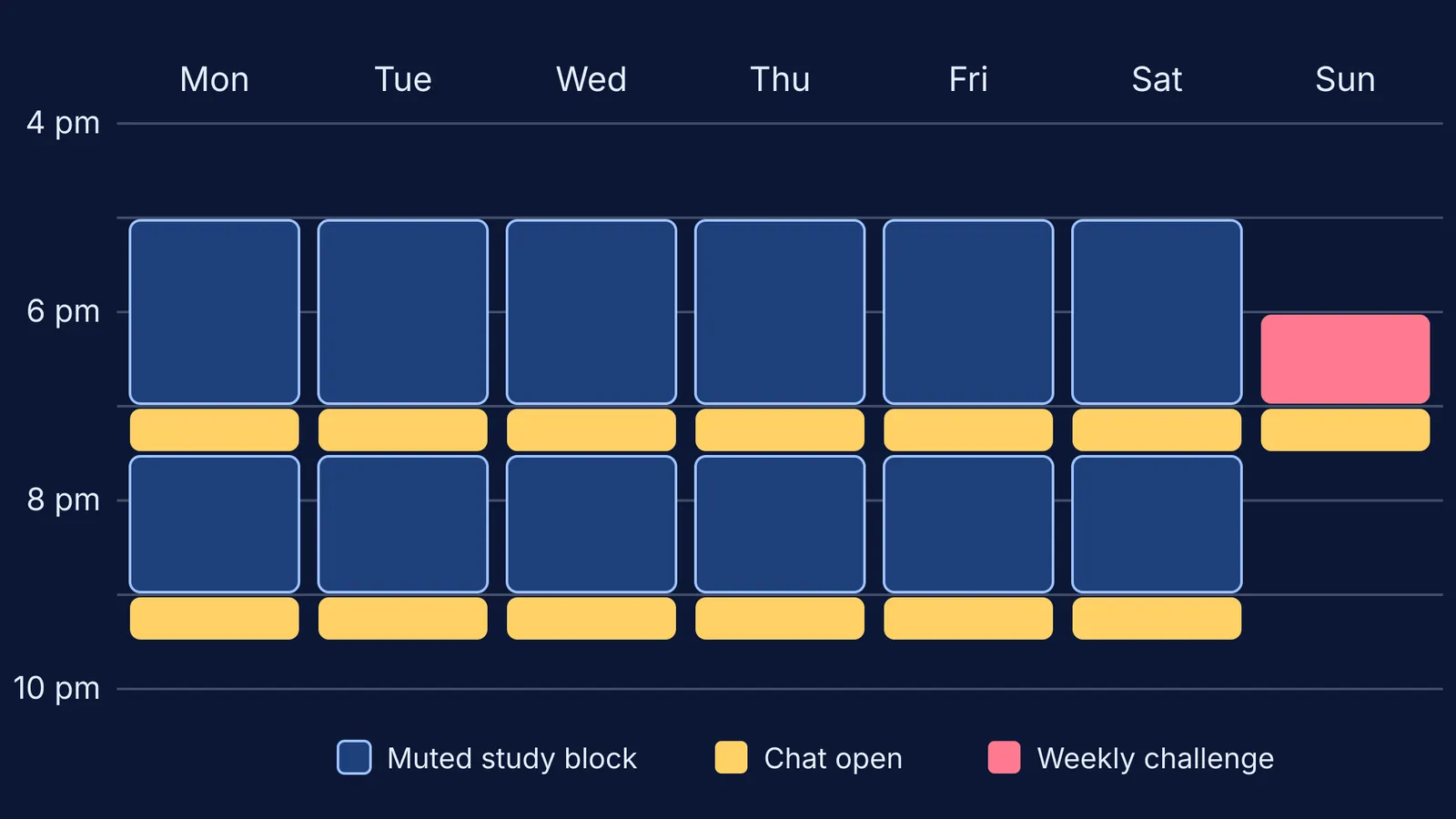
Monday to Saturday, the chat is muted from 5 to 7 pm, open from 7 to 7:30 pm for doubts, muted again until 9 pm, and open from 9 to 9:30 pm. Sunday has the challenge from 6 to 7 pm, then a short open window. Doubts posted any time get answered in the next window. Change the hours to fit your school timetable, but keep them the same every day.
Muting only works if each person does it. For a stronger lock, parents can follow this guide to setting up Focus mode on a teen's phone.
If a doubt is still open after the last window, you need not wait for tomorrow. The Fermi Problem Library has worked problems with a step-by-step solver that explains the reasoning rather than printing an answer, so you can bring the method back to the group. When the same doubt keeps coming back, it is usually a concept gap; the Fermi Concept Library has a lesson for every concept in physics, chemistry, biology, mathematics and computing.
How do you get classmates to agree to the rules?
Propose a trial instead of announcing a law. You can send this as it is:
"Hi all, this group is hard to use before tests. Can we try four rules for two weeks? 1) Doubts with book, page and question number. 2) No forwards. 3) A question challenge every Sunday at 6. 4) Muted during study hours, open 7 to 7:30 and 9 to 9:30 pm. If it doesn't help, we drop it."
Keep a separate group for stickers and birthday wishes. If someone breaks a rule, reply once with "rule 2, please" and move on.
If the urge to check the group pulls you out of a study block, note it on a distraction parking-lot sheet and check it in the next open window.


