

On this page
You sit down to a chapter of rotational motion and, within minutes, your mind brings up something else: the lab file due on Friday, a message you forgot to answer, whether last week's mock test went as badly as it felt. Each thought is small. Together they break a study session into pieces. You cannot switch them off, but you can give them somewhere to wait: a parking-lot sheet.
Why do random thoughts pop up while studying?
A wandering mind is normal, not a personal failing. In a smartphone study, Killingsworth and Gilbert found that people think about what is not happening almost as often as they think about what is (Science, 2010).
Many of those stray thoughts are unfinished business. In experiments by Masicampo and Baumeister, an unfinished goal caused intrusive thoughts during an unrelated reading task and hurt performance on an unrelated word puzzle (Journal of Personality and Social Psychology, 2011).
If your mind drifts most in lectures and online classes, our piece on mind wandering in lectures covers that setting.
Does writing a thought down really stop it?
It helps when what you write is a plan, not just a complaint. In the same 2011 studies, letting people make a specific plan for their unfinished goal removed the intrusions and the drop in performance, and the people who later carried out their plans were the ones whose intrusions stopped (Masicampo and Baumeister, 2011). You do not have to finish the task to quiet it; you have to decide when.
Specific notes seem to work better than vague ones. In a sleep-lab study of 57 young adults, those who wrote a to-do list for five minutes before bed fell asleep faster than those who wrote about tasks they had already finished, and the more specific the to-do list, the faster they fell asleep (Scullin and colleagues, 2018). That study was about sleep, not studying, but it points the same way: a clear next step settles the mind better than a loose worry.
Why only five words?
Because the note itself is an interruption. In a lab task where people had to keep their place in a sequence of steps, interruptions averaging 2.8 seconds doubled the rate of sequence errors, and interruptions averaging 4.4 seconds tripled it (Altmann, Trafton and Hambrick, 2014). A long note, or a phone reminder, can cost you your place in the problem.
So keep the sheet on paper, not on your phone. Our piece on whether a phone on your desk hurts focus explains why the phone is better out of reach.
How do you set up a parking-lot sheet?
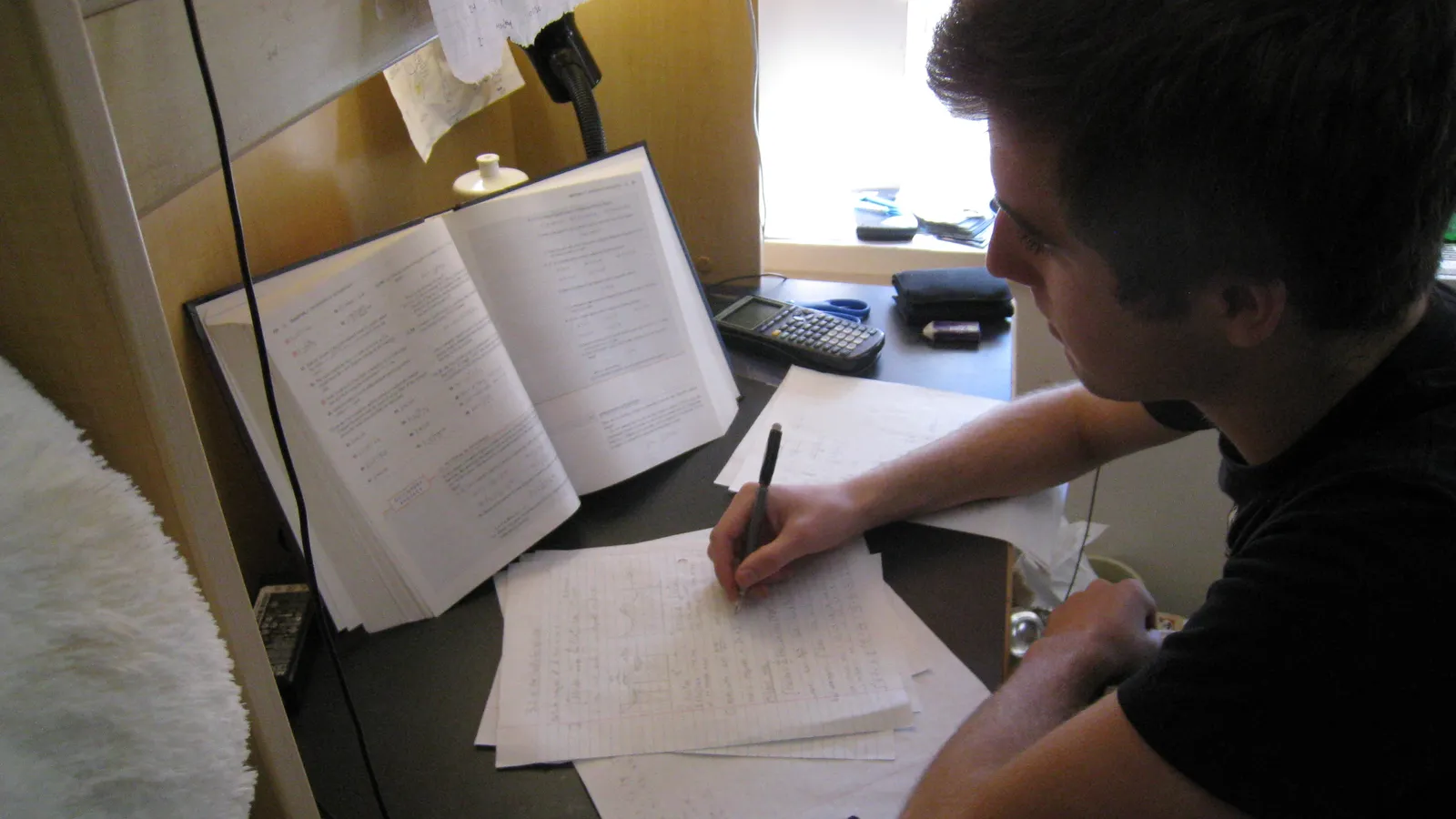
Before you start, put one blank sheet and a pen to the side of your books, with the heading "Later".
When a thought pulls at you, write it in about five words. If you are mid-calculation, finish the line first.
Go straight back to work. Do not act on the note, however small it is.
If the same thought returns, tick it rather than writing it again.
At the end of the session, clear the list. Every item gets one of four labels: do now (if it is tiny), schedule (write a day and time), drop, or talk to someone.
If you study in timed blocks, leave the sheet alone during short breaks; see what research says about the Pomodoro technique for planning them.
What does a filled-in sheet look like?
An evening physics session for a Class 12 student might leave this sheet:
reply to cousin's message (ticked twice)
did I submit lab file?
mock test score worry
why is torque a vector?
buy graph paper tomorrow
The message and the lab file: do now. The mock-test worry: schedule it, as "review the mock with the answer key, Sunday morning". Graph paper: tomorrow's list. The torque question is a doubt about physics itself, worth taking to a tutor. Fermi's AI tutor notices where a student is stuck and decides whether to explain, ask or show, so a parked question becomes a short lesson rather than a nagging gap. If the doubt is about a specific problem, the Fermi Problem Library has worked problems with a step-by-step solver that explains the reasoning.
What if the same worry keeps coming back?
A sheet works well for tasks and small doubts. It is weaker against worries about results, family or how you feel. If one of those keeps returning session after session, the "talk to someone" label is the right one: a parent, a teacher or a school counsellor.
Parents can help by asking "what's on your later list today?" instead of "why aren't you focusing?" It turns distraction into something the two of you can sort out together.
If worry or low mood is affecting your sleep, eating or everyday life, please speak to a doctor or counsellor. Tele MANAS, India's free 24x7 national mental-health helpline, is reachable on 14416 or 1800-891-4416 (IIT Kanpur Counselling Service).
Tonight, put a blank sheet beside your books before you open them, and clear it before you close them.


