On this page
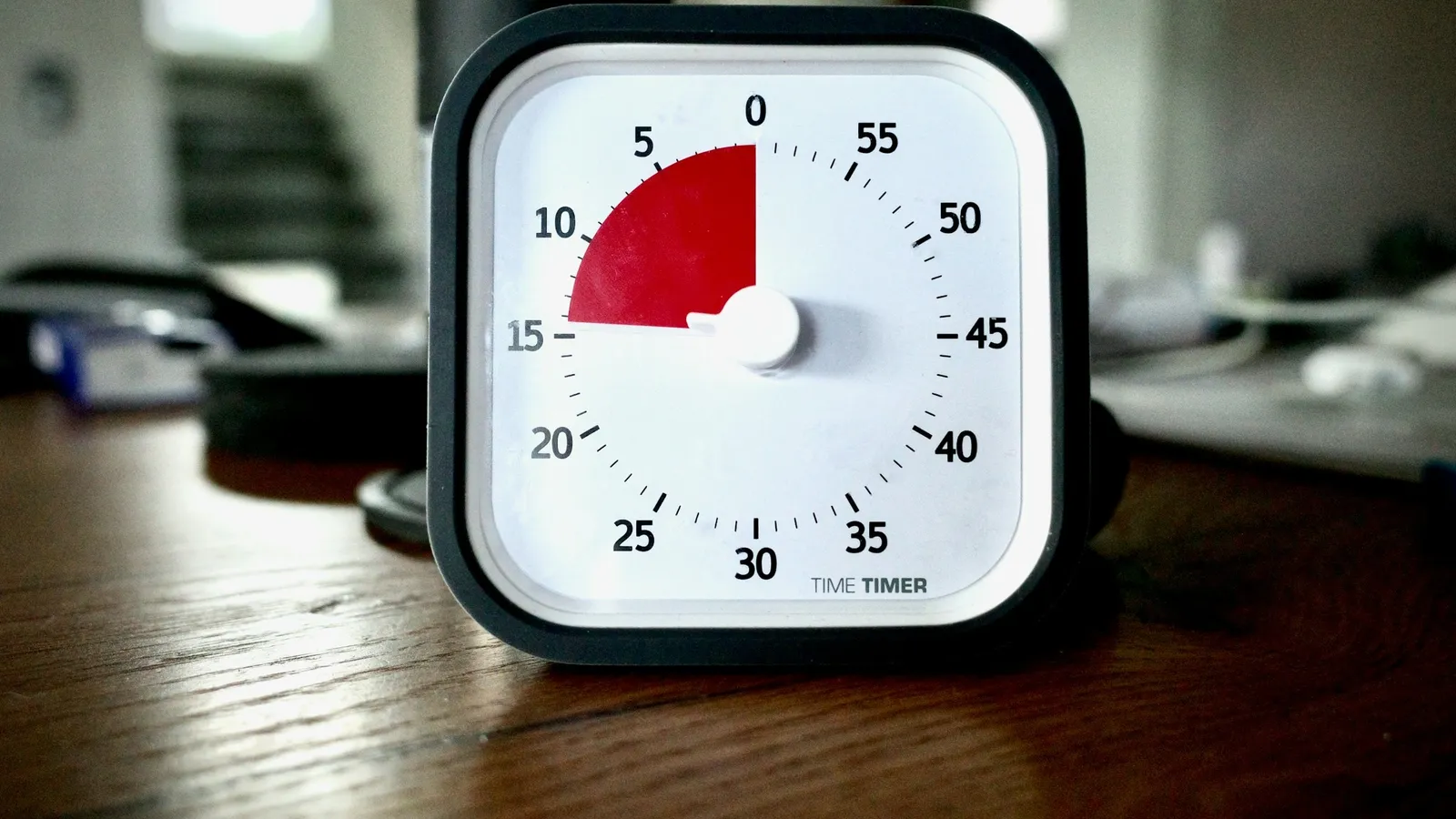
Set a timer for 25 minutes, work on one thing, take a 5-minute break, repeat. The Pomodoro technique is simple enough to start tonight, and many students swear by it. But does the research back it, and is 25 minutes the right block for a hard JEE problem set?
Where does the Pomodoro technique come from?
Francesco Cirillo developed it as a college student. In the publisher's description of his book, he used "a kitchen timer shaped like a pomodoro (Italian for tomato)" and "divided the time he spent working on a project into 25-minute intervals, with 5-minute breaks in between". It began as a personal productivity method, not a tested learning technique, so it is fair to ask what the evidence says.
What did the research on Pomodoro breaks find?
Direct studies are few. The clearest is a 2023 study in the British Journal of Educational Psychology by Felicitas Biwer and colleagues. Eighty-seven university students in the Netherlands did their real self-study for one day under one of three rules: take breaks whenever they chose, take a 6-minute break after every 24 minutes (the "Pomodoro" condition), or take a 3-minute break after every 12 minutes.
Students who chose their own breaks studied in longer stretches and took longer breaks. They also reported more fatigue and distraction, and lower concentration and motivation, than the fixed-break groups. There was no difference in mental effort or in how much of their task students completed. The authors concluded that fixed breaks had mood benefits and appeared to be more efficient, finishing similar work in less time.
That is encouraging but limited: one day, one university, self-reported feelings, and no exam scores.
What does wider research on breaks say?
A 2022 meta-analysis in PLOS ONE by Patricia Albulescu and colleagues pooled 22 study samples with 2,335 people on micro-breaks, short breaks taken between work tasks. Breaks had small but statistically significant effects on vigour and fatigue, but the overall effect on performance was not statistically significant. Performance gains showed up only for less demanding tasks, and longer breaks went with bigger performance boosts. The authors suggest that recovering from highly draining tasks may need breaks of more than ten minutes.
A lab study by Atsunori Ariga and Alejandro Lleras, published in Cognition in 2011, adds a reason breaks might help focus: in a long, monotonous attention task, brief switches to another task prevented the usual decline in performance over time.
Put together: structured breaks probably help you feel fresher and keep starting and stopping on schedule. The evidence that they raise marks on demanding work is weak so far.
How to adapt Pomodoro for JEE, NEET or board study
Treat 25/5 as a default you can change, not a rule. These adjustments follow from the findings above; they are our suggestions, not tested prescriptions.
Match block length to the task. Short blocks of 25 minutes suit flashcards, formula recall and NCERT reading. Multi-step problems may need 40 to 50 minutes so you are not cut off halfway through a solution.
Take a longer break after demanding blocks. After two or three hard blocks, take 15 to 20 minutes, in line with the finding that draining tasks need more recovery.
Make breaks actually restful. Stand up, drink water, look out of a window. Scrolling a feed is not a break from attention. See our piece on why a phone on the desk hurts focus.
Write the next step before you stop. One line, such as "next: find tension in the second string", makes restarting easy.
Count blocks, not hours. "Four blocks of organic chemistry" is a clearer target than "study all evening".
A worked example evening
6:00 to 6:25: Block 1, retrieval practice on yesterday's chemistry (25 min). Break 5 min.
6:30 to 7:15: Block 2, eight rotational mechanics problems (45 min). Break 10 min.
7:25 to 8:10: Block 3, continue problems and check mistakes (45 min). Break 20 min, dinner.
8:30 to 8:55: Block 4, maths formula recall and three short questions (25 min).
8:55: Write tomorrow's first step and stop.
If the hardest part is the first five minutes, the timer is doing its real job: it makes starting smaller. Our posts on why procrastination is about feelings and building a study routine that lasts go further.
If you sit down to a block and are not sure what to work on, Fermi's AI tutor can work out what you already know and build a plan for the session, so the first block starts with a clear next step.
Try tomorrow's study session in timed blocks and note how you feel at the end compared with a normal evening.