On this page
You open the solution manual "just to check the first step". Twenty minutes later you have nodded along to six solutions and could not redo one with the book shut. That is how solution books usually go wrong: reading a solution feels like understanding it. The fix is to decide how much of the book you see, and when.
Why does reading the solution feel like learning when it isn't?
In Chi and colleagues' 1989 study in Cognitive Science, stronger students studying worked mechanics examples generated many explanations, linking the steps to principles from the text. Weaker students produced few explanations, kept poor track of what they did not understand, and leaned heavily on the examples when they had to solve problems.
Trying before you look helps even when the attempt fails. In Kornell, Hays and Bjork's 2009 experiments, which used trivia questions and word pairs, some participants tried to answer before the answer was shown, while others saw the question and answer together. Unsuccessful attempts still led to better learning than reading alone.
What is the cover-attempt-peek-one-line method?
A 2021 meta-analysis by Sinha and Kapur in the Review of Educational Research pooled 53 studies and found a moderate advantage (Hedges' g = 0.36) for solving problems first and getting instruction afterwards when learning a new concept, compared with instruction first. One limit matters: for younger children, in grades 2 to 5, the results favoured instruction first. The method below is meant for high-school problem sets.
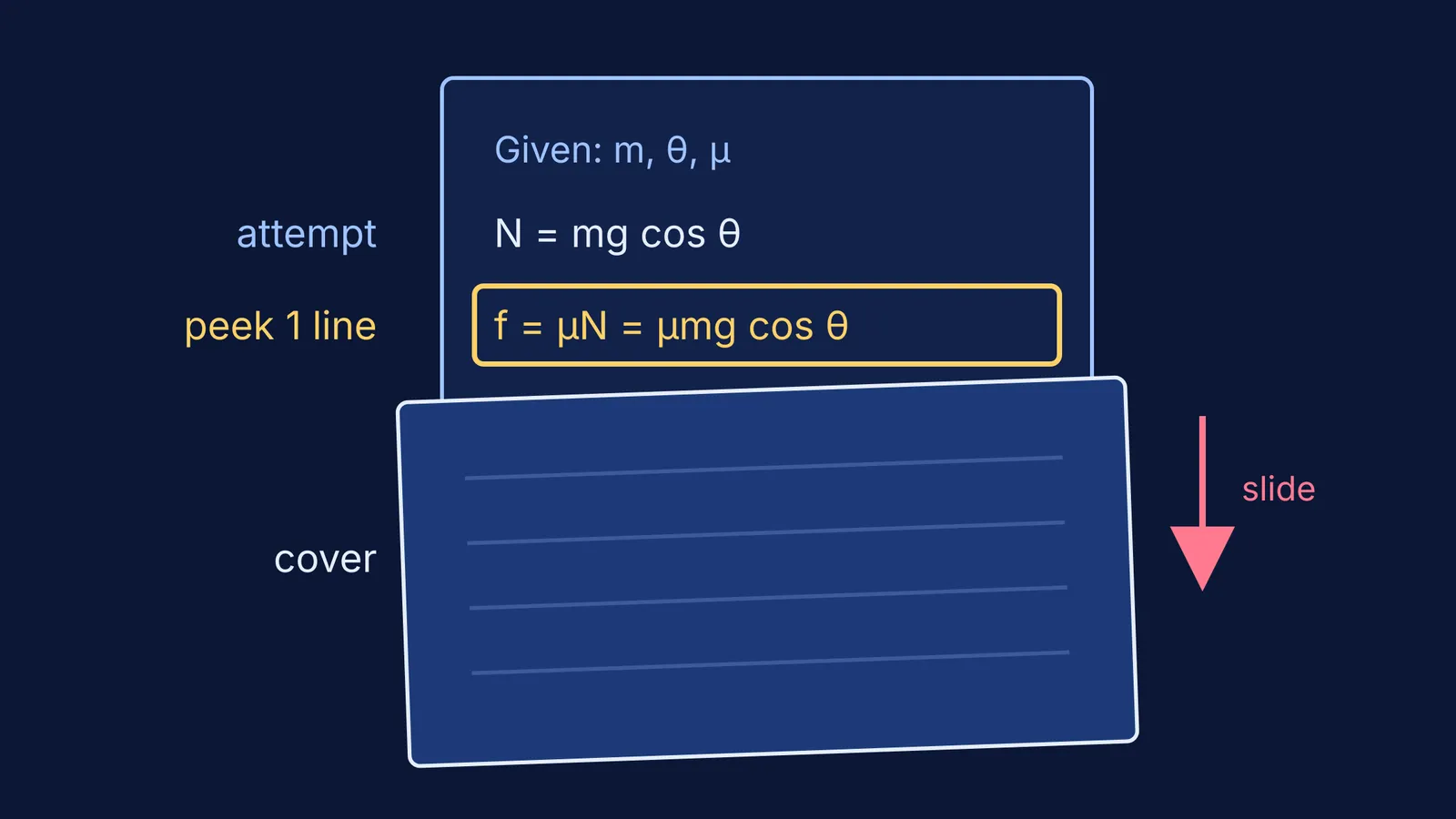
Cover. Put a card over the solution before you look at the page.
Attempt. Set a fixed time in advance, say ten minutes. Write down what you can: a diagram, the knowns, a first equation.
Name the block. If you are stuck, write one sentence saying where: "I don't know how to bring friction in."
Peek one line. Slide the card down just far enough to show the next line of the solution. Read it, then cover it again.
Continue alone. Carry on from that line yourself. If you get stuck again, peek one more line. Make a tally mark for every peek.
Explain and redo. Explain each line aloud in your own words, then redo the problem from a blank page a day or two later.
What does one peek look like on a real problem?
Take this one: a block slides down a rough incline at angle θ, and the coefficient of kinetic friction is μ. Find its acceleration.
Your attempt: you draw the forces (weight mg, normal force N, friction f) and write N = mg cos θ. Then you stall.
Your stuck sentence: "I don't know what to write for friction."
The one line you peek at: f = μN = μmg cos θ.
Cover and continue: along the incline, mg sin θ − μmg cos θ = ma, so a = g(sin θ − μ cos θ).
Check it yourself: set μ = 0 and you get a = g sin θ, the frictionless result.
Log it: one peek, at the friction formula. That is a concept gap, not a method gap, so revise kinetic friction before your next set.
How many peeks is too many?
Read your tally marks like this:
No peeks: move on, and mark the problem for a redo next week.
One or two peeks at the same idea: a concept gap. Revise that one idea, then redo the problem tomorrow without the book.
Peeking at the very first line, or three or more peeks: the problem is ahead of where you are. Study a worked example of the same type properly, then try a similar problem.
Studying it properly means explaining each step to yourself, not just reading it. A 2018 meta-analysis by Bisra and colleagues in Educational Psychology Review combined 69 effect sizes from 64 research reports and found that prompting learners to self-explain while studying or solving problems gave an average effect of g = 0.55. For each line, ask "why this step, and why now?"
Printed solutions often skip the very step you are stuck on. When that happens, the Fermi Problem Library has worked problems with a step-by-step solver that explains the reasoning rather than printing an answer, so you can keep the one-line-at-a-time rule. Once you have a full answer, use our guide on how to compare your attempt with the model solution. If you prefer AI help to a printed book, the same idea works as an AI hint ladder for hard maths and physics problems.
What can parents do?
Taking the solution book away usually just moves the copying somewhere else. Ask to see the tally marks instead: "Which line did you peek at, and what did you try before that?" A child who can answer is using the book to learn, not to copy.
If a whole chapter keeps needing three or more peeks, the concepts need work, perhaps with a teacher. It does not mean your child is lazy.
For the step-by-step habit underneath all of this, read how to solve physics problems step by step, with a worked example.