On this page
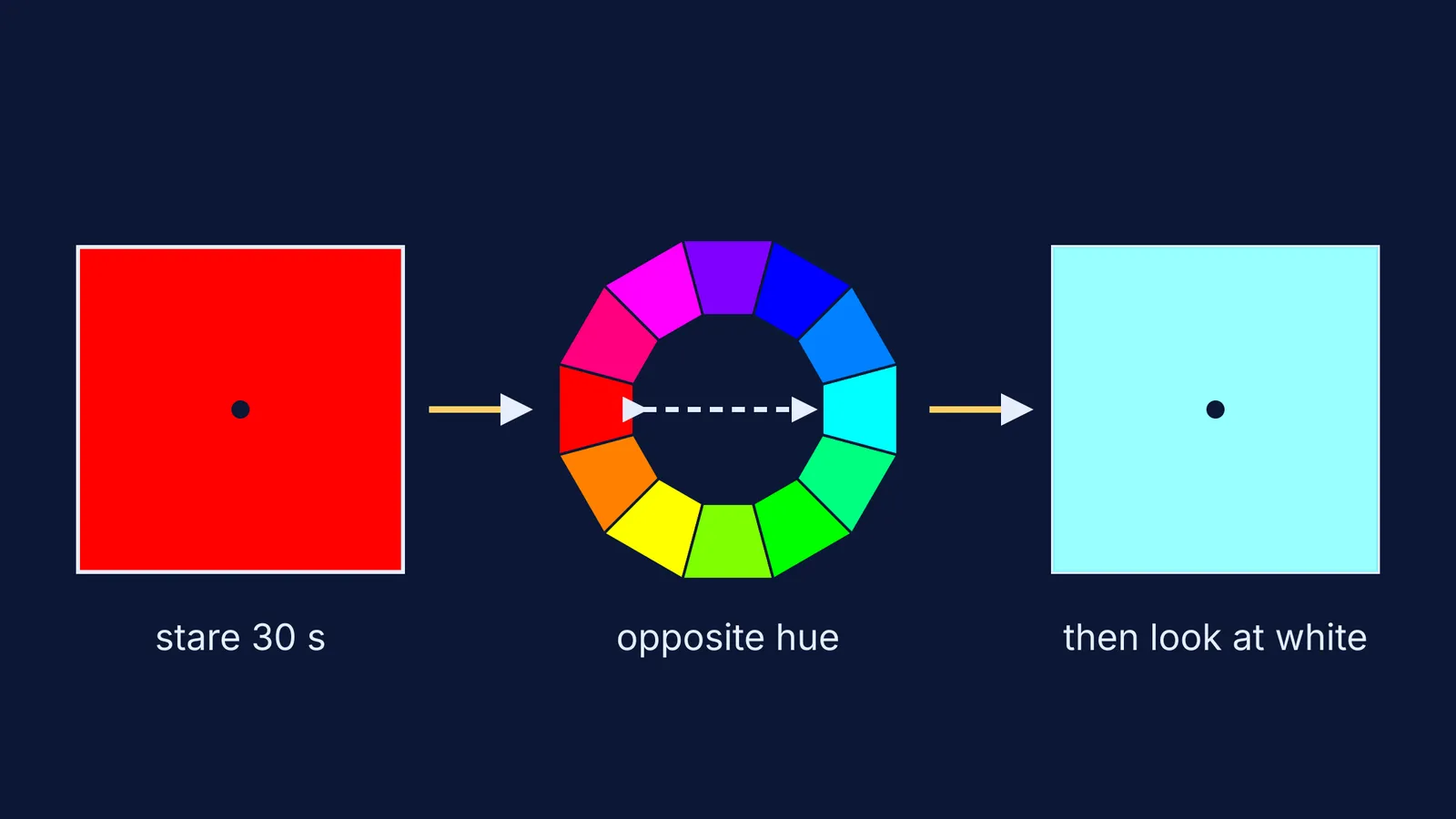
Stare at a red square for half a minute, then look at a white wall. A square appears that is not there, and it is not red. Most people call it green; on a screen it often looks closer to cyan, a blue-green. Make a guess about why before you read on, then test it.
Why does staring at red give a green afterimage?
Your retina has three types of colour-sensitive cones, which respond roughly to red, green and blue light, according to HyperPhysics at Georgia State University. Your visual system does not read those three signals one at a time. It compares them in opposing pairs: red against green, blue against yellow, and light against dark.
That pairing idea comes from Ewald Hering, the father of opponent process theory, who noticed that nobody ever sees a reddish green or a yellowish blue, as this York University page on opponent processes explains. The same page gives the classic demonstration: look at a red patch for about a minute, switch to a white area, and you see a greenish patch.
Here is the chain of events in plain terms:
While you stare, the red-versus-green channel is pushed hard towards red for a long time.
The cells carrying that signal adapt. They turn their response down, the way you stop noticing a ceiling fan.
You look at white, which should balance red and green evenly.
Because the red side has been turned down, the balance tips the other way, and you see green until the cells recover.
Can you predict the afterimage colour before you test it?
You need a phone or laptop and a plain white page. Keep the screen at normal brightness. Never try this with the Sun, a bright lamp or a laser.
Fill the screen with a solid colour square and put a small dot in its centre.
Fix your eyes on the dot for 30 seconds without letting them wander. Blinking is fine.
Switch to the white page and keep looking at one spot.
Write down the colour you see and roughly how long it lasts.
On a screen, every colour is a mix of red, green and blue values from 0 to 255. Our prediction rule: subtract each value from 255. That gives the colour sitting directly opposite on a colour wheel, as in the diagram above. Write all five predictions before you test any of them.
Red (255, 0, 0) predicts cyan (0, 255, 255), which most people call green or blue-green.
Green (0, 255, 0) predicts magenta (255, 0, 255), a pinkish purple.
Blue (0, 0, 255) predicts yellow (255, 255, 0).
Yellow (255, 255, 0) predicts blue (0, 0, 255).
A black square on white predicts a pale patch, lighter than the page.
Then stare for 10 seconds instead of 30 and compare. A wrong prediction is useful data, not a failure.
Is it really tired cone cells?
The textbook story says red-sensitive cones get tired and send a weaker signal. Measurement has refined that picture.
In a 2012 study in Current Biology, Qasim Zaidi, Robert Ennis, Dingcai Cao and Barry Lee recorded from retinal ganglion cells in anaesthetised macaque monkeys, the cells that carry signals from the eye to the brain (full paper on PubMed Central, DOI). These cells adapted to a long-lasting colour and then gave a rebound response when the colour was removed, which could supply the afterimage signal.
The ganglion cells adapted with time constants from 4.8 to 17.6 seconds, almost all between 5 and 12 seconds, while at the light levels used, cone adaptation has time constants of about 0.01 seconds, according to the same paper. Zaidi concluded that afterimage signals are generated in the retina, though cortical processes in the brain may modify them (Zaidi's summary of the work).
So a fairer line for your notes is: cones detect the red, and the slower opposing circuits behind them adapt and rebound.
Colour mixing is one of those ideas that is easier to see than to read; the Fermi Simulation Lab has interactive simulations for ideas like that.
How do you explain an afterimage in a biology or physics answer?
Three points usually carry a school answer:
Cones in the retina respond roughly to red, green and blue light.
Their signals are compared in opponent pairs: red against green, blue against yellow.
Long viewing adapts one side of a pair, so a neutral surface then looks like the opposite colour.
For more on the cones themselves, read how our eyes see so many different colours. If some colour pairs look alike to you, the story of the Ishihara colour blindness test explains how that is checked. For the eye's other everyday adjustment, see how the lens changes shape for near vision.
Run the red square once more tonight, and this time say your prediction out loud before you look away.