

On this page
How do our eyes see so many colours when the primary colours of light are just red, green, and blue? The colours we perceive are just different wavelengths of visible light, a fact familiar to anyone who has studied the dispersion of white light by a glass prism.
The answer lies in the millions of specialised cells at the back of the eye. The human eye can distinguish about 10 million different colours (Wikipedia). It achieves this massive range using a remarkably small set of tools.
What do the three types of cone cells do?
The human retina contains approximately 120 million rod cells and 6 million cone cells (Wikipedia).
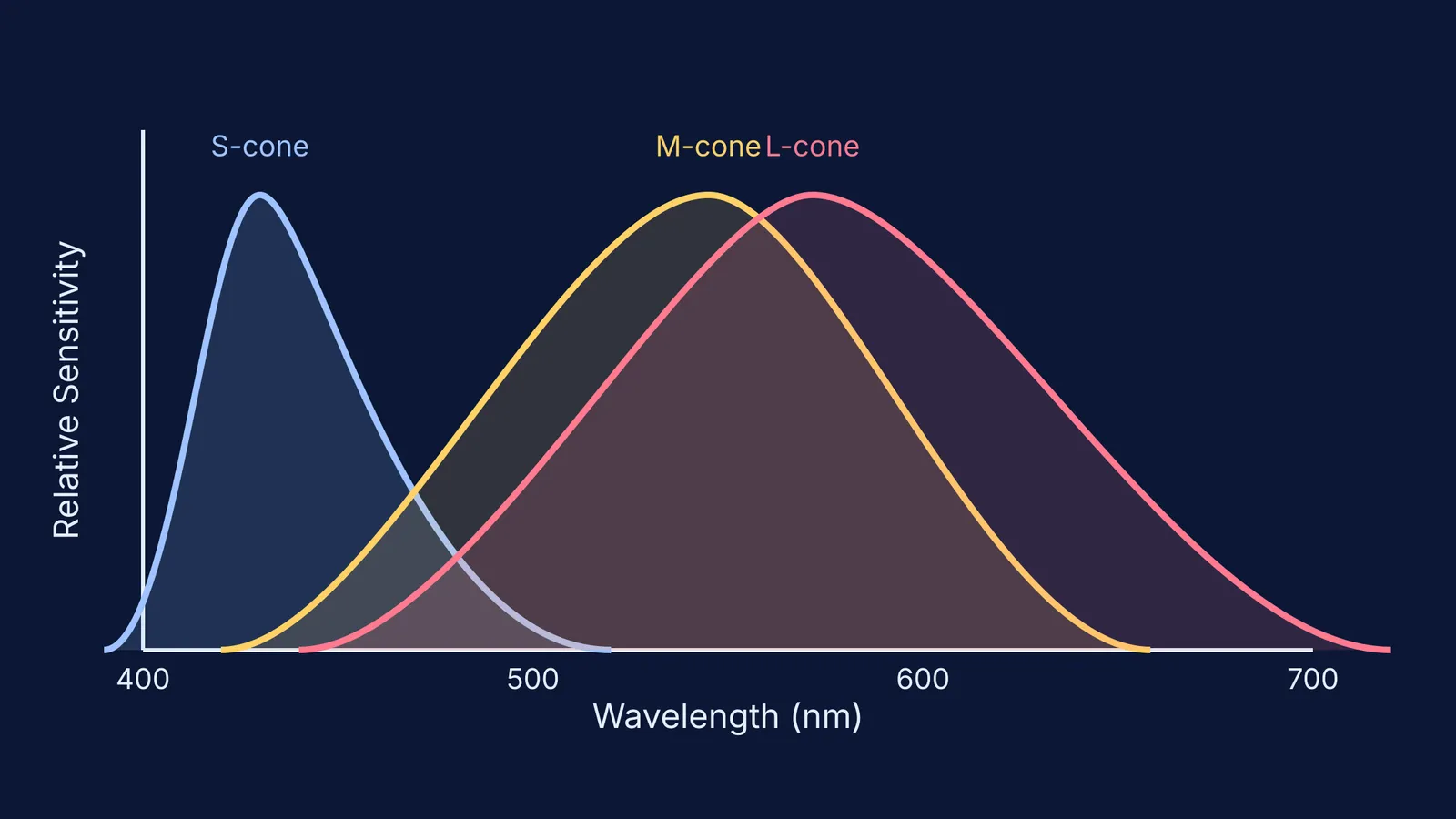
Cones are the photoreceptors responsible for colour vision, and they come in three main types. Each type is tuned to a specific range of light wavelengths (Wikipedia):
S-cones (Short): Peak sensitivity at 420–440 nm, in the blue region of the spectrum.
M-cones (Medium): Peak sensitivity at 534–555 nm, in the greenish-yellow region.
L-cones (Long): Peak sensitivity at 564–580 nm, in the greenish-yellow to red region.
These three sensors form the basis of our trichromatic vision. Each cone type responds differently depending on the specific light hitting it, providing the brain with three distinct data points for any given incoming ray of light.
How do our eyes see so many colours?
If we only have sensors peaking at three specific ranges, how do we manage to perceive 10 million distinct shades? It all happens through signal overlap and the way these sensitivity curves interact.
When light enters the eye, it rarely hits just one type of cone. Because the sensitivity curves of the M and L cones overlap heavily, almost any wavelength in the visible spectrum triggers a combination of signals from multiple cone types. For example, pure yellow light (around 580 nm) stimulates both L-cones and M-cones simultaneously, but to different extents. Even light that falls squarely on the peak of the S-cone will produce minor responses in the other cones if it is bright enough. This constant mixing of inputs is what gives our vision such a rich palette.
Why do we need the brain to see colour?
The eye only collects the raw data; the brain does the actual comparing and computing. Retinal ganglion cells and the visual cortex act as an opponent process, weighing the output of one cone type against another to determine the final result.
By computing the exact ratios of these signals, the brain assigns a specific hue to what you are seeing. This complex integration means you perceive a continuous spectrum rather than isolated bands of light. If you are preparing for exams on the human eye and its defects, remember that colour blindness usually happens when one of these cone types is faulty or completely missing.
Working out the optics of the eye can sometimes feel abstract when simply reading a textbook. Interactive tools like the Fermi Simulation Lab are built for ideas that are easier to see than to read, allowing you to manipulate wavelengths and see the resulting colour directly.
A quick checklist for exam questions
When tackling optics or biology questions about human colour vision, use this framework to structure your thoughts:
Identify the light source's wavelengths (is it monochromatic like a laser, or mixed like sunlight?).
Trace those wavelengths to the three cone types (S, M, and L).
Determine which cones are stimulated most strongly due to their overlapping sensitivities.
Remember the brain's role in computing the ratio to give the final perceived colour.
If a biological process or physics concept is not clicking, Fermi's AI tutor works out what you already know and builds a plan for the session, teaching through it by drawing the figure and checking your understanding as it goes.


