

On this page
Using AI to study for competitive exams like JEE Main or NEET-UG can feel like a massive advantage. When you are stuck on a tough physics numerical or an obscure calculus problem, you can take a photo and the correct working appears in seconds. But there is a catch: getting the final answer immediately often short-circuits your own cognitive process.
When you use an AI tool that simply hands over the solution, you fall into the trap of "cognitive offloading". Your brain recognises that it does not need to store the method because the machine has already done the heavy lifting. To actually build problem-solving skills that survive until exam day, you need what intelligent tutoring systems call a "hint ladder".
What is a hint ladder?
In educational research, a hint ladder (often referred to as scaffolding) is a sequence of increasingly specific clues provided to a student. Instead of giving you the full method upfront, a good tutor provides the least amount of help necessary for you to take the next step yourself.
If you read about Hints or answers? What tutoring research says about the right help, you will know that productive struggle is essential for memory retention. When you set up an AI tutor to use a hint ladder, it will not spit out the final line of working. Instead, it starts with a gentle conceptual nudge. If you are still stuck, it provides a slightly more direct clue, and only as a last resort will it show you the procedural step.
The researchers in that study, published in the *Proceedings of the National Academy of Sciences* (*PNAS*), found that when the AI was restricted to act as a scaffolded tutor—forcing students to reason through hints rather than handing them the answer—this severe learning loss was prevented. The guardrails forced the students to do the thinking.
What are the three levels of an effective hint ladder?
If you are prompting a standard chatbot, you have to explicitly tell it not to give the answer. Alternatively, purpose-built educational platforms like Fermi's AI tutor are designed to teach this way by default. Fermi holds a line of reasoning across a whole session, notices where a student is stuck, and decides whether to explain, ask, or show, rather than simply printing an answer.
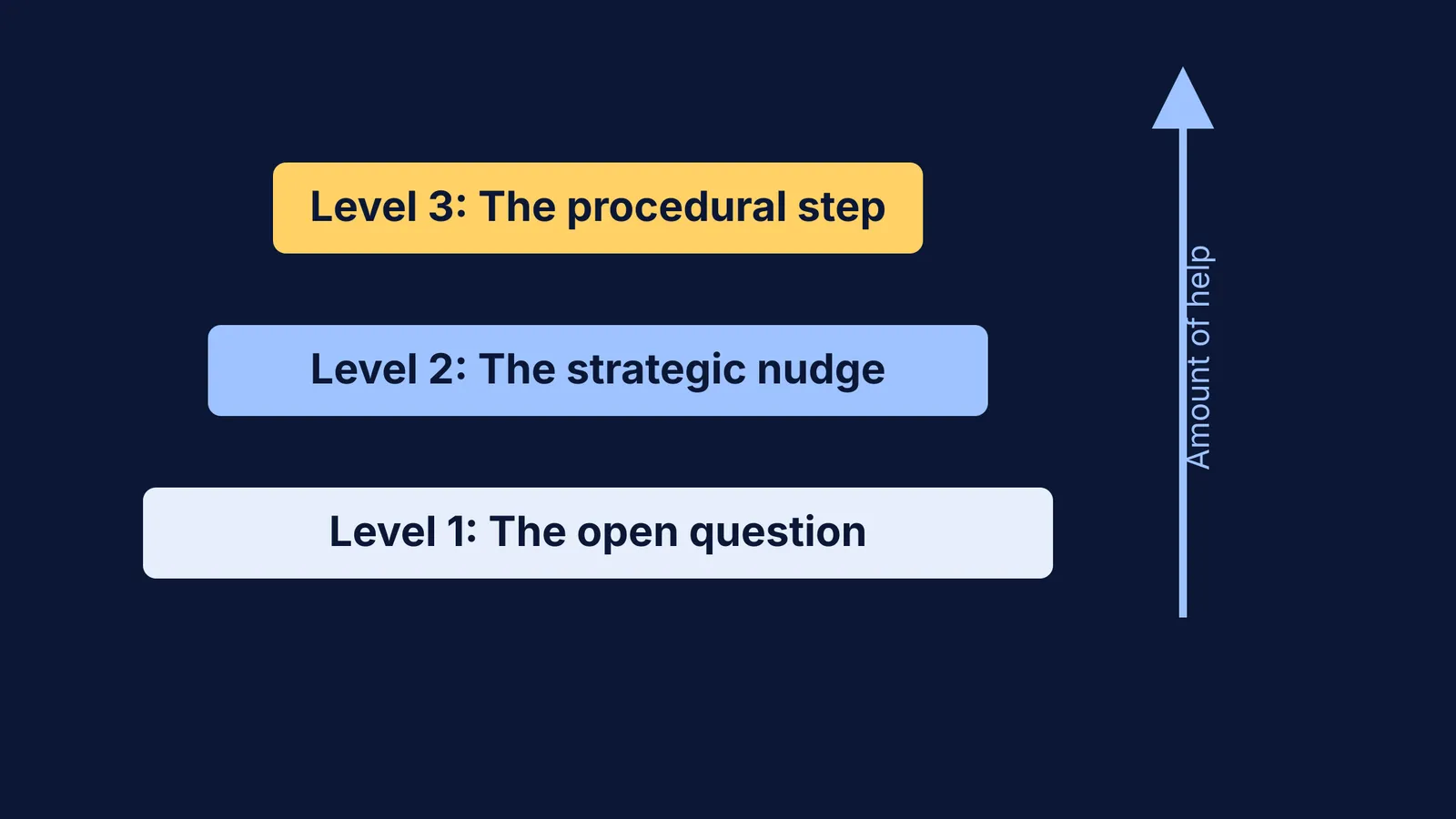
Whether you are writing a custom prompt or using a dedicated platform, a standard hint ladder is usually broken down into three distinct levels of support:
The open question: The AI asks you to look at the problem again and identify what principles might apply, without telling you which one is correct. For example, if you are struggling with mechanics, it might ask, "What forces are acting on the block in this diagram?"
The strategic nudge: If you still cannot move forward, the AI points you toward the right rule or formula without telling you how to plug in the numbers. It might say, "Since the block is sliding at a constant velocity, what does Newton's first law tell you about the net force?"
The procedural step: If the concept is clear but the mathematics is not, the AI gives you the first line of the calculation. "Try setting up the equation where the component of gravity equals the force of kinetic friction."
How do I set up my own hint ladder?
To stop yourself from taking the easy way out when you are frustrated, you must set the rules before you start your study session. If you are using a general AI tool, paste a strict system instruction into the chat before you upload your first question.
Here is a script you can use:
*"You are an expert tutor. I am studying for a competitive exam, so you must never give me the final answer or the complete working. When I am stuck, give me one hint at a time using a three-level hint ladder. Start with a vague conceptual question. If I ask for more help, give me a strategic nudge. If I am still stuck, give me one procedural step. Always wait for my reply before moving to the next hint."*
This approach ensures you remain the one driving the session. When you evaluate an AI tutor, its ability to withhold information and manage this ladder is just as important as its ability to generate accurate text.
When should I stop asking for hints?
The ultimate goal of scaffolding is to step off the ladder as early as possible. If the first open question is enough to unstick you, stop asking the AI for more hints and finish the calculation on your own paper.
If you find yourself needing the third level—the procedural step—for every single question in a chapter, it is a glaring sign that you have foundational gaps. This is exactly why some JEE Main aspirants plateau despite studying every day: they try to brute-force numericals without understanding the underlying theory. Instead of asking the AI for more hints on the current problem, step back and ask the tutor to explain the core concept from scratch.
By taking help one rung at a time, you ensure that the AI acts as a true educational tool, rather than just an incredibly fast answer key.


