

On this page
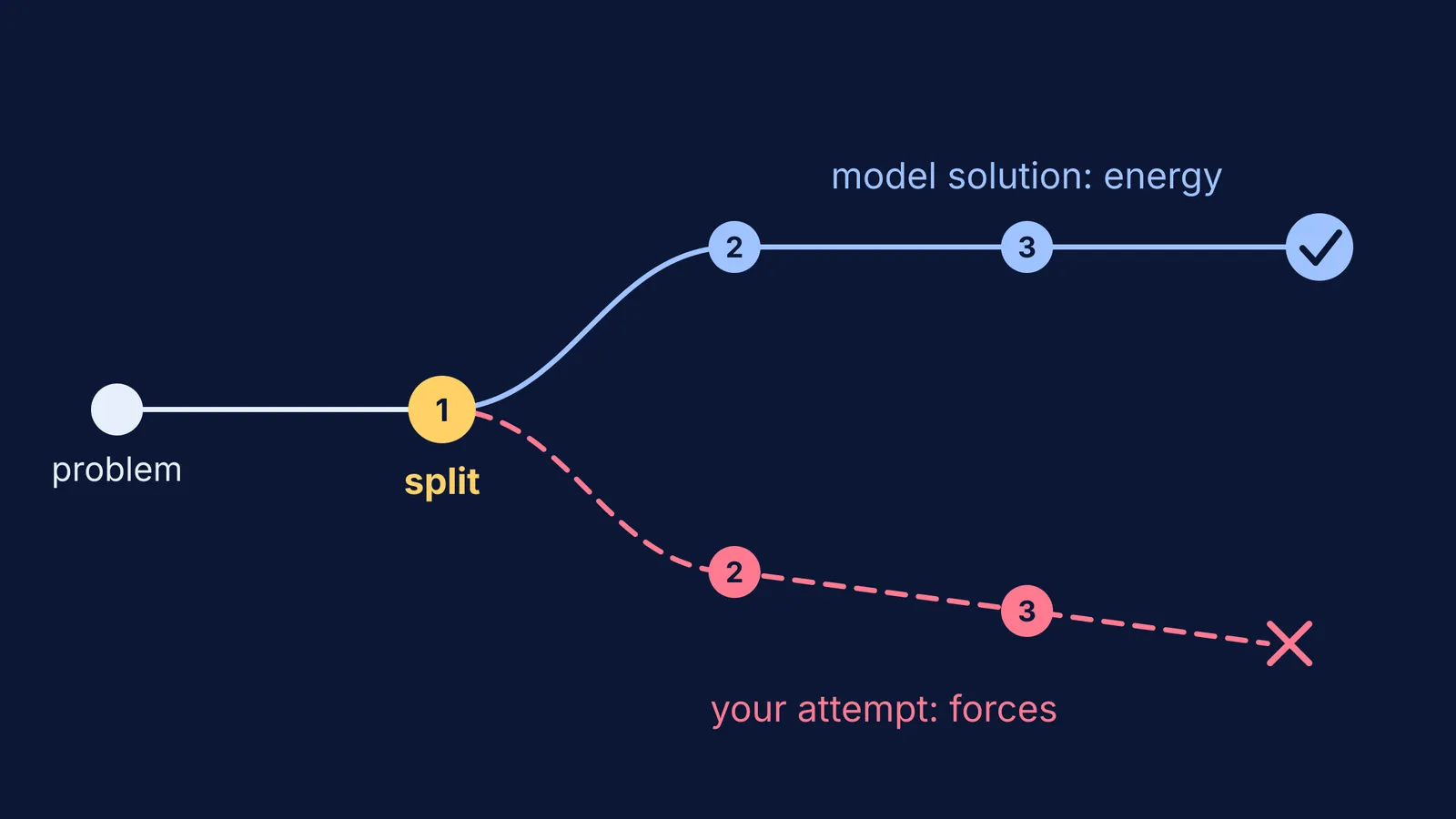
You open the official solution, nod and close it. A week later a similar question beats you again. The useful work is finding the exact line where your path left the model's, and writing down what should have sent you the other way.
Why compare line by line instead of just reading the answer?
Because the learning lives in the explanations you give yourself. In a 1989 study in Cognitive Science, Michelene Chi and colleagues listened to students think aloud over worked mechanics examples. The stronger learners generated many explanations of the steps and related them to principles in the text; weaker learners explained too little and relied heavily on the examples. A 2013 review by John Dunlosky and colleagues rated self-explanation as moderate utility: promising, but not yet tested enough in classrooms.
Comparing two methods side by side helps too. In a study of 70 seventh-graders by Bethany Rittle-Johnson and Jon Star, students who compared solution methods for linear equations became better equation solvers and more readily used the shortcuts they had been shown than students who studied the same methods one at a time; their grasp of the big ideas did not differ. Your attempt and the official solution make a similar pair.
Janet Metcalfe's 2017 review of learning from errors reports that, in experiments, errors followed by corrective feedback help learning, and that feedback analysing the reasoning behind the mistake is crucial. It also notes that high-confidence errors are corrected more readily than low-confidence ones.
How do you find where your path split from the model solution?
Number the lines of your working and of the official solution.
Walk down both together, ticking every line where you agree, even if the notation differs.
Stop at the first real difference. That is the split; what follows is consequence.
Name the split: a shortcut missed (valid but long), a concept error, a misread or a slip (algebra or arithmetic).
Ask what in the question told the model to go that way: a word, a given or missing quantity, the diagram.
A few days later, solve the question again cold, without looking.
This is the self-explanation technique aimed at one question at a time. For the whole-paper view, pair it with how to analyse a mock test.
A worked example: where did the split happen?
Question: a small block is released from rest at a height of 5 m on a smooth curved ramp. Find its speed at the bottom. Take g = 10 m/s².
Your attempt:
Draw the block on the ramp; mark its weight mg and the normal force N.
Along the ramp, ma = mg sin θ.
But θ changes along the curve, so a is not constant.
Guess an average angle, use v² = 2as, and get a wrong answer.
Model solution:
Draw the block; mark mg and N.
The ramp is smooth, so there is no friction, and N is perpendicular to the motion, so it does no work.
Mechanical energy is conserved: mgh = ½mv².
v = √(2gh) = √(2 × 10 × 5) = 10 m/s.
Line 1 matches. The split is line 2: you reached for forces, the model for energy. It is a shortcut missed with a concept edge, because you never asked which forces do work. The signal was in the question: “smooth”, “curved”, only a height given, no time asked. Energy does not care about the shape of the path.
What should you write in your mistake log?
One short entry per split:
Question: paper, number, date
Split at: line 2
Type: shortcut missed, concept, misread or slip
Signal I missed: smooth surface, curved path, only heights given, asks for speed
Rule for next time: when the path is curved and only heights are given, try energy before forces
Confidence: H, M or L
Re-solved on: date and result
The rule matters most. “Be careful” is not a rule; “When ___, try ___” is. If the same rule keeps turning up, that is a topic to revise. Our piece on why mistakes help you learn explains how to put errors to use.
What if the official solution doesn't explain the step?
Many answer keys print the working but not the why. If you cannot say why line 2 is allowed, the gap is in the concept, so look it up before moving on. The Fermi Concept Library covers every concept in physics, chemistry, biology, mathematics and computing, each with its own lesson. To see the reasoning on a similar problem, the Fermi Problem Library has worked problems with a step-by-step solver that explains the reasoning rather than printing an answer. A teacher or friend works too; leave with a reason, not a copied line.
Tonight, take one question you got wrong this week, find its split, and write a single log entry.


