On this page
An Ellingham diagram looks like a dozen tangled lines, but reading it takes one rule and one subtraction. Below, we read real data for two classic cases: aluminium with chromium oxide, and carbon with zinc oxide.
What does an Ellingham diagram show?
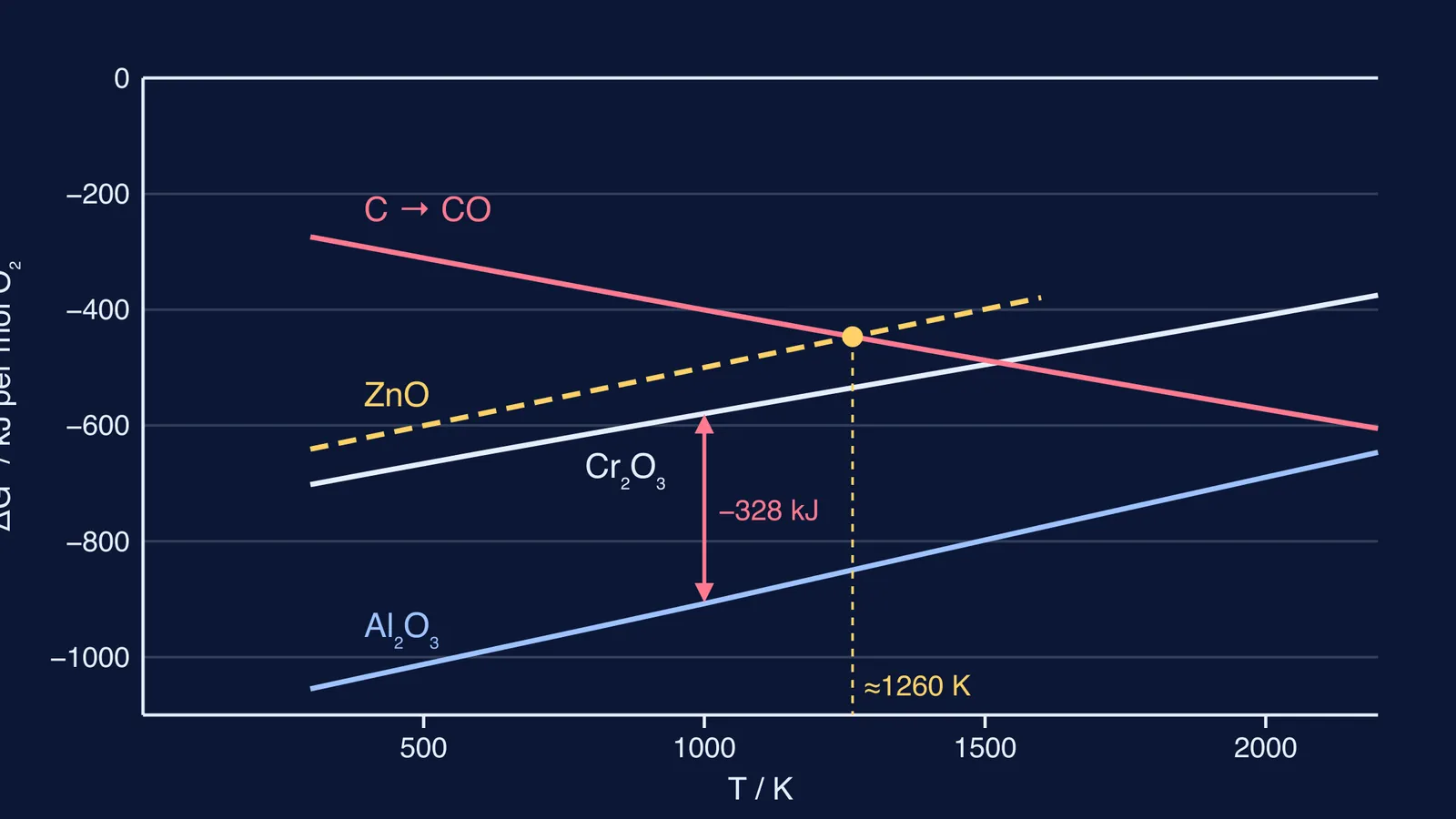
An Ellingham diagram plots the standard Gibbs energy change, ΔG°, for forming each oxide against temperature, and Harold Ellingham first built these diagrams in 1944 (overview of the Ellingham diagram). Every reaction is written per mole of O2, for example 4/3 Al + O2 → 2/3 Al2O3, so the lines can be compared directly.
The slope of each line equals −ΔS°. When a metal turns into a solid oxide, a gas (O2) is used up, entropy falls, and the line rises to the right. The line for 2C + O2 → 2CO is the exception: one mole of gas becomes two, entropy rises, and the line slopes down. That one downward line is why coke does so much of the work in extraction, as you can see in the reactions inside a blast furnace, zone by zone.
Which metal reduces which oxide on an Ellingham diagram?
The rule is that at a given temperature, the element with the lower line will reduce the oxide whose line lies higher (overview of the Ellingham diagram). A lower line means a more stable oxide.
The reason is one subtraction. Reverse the upper reaction and add the lower one: O2 cancels, and ΔG° for the reduction is ΔG°(lower) − ΔG°(upper), which is negative. If that arithmetic feels shaky, revise standard Gibbs energy of reaction from formation values first.
Worked example: why does aluminium reduce Cr2O3?
We used the NIST-JANAF thermochemical tables (Al2O3 table, Cr2O3 table). At 1000 K, ΔfG° is −1361.4 kJ/mol for Al2O3 and −869.2 kJ/mol for Cr2O3.
Convert to per mole of O2 by multiplying by 2/3: Al2O3 gives −907.6 kJ and Cr2O3 gives −579.5 kJ.
Aluminium's line is lower, so Al is the reducing agent.
Subtract: −907.6 − (−579.5) = −328 kJ per mole of O2 for 4/3 Al + 2/3 Cr2O3 → 2/3 Al2O3 + 4/3 Cr.
The same tables put aluminium's line below chromium's at every listed temperature from 298 K to 2200 K, so the lines never cross. That is the thermodynamics behind the aluminothermic (thermite) route to chromium.
Why does carbon reduce ZnO only above about 1270 K?
Here the lines cross. The JANAF table for CO gives ΔfG° = −217.8 kJ/mol at 1200 K and −226.5 kJ/mol at 1300 K, so 2C + O2 → 2CO sits at −435.6 and −453.0 kJ per mole of O2. The line is falling.
For zinc oxide, NIST lists the CODATA values ΔfH° = −350.46 kJ/mol and S° = 43.65 J/(mol K) (NIST WebBook, zinc oxide). It gives S° = 41.63 J/(mol K) for zinc (NIST WebBook, zinc), and JANAF gives 205.15 J/(mol K) for O2 (JANAF O2 table). If you treat ΔH° and ΔS° as constant, the ZnO line is ΔG° ≈ −700.9 + 0.201T kJ per mole of O2. It rises.
At 1200 K: ZnO is about −459.6 kJ and CO is −435.6 kJ. ZnO is lower, so carbon cannot reduce it.
At 1300 K: ZnO is about −439.5 kJ and CO is −453.0 kJ. Now carbon's line is lower, and 2ZnO + 2C → 2Zn + 2CO becomes feasible.
The lines cross near 1260 K. Textbook explanations put the crossover at about 1273 K, or 1000 °C (a typical JEE answer explanation). Treat our 1260 K as an estimate: the straight-line method ignores zinc melting at about 693 K (NIST WebBook, zinc) and boiling at about 1180 K (zinc properties), both below the crossing.
How do you answer Ellingham questions in an exam?
Use this four-step check on any diagram:
Draw a vertical line at the temperature in the question.
Find the two lines it meets. The lower one belongs to the reducing agent, so if an option's reducing agent sits higher, that option is wrong.
Estimate the gap. A bigger gap means a more negative ΔG° for the reduction.
Scan left and right for crossings. A crossing is the temperature where the answer flips, as it does for C and ZnO.
This is the skill tested in a JEE Main question from 10 April 2023, Shift 2, where you judge statements about C, CO, FeO and ZnO at 600 °C. Try the four steps before reading the answer.
Copper is one example: read how self-reduction extracts copper from copper pyrites. For more practice, the Fermi Problem Library has worked problems with a step-by-step solver that explains the reasoning rather than printing an answer. If entropy and the sign of a slope are the real gap, the Fermi Concept Library gives each concept its own lesson.
Next time: pick a temperature, find the lower line, subtract.