On this page
One metallurgy question keeps coming back: write the reactions in the different zones of the blast furnace. Here is the standard textbook answer, zone by zone, plus a worked mass balance most notes skip.
What goes into a blast furnace, and what comes out?
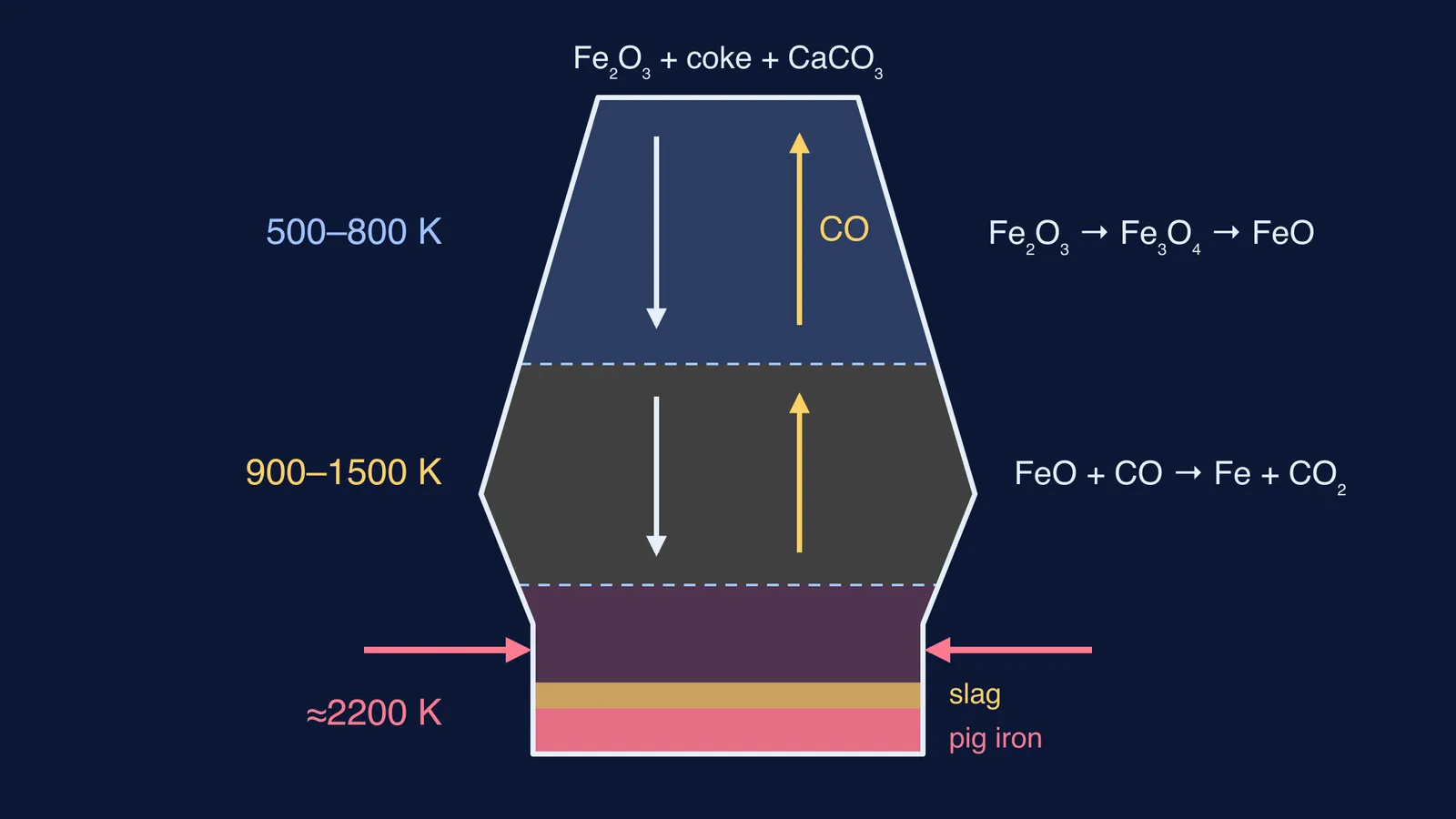
Iron ore (haematite, Fe₂O₃), coke and limestone are loaded at the top, and hot air is blown in near the bottom. The International Iron Metallics Association describes the furnace as a counter-current gas/solids reactor: the solid charge falls while hot gases rise through it. The same page says the air blast is preheated to 900–1,300 °C and the hottest zone reaches 1,850–2,200 °C.
What comes out is molten iron, molten slag and waste gas. Used as cast iron, the molten iron contains about 4% carbon, according to Chemguide's page on iron extraction.
What are the reactions in each zone of the blast furnace?
The kelvin ranges below follow the NCERT answer reproduced on Careers360, with the peak of about 2200 K from Vedantu's blast furnace notes. Real furnaces run hotter: IIMA's 1,850–2,200 °C is roughly 2,100–2,500 K. Read the zones from the bottom up, because that is the way the gas travels.
Combustion zone, near the air inlets (about 2200 K):
C + O₂ → CO₂ (coke burns and supplies the heat)
CO₂ + C → 2CO (the CO₂ meets more hot coke and becomes the reducing gas)
Lower zone (900–1500 K):
C + CO₂ → 2CO
FeO + CO → Fe + CO₂
CaO + SiO₂ → CaSiO₃ (slag)
Upper or reduction zone (500–800 K):
3Fe₂O₃ + CO → 2Fe₃O₄ + CO₂
Fe₃O₄ + 4CO → 3Fe + 4CO₂
Fe₂O₃ + CO → 2FeO + CO₂
CaCO₃ → CaO + CO₂
How does CO reduce Fe₂O₃ in the blast furnace?
The overall reaction is Fe₂O₃ + 3CO → 2Fe + 3CO₂, and Chemguide notes that carbon monoxide is the main reducing agent in the furnace. In the hotter parts, carbon itself also reduces the ore: Fe₂O₃ + 3C → 2Fe + 3CO.
Oxidation numbers explain the zone list. Iron steps down from +3 in Fe₂O₃ to +8/3 in Fe₃O₄, then +2 in FeO, then 0 in the metal. Each CO is oxidised from carbon +2 to carbon +4 in CO₂. The ore loses oxygen a little at a time as it falls into hotter gas.
Compare copper, whose sulphide ore partly reduces itself (self-reduction in copper extraction) after froth flotation of sulphide ores.
What is the role of limestone in the blast furnace?
Limestone is a flux. Without it, the rocky material in the ore, such as silica, would not melt and would eventually clog the furnace, as Chemguide explains. Heat decomposes limestone, CaCO₃ → CaO + CO₂, and the basic oxide CaO reacts with acidic SiO₂ to give calcium silicate, CaSiO₃.
This slag melts, runs down and forms a layer on top of the molten iron, so the two can be tapped off separately. The same source says slag is used in road making and in slag cement. Lime came back later in steelmaking, when it was used to pull phosphorus out of iron in the Gilchrist Thomas basic process.
Worked example: how much ore and CO make one tonne of iron?
This is the ideal stoichiometry from Fe₂O₃ + 3CO → 2Fe + 3CO₂, using the standard atomic weights from CIAAW (Fe 55.845, C 12.011, O 15.999, plus Ca 40.078 and Si 28.085 for the flux).
Moles of iron in 1,000 kg: 1,000,000 g ÷ 55.845 g/mol = 17,907 mol.
Fe₂O₃ needed is half that, 8,953 mol, × 159.69 g/mol = about 1,430 kg.
CO needed is 3/2 × 17,907 = 26,860 mol, × 28.01 g/mol = about 752 kg.
CO₂ released is 26,860 mol × 44.01 g/mol = about 1,182 kg.
Check the mass balance: 1,430 + 752 = 2,182 kg in, and 1,000 + 1,182 = 2,182 kg out.
For the flux, 60.08 g of SiO₂ needs 100.09 g of CaCO₃, so 100 kg of silica needs about 167 kg of limestone and gives about 193 kg of CaSiO₃. A real furnace uses more coke than this, because coke also supplies heat and some carbon dissolves in the iron.
How do you remember the blast furnace zones for the exam?
Checklist for the written answer:
Draw the furnace with two arrows: solids down, gas up.
Write the NCERT temperatures from the top: 500–800 K, 900–1500 K, about 2200 K.
Follow iron's oxidation state: +3, +8/3, +2, 0.
Put limestone in two steps: it decomposes, then CaO + SiO₂ → CaSiO₃.
Balance the oxygen in every CO step before you move on.
Syllabuses change, so first check that metallurgy is in yours. If you keep mixing up the steps, the Fermi Problem Library has worked problems with a step-by-step solver that explains the reasoning rather than printing an answer. If redox itself is the shaky part, the Fermi Concept Library gives each chemistry concept its own lesson and shows where it fits in the map.