On this page
Most electrolysis numericals ask how much metal a current lays down in a given time. The electrochemical equivalent, Z, answers that in one multiplication. Here we find Z for copper and silver, then use it for 2 A running for 30 minutes.
What is the electrochemical equivalent Z?
Faraday's first law, as the NCERT Class 12 chemistry chapter on electrochemistry states it, says the amount of chemical reaction at an electrode is proportional to the quantity of electricity passed through the electrolyte. Written for the mass deposited, that is m ∝ Q, so m = ZQ = ZIt.
The electrochemical equivalent Z is the mass of a substance deposited or liberated by one coulomb of charge. Its SI unit is kg/C; g/C is handier in school problems.
Where does Z = M/(nF) come from? Depositing one mole of a metal whose ion carries charge n+ takes n moles of electrons, each mole carrying one faraday, and the Faraday constant is 96 485.332 12... C/mol, an exact value in the CODATA 2022 values published by NIST. So nF coulombs deposit M grams, and one coulomb deposits M/(nF) grams. The NCERT chapter derives 96 487 C/mol and uses 96 500 C/mol for approximate calculations.
How do you calculate Z for copper and silver?
You need the molar mass M and ion charge n. The standard atomic weight of copper is 63.546 and the standard atomic weight of silver is 107.8682, both from IUPAC's Commission on Isotopic Abundances and Atomic Weights (CIAAW).
Copper, deposited from copper sulphate (Cu²⁺ + 2e⁻ → Cu, so n = 2):
nF = 2 × 96 485.33 = 192 970.66 C/mol
Z(Cu) = 63.546 ÷ 192 970.66 = 3.293 × 10⁻⁴ g/C
In SI units, Z(Cu) = 3.293 × 10⁻⁷ kg/C
Silver, deposited from silver nitrate (Ag⁺ + e⁻ → Ag, so n = 1):
nF = 96 485.33 C/mol
Z(Ag) = 107.8682 ÷ 96 485.33 = 1.118 × 10⁻³ g/C
In SI units, Z(Ag) = 1.118 × 10⁻⁶ kg/C
How much copper and silver do 2 A for 30 minutes deposit?
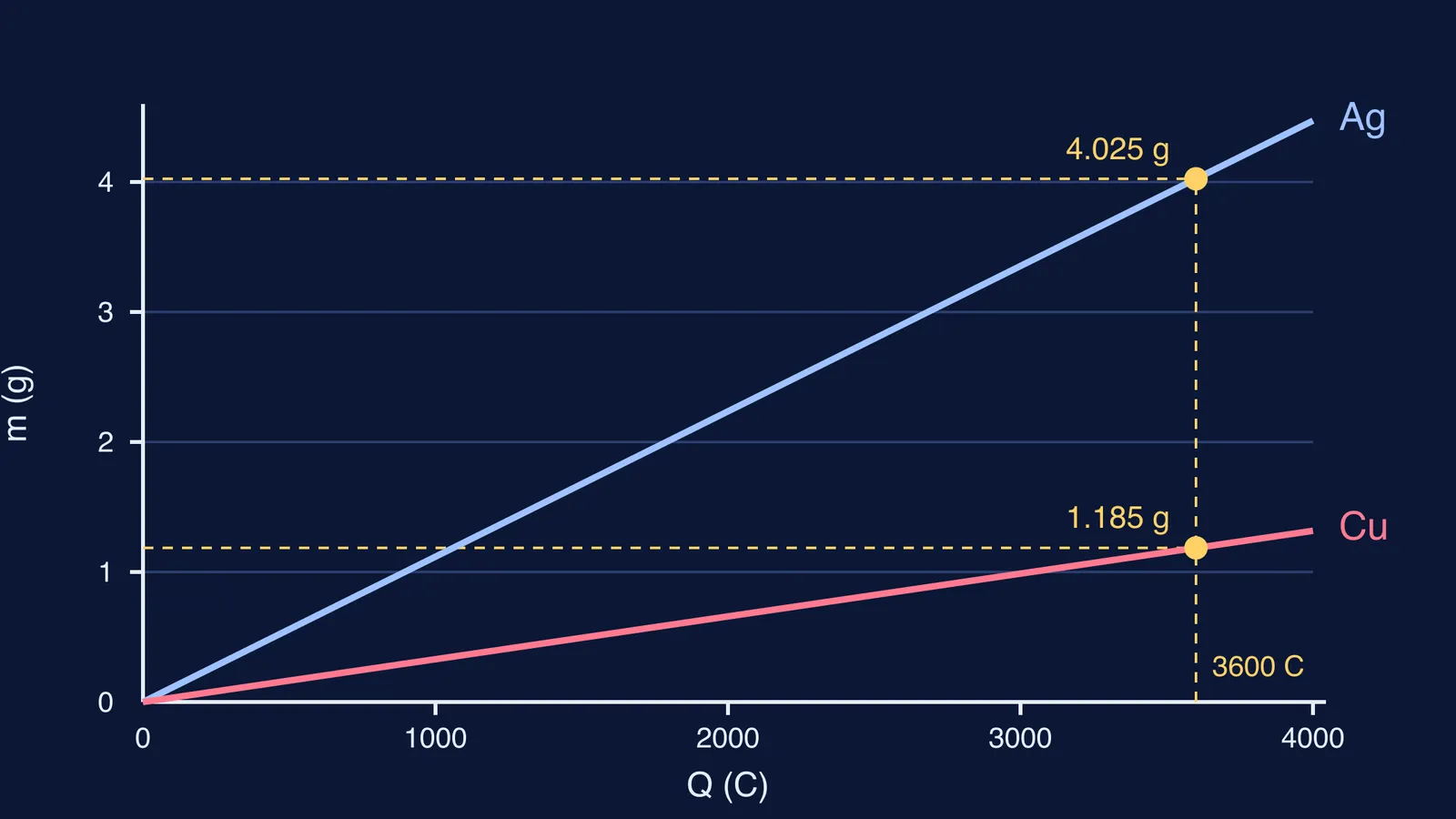
First the charge, Q = It, with I in amperes and t in seconds as the NCERT chapter sets it out: 30 minutes = 1800 s, so Q = 2 × 1800 = 3600 C.
Copper: m = Z × Q = 3.293 × 10⁻⁴ g/C × 3600 C = 1.185 g
Silver: m = 1.118 × 10⁻³ g/C × 3600 C = 4.025 g
Cross-check through moles, the route NCERT's Example 2.10 takes for copper: 3600 C ÷ 96 485.33 C/mol = 0.03731 mol of electrons, which reduces 0.01866 mol of copper (1.185 g) or 0.03731 mol of silver (4.025 g). Z is just the mole route folded into one constant. With F = 96 500 C/mol, silver comes out at 4.024 g; only the fourth significant figure moves.
Why does silver deposit more than three times as much as copper?
With the same 3600 C, the mass ratio is the Z ratio: 4.025 ÷ 1.185 ≈ 3.40. With the CIAAW atomic weights, that equals (107.8682 ÷ 1) ÷ (63.546 ÷ 2) = 107.87 ÷ 31.77 ≈ 3.40, the ratio of the two metals' equivalent weights.
This is where the first law meets the second. The NCERT chapter states the second law as: the amounts of different substances liberated by the same charge are proportional to their equivalent weights, defined as atomic mass divided by the number of electrons needed to reduce the cation. Since Z = M/(nF), Z is the equivalent weight divided by F: the first law gives m = ZQ for one metal, the second tells you how Z changes between metals. That is the classic series-cell question: copper sulphate and silver nitrate cells in series both receive 3600 C, giving 1.185 g of copper and 4.025 g of silver. For how Faraday arrived at both laws, read Faraday's first and second laws of electrolysis, and for where the number comes from, why the Faraday constant is 96500 C/mol.
What mistakes cost marks in Z = M/nF numericals?
Before the final answer:
Convert time to seconds before finding Q.
Read n from the ion reduced, not the salt's formula: Cu²⁺ means n = 2.
Write the unit with Z, and never mix g/C with kg/C.
Use the F the question gives; otherwise 96 500 C/mol, the value the NCERT chapter uses for approximate work.
If a current efficiency is given, multiply the ideal mass by it; see current efficiency in electrolysis for why real mass falls short.
Sanity-check the size: copper's Z is about a third of a milligram per coulomb, silver's just over a milligram.
If you keep picking the wrong n or losing a factor of 60, the Fermi Problem Library has worked problems with a step-by-step solver that explains the reasoning rather than printing an answer. If the mole of electrons itself feels shaky, the Fermi Concept Library gives each concept its own lesson and its place in the map.
Next electrolysis numerical: find Q, then Z, then multiply.