

On this page
Before the 1830s, physicists debated whether the electricity from friction, chemical batteries, and magnets were different phenomena. To settle this, Michael Faraday passed currents through various solutions to study chemical decomposition. These experiments, described in 1833, proved that electricity is uniform and gave us the quantitative rules that govern Class 12 electrochemistry today.
The history of Faraday's first and second law of electrolysis
In the early nineteenth century, the concept of electric charge as a measurable unit did not exist. Faraday had to quantify the electricity passing through a circuit without a modern ammeter. He solved this by inventing the "volta-electrometer" (later known as a voltameter). This device passed a current through water and collected the resulting hydrogen and oxygen gases.
Faraday established that the volume of gas produced was a perfectly reliable measure of the total electricity that had flowed through the circuit. By shifting away from "action at a distance" theories toward the idea that electricity is an internal force acting on the particles of a liquid, he laid the groundwork for his two laws.
What is Faraday's first law of electrolysis?
Faraday's first law states that the mass of a substance deposited or liberated at an electrode is directly proportional to the total quantity of electricity that passes through the electrolyte.
If a current of I amperes flows for t seconds, the total charge Q is I × t. The mass m deposited is given by the formula m = ZIt, where Z is the electrochemical equivalent of the substance. In the Fermi Problem Library, the step-by-step solver breaks down these m = ZIt calculations, showing you exactly how to convert current and time into coulombs before finding the deposited mass.
What is Faraday's second law of electrolysis?
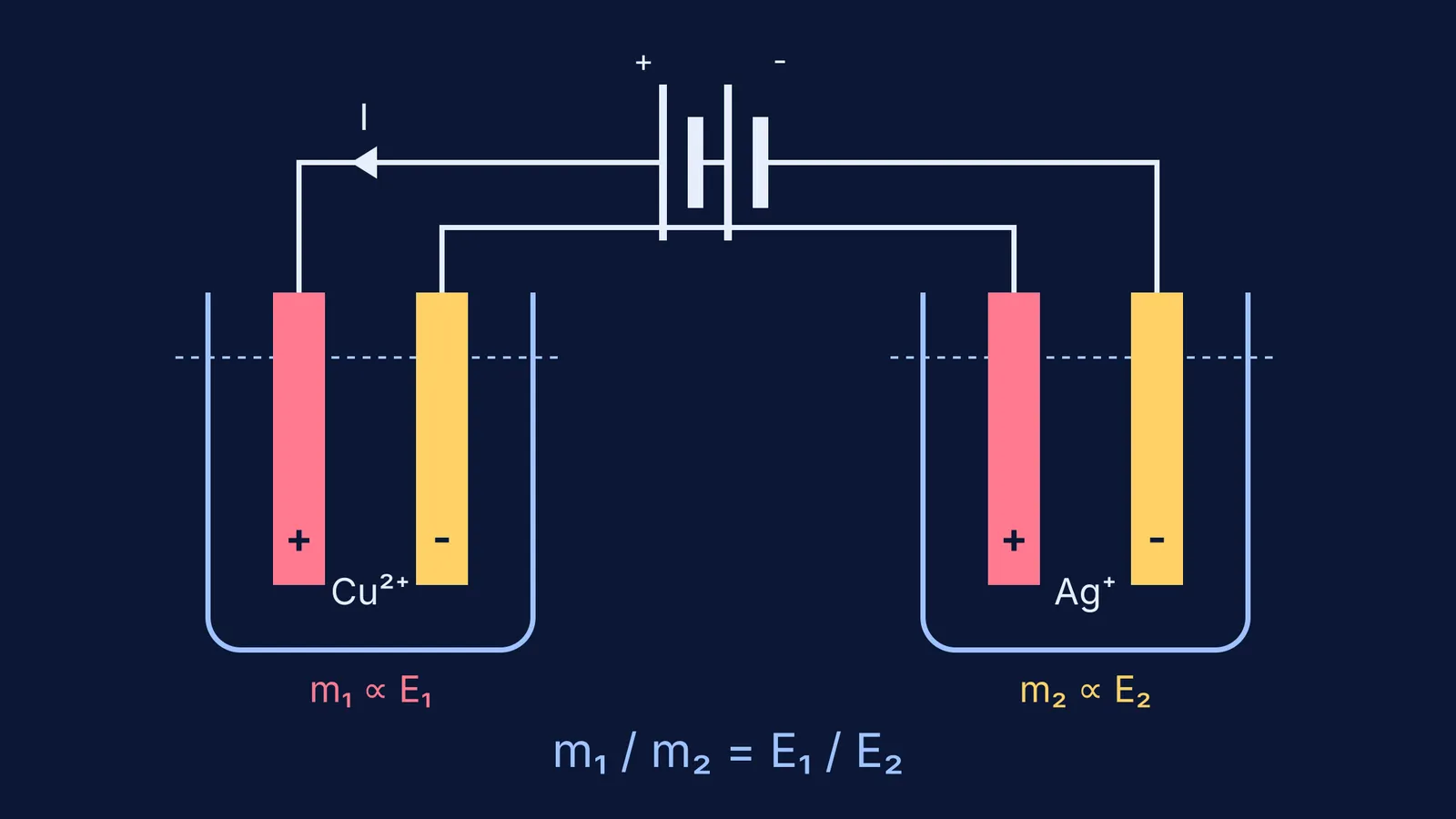
Faraday did not stop at a single solution. He connected several different electrolytic cells in a single series circuit. This ensured that the exact same quantity of electricity passed through every cell.
His second law states that when the same quantity of electricity passes through different electrolytes, the masses of the substances deposited are proportional to their respective chemical equivalent weights. For example, if the same current passes through a silver nitrate solution and a copper sulphate solution, the ratio of the mass of silver to the mass of copper will equal the ratio of their equivalent weights.
How to solve Faraday's laws numericals
When you face an electrochemistry problem in an exam, use this three-step framework:
Find the total charge: Multiply the current in amperes by the time in seconds to get the charge in coulombs (Q = I × t). Remember to convert minutes or hours into seconds.
Calculate the equivalent weight: Divide the atomic weight of the element by its valency. For example, copper has an atomic weight of 63.5 and a valency of 2 (in Cu²⁺), so its equivalent weight is 31.75.
Apply the Faraday constant: Divide the total charge by 96,485.33 to find the number of Faraday equivalents, then multiply this by the equivalent weight to get the final deposited mass.
Coining the language of electrochemistry
To explain his findings without relying on older theories of magnetic "poles", Faraday needed new words. In 1834, he consulted the polymath William Whewell to create a neutral vocabulary based on Greek roots. Together, they introduced terms such as electrode, anode, cathode, electrolyte, ion, anion and cation.
These terms became the universal language for the electrolytic refining of copper and all modern battery chemistry. The definitions and context of these terms are mapped out in the Fermi Concept Library, helping you see how an anode and a cathode apply across different types of electrochemical cells.
By demonstrating that fixed amounts of electricity liberate fixed amounts of matter, Faraday's laws provided the earliest hint that electricity itself comes in discrete, measurable chunks. This exact insight eventually led George Johnstone Stoney, who named the electron, to propose its existence decades later.


