

On this page
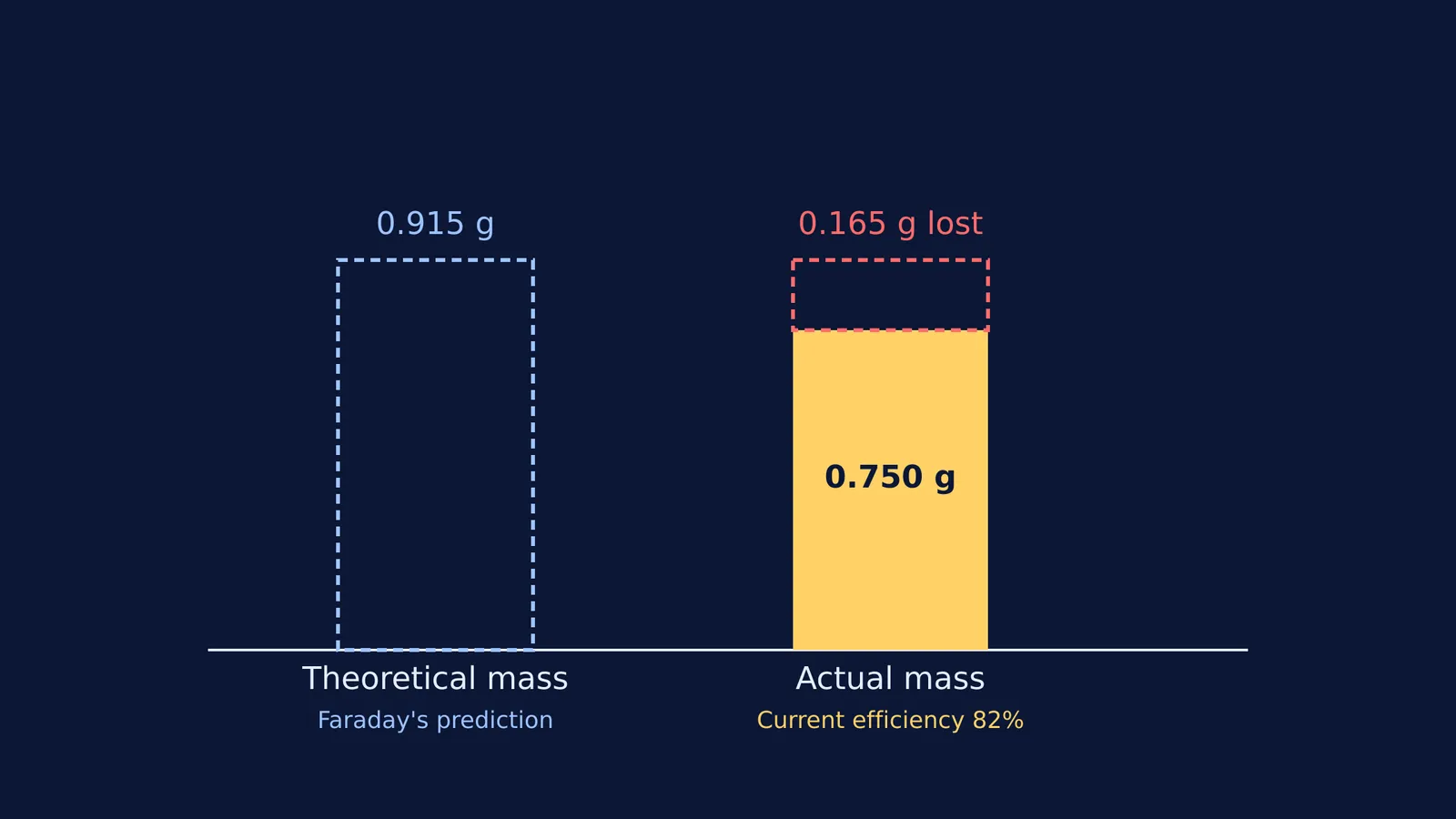
Imagine running 1.5 amperes for 30 minutes through a zinc sulphate solution. By Faraday's laws of electrolysis, published in 1833, you expect 0.915 grams of zinc to coat the cathode. When you weigh the dried electrode, it has gained only 0.750 grams. Where did the missing mass go?
In electrolysis, not every electron performs the job you intended. The actual amount of product is almost always less than the theoretical amount. In lab experiments for copper electrorefining, certain additives can push current efficiency to 97% https://doi.org/10.3390/ma17061262. The remaining 3% of the current is lost to short circuits and side reactions. This gap between the ideal prediction and the real world is exactly what current efficiency measures.
What is current efficiency?
Current efficiency (η) is the fraction of total charge passed that goes into the desired electrochemical reaction. It is the ratio of actual mass deposited at an electrode to the theoretical mass predicted by Faraday's laws of electrolysis.
It is easiest to calculate using the masses: Current efficiency = (Actual mass produced / Theoretical mass predicted) × 100%
The actual mass is what you measure in the lab or what a numerical problem provides. The theoretical mass is what Faraday's first law predicts, assuming all of the current is useful.
How do you calculate current efficiency?
Let us solve the zinc example above. A typical textbook problem might state: A current of 1.5 A is passed through aqueous ZnSO₄ for 30 minutes, depositing 0.750 g of zinc. What is the current efficiency? (Molar mass of Zn = 65.4 g/mol). Faraday's constant is about 96,485.332 C/mol, though usually rounded to 96,485 C/mol Faraday constant.
Find the total charge passed (Q = I × t).
Q = 1.5 A × (30 × 60) s = 2,700 C
Find the theoretical mass. Zinc is Zn²⁺, so n = 2 electrons per ion.
m = (Q × M) / (n × F) m = (2,700 × 65.4) / (2 × 96,485) = 0.915 g
Calculate the efficiency.
η = (0.750 g / 0.915 g) × 100% = 82.0%
Why does actual mass fall short?
The main reason current efficiency drops is competing side reactions. In any aqueous solution, water is present and can be electrolysed. At the cathode, water can be reduced to hydrogen gas instead of the metal:
2H₂O(l) + 2e⁻ → H₂(g) + 2OH⁻(aq)
If a fraction of the electrons goes into making hydrogen bubbles, fewer electrons are left to reduce the metal ions. In zinc electrowinning, the reduction potential of water to hydrogen is actually higher than that of zinc, meaning hydrogen should evolve first. We can still plate zinc because hydrogen has a high "overpotential" on a zinc surface, which slows the side reaction down. Even so, some hydrogen still evolves, reducing the current efficiency. (You can read more about standard potentials in cell EMF to ΔG° and K).
In processes like the electrolytic refining of copper, the efficiency drops for other reasons. Impurities such as iron (Fe³⁺) can be reduced at the cathode to Fe²⁺ without depositing any solid metal. These ions then migrate back to the anode, re-oxidise to Fe³⁺, and cycle round again, eating up current in an endless loop. Physical short circuits, where a rough nodule of copper grows across the gap and touches the anode, also divert current into useless heat.
How do you calculate time when efficiency is known?
Examiners often flip the question, testing your knowledge of Faraday's laws of electrolysis: they give you the current efficiency and ask how long it takes to deposit a certain mass.
Imagine you need to deposit 2.00 g of silver (Ag⁺, M = 107.9 g/mol) using a current of 0.50 A, and the cell operates at 90.0% current efficiency. How long will it take?
Find the theoretical mass you need to aim for. Since only 90.0% of the current makes silver, you must plan to deposit more than 2.00 g theoretically:
Theoretical mass = Actual mass / 0.90 = 2.00 / 0.90 = 2.22 g
Set up Faraday's equation to solve for time (t):
m = (I × t × M) / (n × F)
Rearrange and plug in the numbers (n = 1 for Ag⁺):
t = (m × n × F) / (I × M) t = (2.22 × 1 × 96,485) / (0.50 × 107.9) = 3,970 seconds (about 66 minutes).
Mastering electrolysis problems
Numerical problems on Faraday's laws often combine time, current, moles, and efficiency in one long chain. The Fermi Problem Library has worked problems with a step-by-step solver that explains the reasoning rather than printing an answer. If you keep getting the wrong theoretical mass because of a tricky valence number or a missed unit conversion, Fermi's AI tutor can work out what you already know and build a plan for the session, helping you spot the mistake and trace the electrons correctly. You can also explore the electrochemical series and how potentials work in the Fermi Concept Library.


