On this page
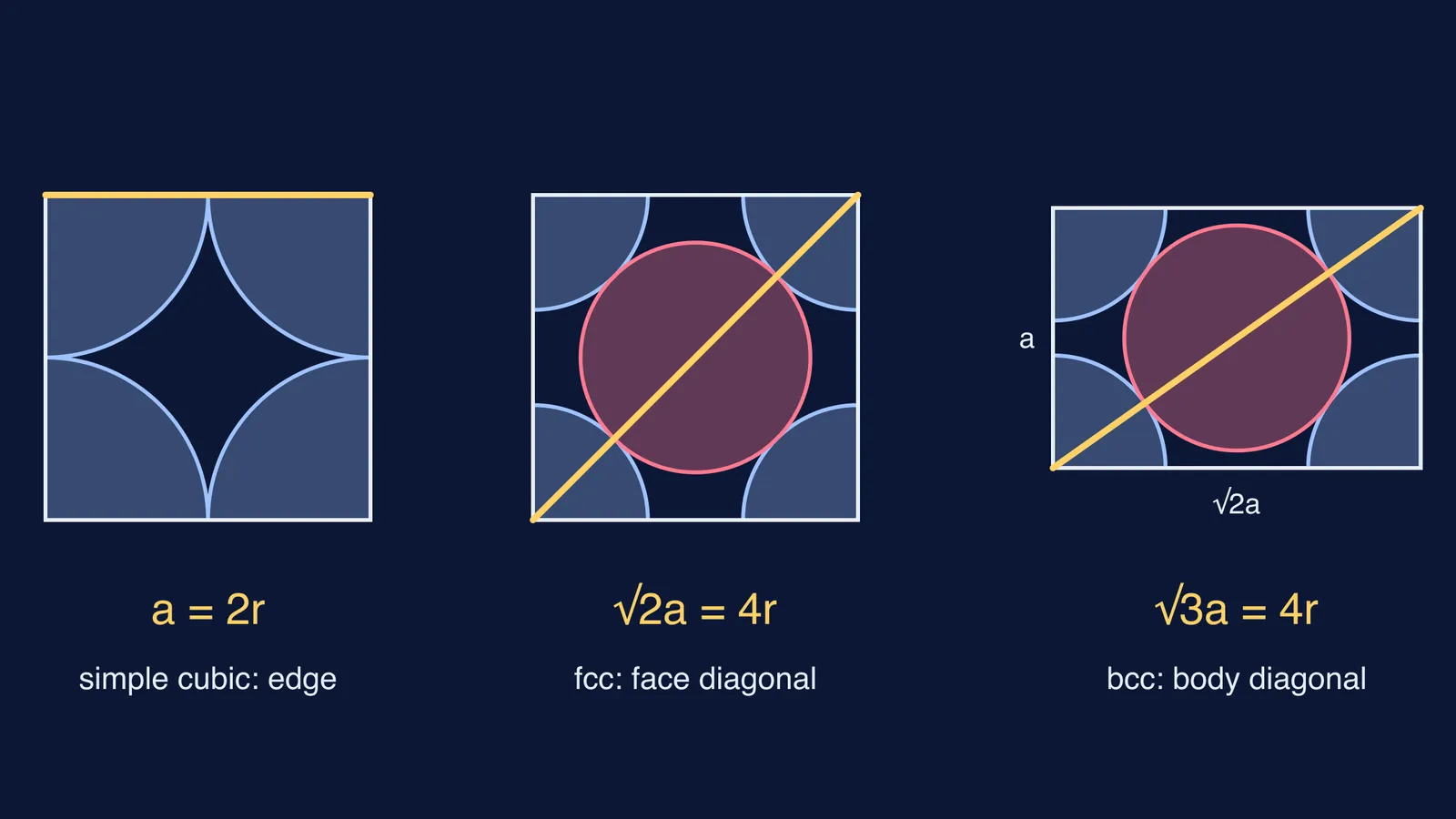
Three formulas sit behind many solid-state numericals: a = 2r, √2a = 4r and √3a = 4r. Memorised as a list, they get mixed up under exam pressure. You do not need to memorise them. Each one comes from a single question: along which straight line do the atoms touch? Once you can see that line, the formula follows from Pythagoras in two lines.
Below we derive all three, then use the fcc one to find the radius of a copper atom from its measured edge length.
What is the relation between edge length and atomic radius in a cubic unit cell?
Treat atoms as hard spheres of radius r sitting in a cube of edge a. The relations, as set out in this LibreTexts general chemistry chapter on crystal lattices and unit cells, are:
Simple cubic: atoms touch along the edge, so a = 2r.
Body-centred cubic (bcc): atoms touch along the body diagonal, so √3a = 4r.
Face-centred cubic (fcc): atoms touch along the face diagonal, so √2a = 4r, which is the same as a = 2√2r.
The same chapter gives the counts that go with each structure: 1 atom per unit cell in simple cubic, 2 in bcc and 4 in fcc, with about 52%, 68% and 74% of the space filled.
Why is a = 2r in a simple cubic cell?
In simple cubic, atoms sit only at the eight corners. Each edge has an atom at each end, and the two touch in the middle. So the edge holds one radius from each: a = r + r = 2r.
Why is √2a = 4r in fcc?
In fcc, every face has an extra atom at its centre, which pushes the corner atoms apart along the edge. Instead, draw the diagonal across one face. It passes through a corner atom, the face-centre atom and the opposite corner atom, and all three touch. That line holds one radius, then a full diameter, then one radius: r + 2r + r = 4r.
The face is a square of side a, so by Pythagoras its diagonal is √(a² + a²) = √2a. Set the two equal and you get √2a = 4r.
Why is √3a = 4r in bcc?
In bcc, the extra atom sits at the very centre of the cube. It touches the eight corner atoms, but only along the body diagonal, the line from one corner through the centre to the opposite corner. Again that line holds r + 2r + r = 4r.
To find the body diagonal, use Pythagoras twice. The face diagonal is √2a. The body diagonal is the hypotenuse of a right triangle whose sides are that face diagonal and one more edge: √(2a² + a²) = √3a. So √3a = 4r.
If the picture of the body diagonal still feels slippery, the Fermi Concept Library covers every concept in physics, chemistry, biology, mathematics and computing, each with its own lesson and its place in the map.
How do you find the atomic radius of copper from its fcc edge length?
Copper crystallises in a face-centred cubic structure with a lattice constant of 361.50 pm at 20 °C, according to the Wikipedia entry on copper. Here is the full working.
Identify the structure: fcc, so the atoms touch along the face diagonal.
Write the relation: √2a = 4r, so r = √2a / 4.
Substitute: r = 1.4142 × 361.50 pm / 4.
Multiply: 1.4142 × 361.50 ≈ 511.23 pm.
Divide: 511.23 / 4 ≈ 127.8 pm.
So the radius of a copper atom is about 127.8 pm, or 0.128 nm. As a check, the same Wikipedia entry on copper lists an empirical atomic radius of 128 pm, which matches to the precision you would report in an exam.
Try it with a bcc metal. The LibreTexts chapter works through molybdenum, a body-centred metal, and arrives at an edge length of 314 pm and a radius of 136 pm. Check: from √3a = 4r, a = 4 × 136 / 1.732 ≈ 314 pm.
Which mistakes cost marks in these questions?
Use this checklist before you submit an answer:
Wrong touching line: using a = 2r for fcc or bcc gives a radius that is too large. Name the line first.
Mixing the two diagonals: √2 belongs to the face (fcc), √3 to the body (bcc). A quick memory aid: a face is 2D, so √2; the body is 3D, so √3.
Diameter for radius: the touching line holds 4r, which is two diameters, not 4 diameters.
Units: keep picometres throughout, and convert only at the end (1 Å = 100 pm).
Sense check: an answer of 12.8 pm or 1278 pm for copper means a slipped decimal.
When you want more practice, the Fermi Problem Library has worked problems with a step-by-step solver that explains the reasoning rather than printing an answer, which can help you see where a wrong diagonal crept in.
Next step: take one density-of-unit-cell question tonight and solve it starting from the touching line, not from a memorised formula.