On this page
A metal aeroplane wing is a long conductor moving fast through Earth's magnetic field. That makes it the sliding rod from your textbook, just 30 metres long and flying. The problem tests three things: picking the right part of Earth's field, converting the speed, and not claiming that a current flows.
What formula gives the emf between the wing tips?
The NCERT Class 12 chapter on electromagnetic induction (Section 6.6) shows that a straight conductor of length l, moving with speed v perpendicular to a uniform field B, develops a motional emf ε = Blv across its ends. The same section derives it from the Lorentz force: each free charge feels a force qvB along the rod, and the work done per unit charge from end to end is Blv.
For the plane, the "rod" is the wing from tip to tip, so l is the wingspan. The only real question is which B to use.
Why does only the vertical component of Earth's field count?
Earth's field at most places points partly along the ground and partly into it. The angle it makes with the horizontal is the dip, or inclination; our explainer on why a compass needle dips from equator to poles shows it.
In level flight, the velocity and the wing are both horizontal. The force on a charge is q(v × B), so take each part of the field in turn:
The horizontal component is either parallel to v (no force) or makes v × B point straight up or down, pushing charges through the thickness of the wing, not along it.
The vertical component is perpendicular to v, so v × B lies flat and sideways, exactly along the wing.
Only the vertical component, Bᵥ, drives charge from tip to tip, so ε = Bᵥ L v. In level flight the heading does not matter: the vertical component is always perpendicular to the motion.
Worked example: 30 m wingspan at 900 km/h
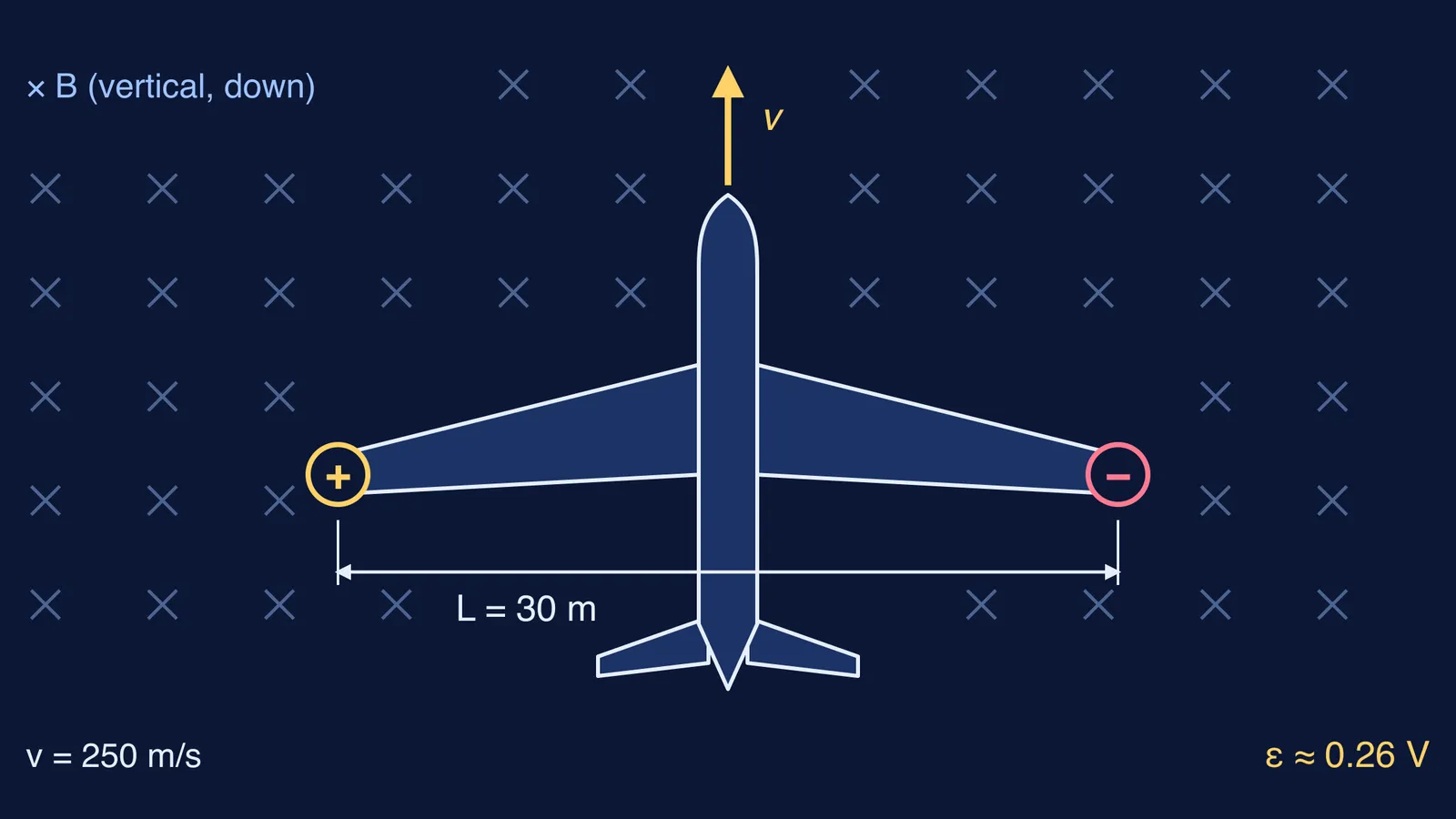
Take a plane with a 30 m wingspan cruising at 900 km/h over New Delhi.
Convert the speed: 900 × 1000 ÷ 3600 = 250 m/s.
Find Bᵥ. The British Geological Survey's IGRF calculator uses the International Geomagnetic Reference Field, 14th generation. Its IGRF-14 values for New Delhi on 1 November 2026 give a vertical intensity of 34,814 nT and an inclination of 45.5°.
Check the altitude. At 11 km above Delhi, the same model gives 34,599 nT, under 1% less, so use Bᵥ ≈ 3.48 × 10⁻⁵ T.
Multiply: ε = (3.48 × 10⁻⁵ T)(30 m)(250 m/s) ≈ 0.26 V.
Now fly the same plane over Thiruvananthapuram, near the magnetic equator. The IGRF-14 values there give a total intensity of 40,873 nT but an inclination of only 4.0° and a vertical intensity of 2,826 nT. The emf drops to (2.83 × 10⁻⁶)(30)(250) ≈ 0.021 V, about 12 times smaller than over Delhi.
Which wing tip is positive?
Use v × B for a positive charge. In the northern hemisphere Bᵥ points down. Face forward with B pointing at the floor, and v × B points to your left. So over Delhi the left wing tip is at the higher potential, whatever the heading. Where Bᵥ points up, in the southern magnetic hemisphere, the right tip is positive. For the general method, see which end of a moving rod is positive.
Can the plane use this voltage?
No, and it is a common follow-up question. To measure the 0.26 V you would run wires from each tip to a voltmeter in the cabin. Those wires fly with the wing, cut the same field, and pick up an equal emf the other way round the loop. The loop moves rigidly through an almost uniform field, so the flux through it does not change and no current flows.
What mistakes cost marks on this problem?
Using the total field. Delhi's total intensity of 48,818 nT, from the same IGRF-14 values, gives about 0.37 V, which is wrong.
Using the horizontal component. That suits a wire falling vertically, as in NCERT Exercise 6.6, not a plane in level flight.
Forgetting to convert km/h to m/s, which inflates the answer 3.6 times.
Writing that a current flows between the tips.
If direction questions are where you lose marks, read our three common mistakes in finding induced current direction. For more motional emf numericals, the Fermi Problem Library has worked problems with a step-by-step solver that explains the reasoning rather than printing an answer. If dip, flux or the Lorentz force feels shaky, each has its own lesson in the Fermi Concept Library.