

On this page
Let a magnetised needle swing up and down as well as sideways, and it will not stay level. It tilts to line up with Earth's magnetic field, by an amount that depends on where you stand. Below, you predict that tilt for seven places and check each guess against the official model.
Why does a compass needle dip at different places?
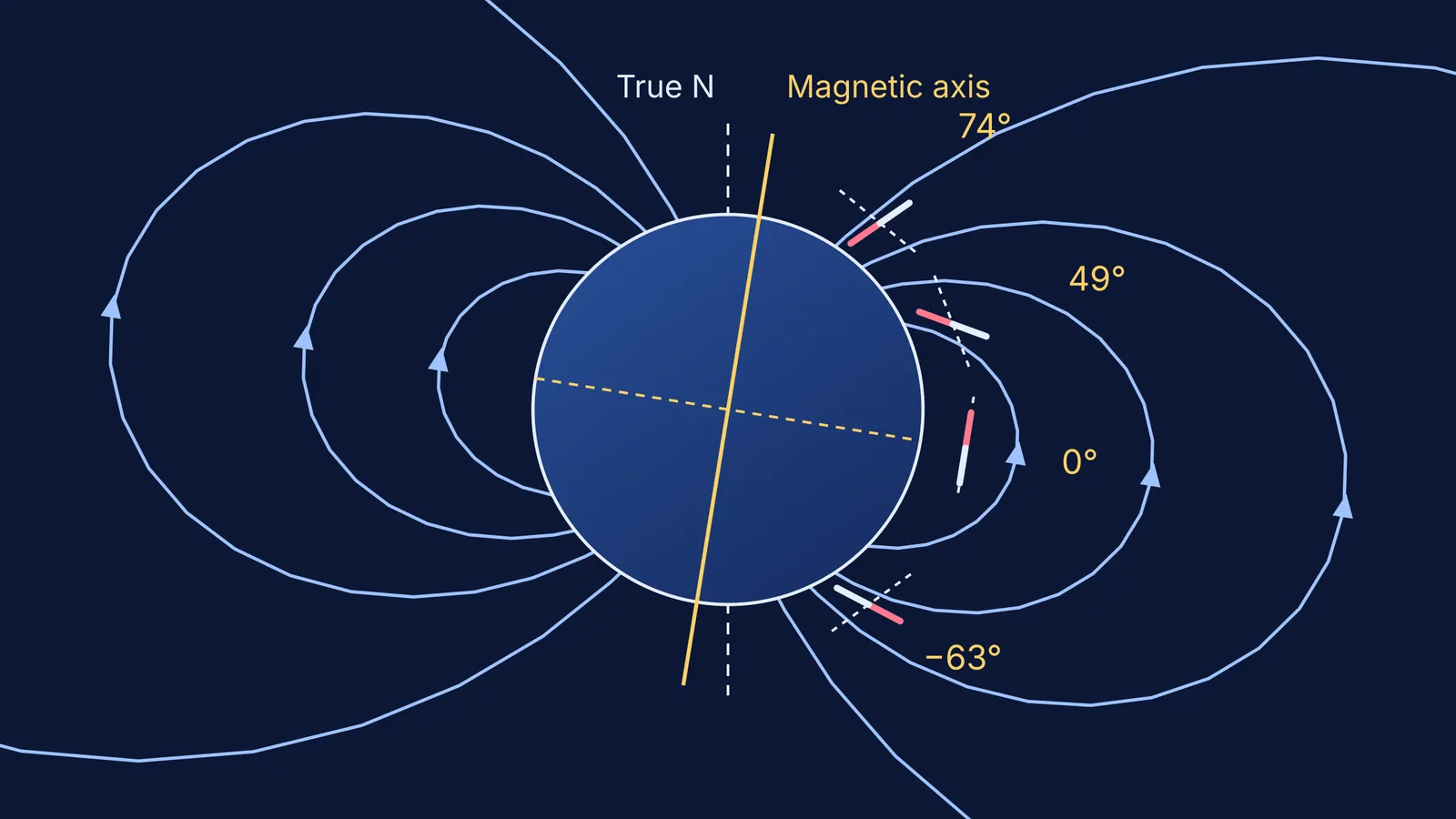
Earth's field looks roughly like the field of a bar magnet near the centre of the planet. More than 90% of the field measured at the surface is generated in Earth's liquid outer core, according to NOAA's geomagnetism FAQ. Field lines leave the ground in the southern hemisphere, arc over the equator and dive back in up north, so their slope changes with latitude.
The same NOAA FAQ defines two angles:
Inclination (dip) is the angle between the horizontal plane and the total field, counted positive when the field points into Earth.
Declination is the angle between magnetic north and true north.
The magnetic equator is the line where dip is zero, and the magnetic (dip) poles are where the field is vertical, according to the NOAA FAQ. A flat compass follows only the horizontal part of the field; a dip circle lets the needle swing vertically and shows the full angle. Our guide to reading electric and magnetic field lines without common mistakes covers the drawing rules.
What dip angle should you predict at the equator, in India and near the poles?
For a perfect bar-magnet (dipole) field, dip I and magnetic latitude are linked by tan I = 2 tan(latitude), as set out on Wikipedia's magnetic dip page. As a first guess, use the ordinary map latitude. Then compare with the World Magnetic Model (WMM2025), which we queried through the British Geological Survey's WMM calculator service for 26 October 2026.
Worked example for Delhi (28.6° N): tan I = 2 × tan 28.6° = 2 × 0.545 = 1.09, so I is about 47.5°. The model gives 45.5°. Close.
Guess first, then check the model value:
Equator at 77° E, south of Kanyakumari: predict 0°; model −17.0° (north end tilts up).
Thiruvananthapuram (8.5° N): predict 16.7°; model 4.0°.
Chennai (13.1° N): predict 24.9°; model 14.8°.
Mumbai (19.1° N): predict 34.7°; model 28.3°.
Delhi (28.6° N): predict 47.5°; model 45.5°.
Leh (34.2° N): predict 53.6°; model 53.5°.
Longyearbyen, Svalbard (78.2° N): predict 84.0°; model 82.5°.
The biggest misses are in the south. The magnetic equator does not follow the geographic one: going by these model values, in India it runs a little south of the southern tip, so a needle in Thiruvananthapuram sits almost flat. The best-fit dipole axis is tilted 9.21° from Earth's spin axis, according to NOAA's page on the wandering geomagnetic poles, and the real field has extra non-dipole parts on top.
The same NOAA pole page gives the 2025 location of the North Magnetic Pole as 85.762° N, 139.298° E, moving north-northwest at about 55 km per year. At that spot the BGS calculator returns a dip of 89.9°: the needle stands almost straight down.
Why is compass north not true north?
A compass points along the horizontal part of the magnetic field where it sits, not at any single point, as NOAA's FAQ explains. The angle between that direction and true north is the declination, and it changes from place to place.
In the same WMM2025 calculation, declination is 1.7° west in Thiruvananthapuram, almost zero in Mumbai, 1.3° east in Delhi and 2.4° east in Leh. Elsewhere it is far bigger: 12.9° east in Svalbard, and about 82° west at India's Bharati station) in Antarctica, where a compass points closer to west than to true north. For the history, read about Shen Kuo and why compasses miss true north, and William Gilbert's idea that the Earth is a magnet.
The field also drifts, so the WMM, which smartphone compass apps rely on, is updated at least every five years, according to NOAA's WMM2025 release note.
How can you check your predictions yourself?
Pick three places: your town, one near the equator, one far north or south.
Predict each dip with tan I = 2 tan(latitude) and write it down.
Sketch the field lines and draw a short needle along each.
Enter the places in the BGS WMM calculator and note dip and declination.
For any gap over 5°, write one sentence explaining it: tilted axis, shifted magnetic equator, or non-dipole field.
Check a component. H = F cos I, so Delhi's total field of 48,831 nT gives 48,831 × cos 45.5° ≈ 34,200 nT, matching the model's 34,224 nT.
If a tilted field in three dimensions is hard to hold in your head, the Fermi Simulation Lab has interactive simulations for ideas that are easier to see than to read.
Start with your own town: guess first, then open the calculator.


