

On this page
If a question shows a rod sliding through a magnetic field and asks which end is at higher potential, you do not need a separate rule for every diagram. You need one force law and one sign.
Why does one end of a moving rod become positive?
A metal rod is full of free electrons. When the rod moves with velocity v through a magnetic field B, every charge inside it moves too, so each one feels the magnetic force F = qv × B (OpenStax University Physics Volume 2, section 13.3). OpenStax College Physics puts it plainly: the magnetic force "moves opposite charges in opposite directions" and so produces an EMF (OpenStax College Physics 2e, section 23.3).
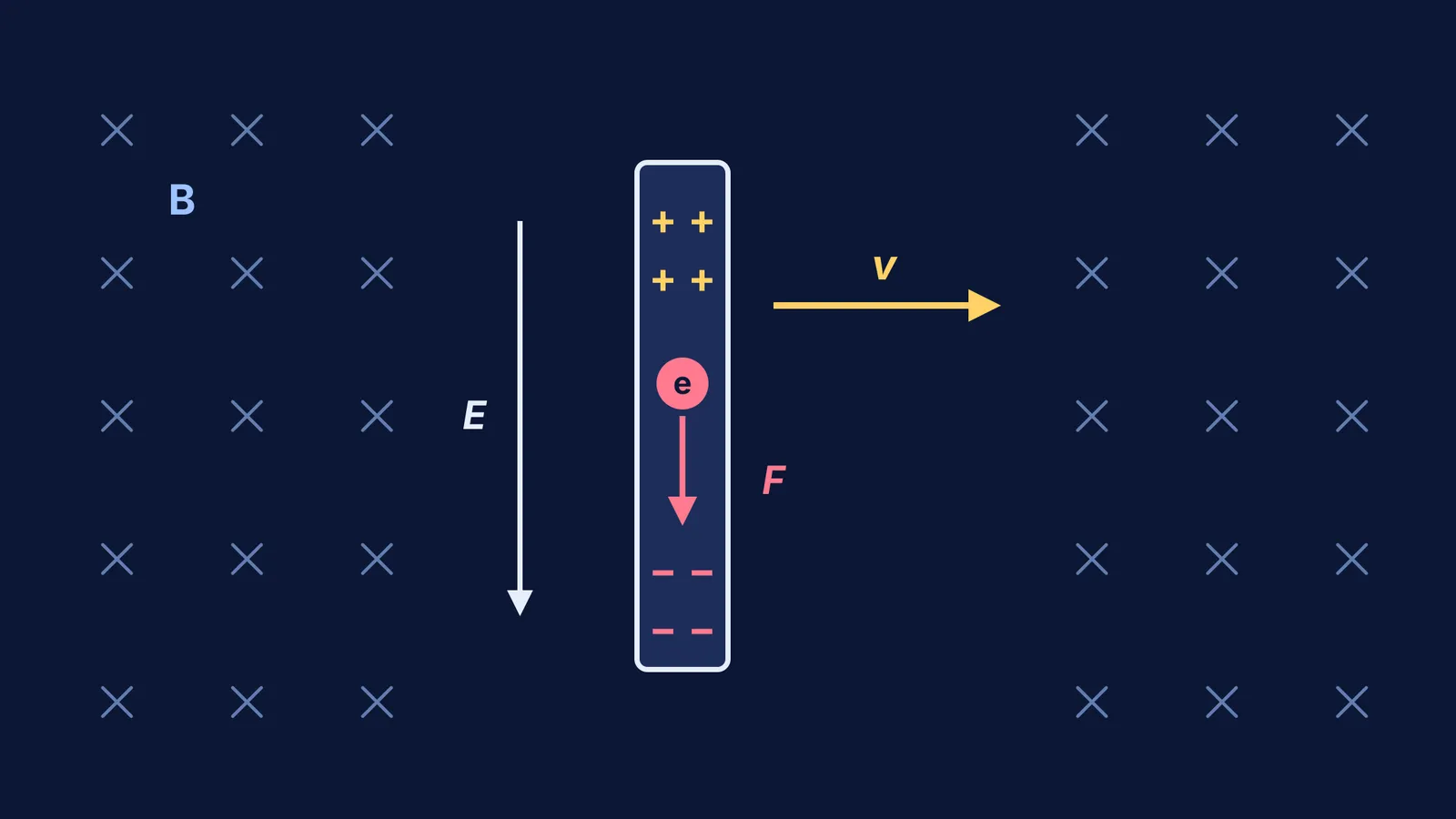
Electrons carry negative charge, so the force on them points opposite to v × B. They collect at one end, making it negative. The other end is left short of electrons, so it is positive.
The pile-up does not go on forever. The separated charge sets up an electric field E inside the rod that pushes back on the electrons, and the drift stops when qE = qvB, that is, when E = vB (Boston University motional EMF notes). Across a rod of length L, the motional EMF is BLv when B, L and v are mutually perpendicular (OpenStax College Physics 2e).
How do you find the positive end in three steps?
Mark the directions of v and B on the diagram, with dots for out of the page and crosses for into it.
Work out v × B as if the charge were positive: point your right-hand fingers along v, curl them toward B, and your thumb gives v × B. Keep only the part of that direction that lies along the rod.
The end v × B points to is positive (higher potential). The other end, where electrons collect, is negative.
The moving rod acts like a cell: in a closed circuit, current inside the rod flows toward the positive end.
Worked example: a rod moving right in a field into the page
Take a vertical rod of length 0.5 m sliding to the right at 4 m/s through a uniform 0.2 T field pointing into the page, as in the diagram above.
v points right and B points into the page.
Right × into the page = up. With axes: x̂ × (−ẑ) = +ŷ. So v × B points to the top of the rod.
The top end is positive. Electrons are pushed down and collect at the bottom, which is negative.
Size: EMF = BLv = 0.2 × 0.5 × 4 = 0.4 V.
Inside the rod, E = vB = 0.8 V/m, pointing from top to bottom; times 0.5 m, that is again 0.4 V.
Now check it with Lenz's law. Suppose rails on the left close the loop. As the rod moves right, the loop grows and the flux into the page increases. The induced current must oppose that, so it makes a field out of the page and runs anticlockwise, which means upward through the rod, toward the positive top end. OpenStax works the same rod-on-rails setup with Lenz's law and also finds the top of the rod positive (OpenStax College Physics 2e).
Now change one thing at a time:
Reverse v (rod moves left): the bottom becomes positive.
Reverse B (field out of the page): the bottom becomes positive.
Reverse both: the top is positive again.
Slide the rod along its own length: v × B is perpendicular to the rod, so no EMF appears between its ends.
If the velocity is tilted, only part of the motion counts; we work through that case in induced EMF when a rod's velocity is not perpendicular.
What mistakes cost marks on this question?
Labelling the electrons' end positive. The force on an electron is −e(v × B). The end electrons are pushed to is the negative end.
Thinking current runs from + to − inside the rod. Inside the source it runs toward the positive end. Outside, in the resistor, it runs from + to −.
Assuming no circuit means no EMF. An isolated rod still has charged ends and a potential difference; see whether an EMF is induced in an open circuit without current.
Skipping the Lenz check. When the rod closes a loop, the current you predict must oppose the change in flux, which is why Lenz's law follows from conservation of energy.
How should you practise rod-polarity questions?
Sketch the four versions of the worked example (as given, v reversed, B reversed, both reversed). For each, find the polarity from the cross product, then check it with Lenz's law. If the answers disagree, find where the sign flipped.
For more cases, work problems in the Fermi Problem Library, where the step-by-step solver explains the reasoning rather than printing an answer. If the cross product itself feels shaky, the Fermi Concept Library gives each concept its own lesson.


