

On this page
The standard formula for motional electromotive force (EMF), ε = Blv, assumes that the magnetic field (B), the rod's length (l), and its velocity (v) are all mutually perpendicular. But what happens if the rod is moving at an arbitrary angle?
Whether you are analysing an aircraft's wings in Earth's magnetic field for a physics exam or predicting the behaviour of orbiting satellites, you have to account for that angle.
Why does a moving rod generate an EMF?
When a conducting rod moves through a magnetic field, the free electrons inside it move with the rod. Because these electrons are moving through a magnetic field, they experience a magnetic force, known as the Lorentz force.
The force on a charge q moving with velocity v in a magnetic field B is given by F = q(v × B). This force pushes free electrons toward one end of the rod, leaving the other end positively charged. The separation of charge creates an internal electric field, which builds up until the electric force perfectly balances the magnetic force. The resulting potential difference between the ends of the rod is the motional EMF.
If you are struggling to picture the forces acting on individual charges in three dimensions, the Fermi Simulation Lab lets you run the experiment interactively and watch the electrons accumulate at the ends.
How to handle velocity at an angle?
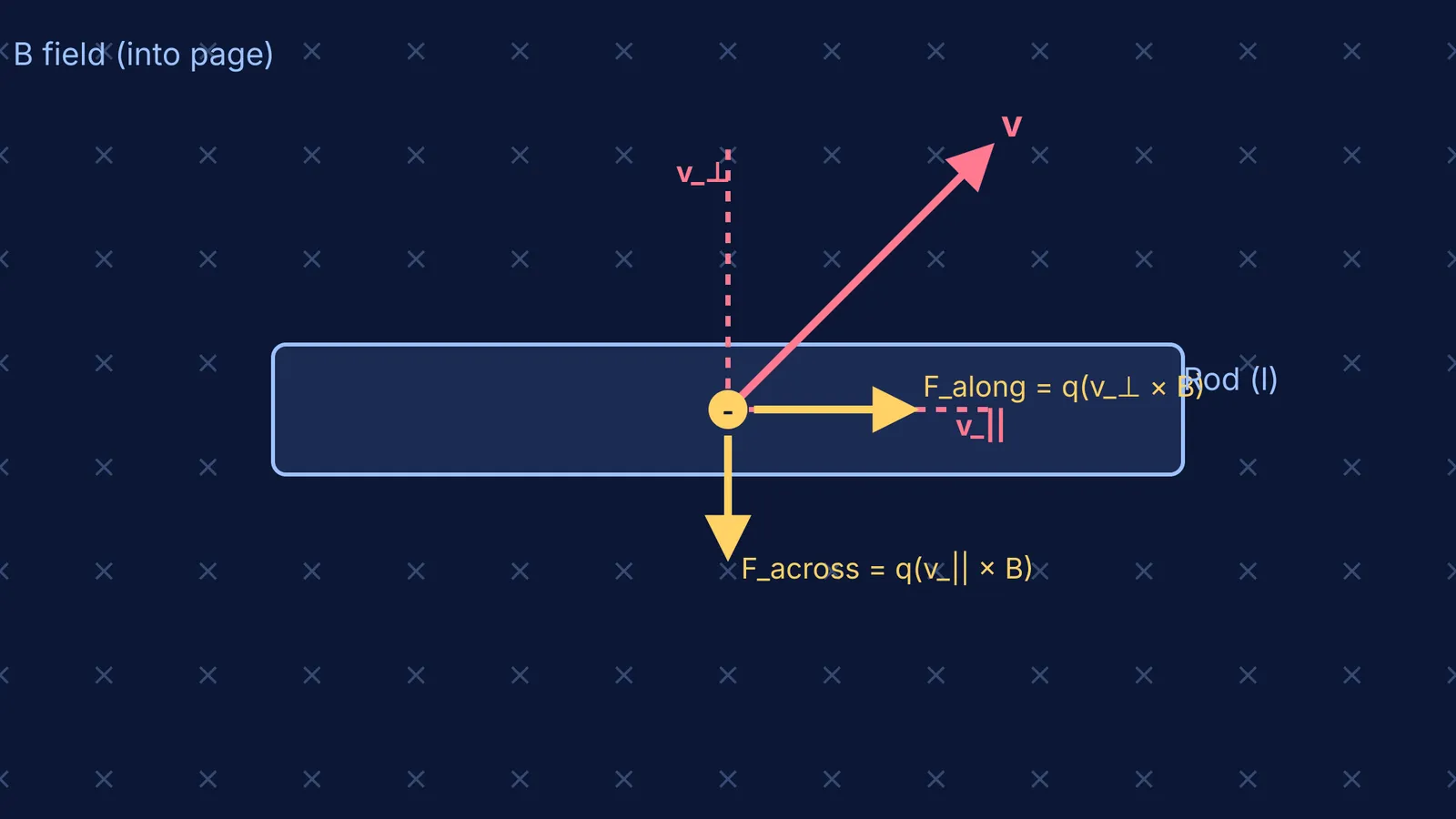
If the velocity vector is not perfectly perpendicular to the rod, we can break it down into two components:
v_||, the component of velocity parallel to the rod's length.
v_⊥, the component of velocity perpendicular to the rod's length.
Let us look at the Lorentz force from each component. Assuming the magnetic field B is uniform and perpendicular to the plane of motion, the cross product (v × B) rotates the velocity vector by 90°.
The parallel component (v_||): The magnetic force generated by v_|| pushes charges *across the width* of the rod, rather than along its length. Because the rod is narrow, charges cannot move very far in this direction. This sideways force does not push charges to the ends of the rod, so it contributes nothing to the motional EMF.
The perpendicular component (v_⊥): The magnetic force generated by v_⊥ pushes charges *along the length* of the rod. This is the force that separates the charges and creates the potential difference.
This is why only the perpendicular component of velocity matters. The induced EMF is given by ε = B l v_⊥. If the velocity v makes an angle θ with the rod, then v_⊥ = v sin θ, making the formula ε = B l v sin θ.
The vector formula: ε = (v × B)·l
In three dimensions, the complete formula for the motional EMF of a straight rod is the scalar triple product:
ε = (v × B)·l
Here is how the mathematics of the triple product matches the physical reality of the moving charges:
The cross product (v × B) gives the direction and magnitude of the magnetic force per unit charge.
The dot product with the length vector l extracts only the component of that force that acts *along* the axis of the rod.
If any two of the three vectors (v, B, or l) are parallel, the scalar triple product evaluates to zero, meaning no EMF is induced. For example, if a rod moves exactly along its own length, the magnetic force (v × B) is entirely perpendicular to l, making the dot product zero.
A worked example in Earth's magnetic field
Motional EMFs on Earth are normally too small to notice. A 1.0-m rod moving at 3.0 m/s perpendicular to the Earth’s field (typically around 0.5 × 10⁻⁴ T) gives an EMF of just 150 μV, according to the OpenStax University Physics text.
However, consider an aircraft with a wingspan of 60 m flying horizontally at 250 m/s, a common textbook scenario. If the Earth's vertical magnetic field component is 5.0 × 10⁻⁵ T, the EMF between the wingtips is calculated as: ε = B l v = (5.0 × 10⁻⁵ T) × (60 m) × (250 m/s) = 0.75 V.
Now, suppose the aircraft climbs at an angle of 30° to the horizontal. The wings (l) are still horizontal, but the velocity (v) is tilted. The component of velocity perpendicular to the vertical magnetic field is now v cos 30°. The formula becomes ε = B l (v cos 30°), which reduces the induced EMF to roughly 0.65 V.
A step-by-step checklist for problems
When you encounter a motional EMF problem with strange angles, do not just plug numbers into ε = Blv. Follow these steps to avoid mistakes:
Check for parallel vectors: If the velocity is parallel to the magnetic field, or if the rod is moving perfectly along its own length, the EMF is instantly zero.
Find the effective velocity: Identify the component of velocity that is perpendicular to both the magnetic field and the rod itself.
Find the effective length: If the conducting rod is bent or curved, replace it with the straight-line displacement vector l connecting its start and end points.
Calculate: Multiply the magnetic field strength, the effective length, and the effective perpendicular velocity together.
If you consistently forget to check the components before multiplying, the AI tutor in the Fermi Problem Library notices where you are stuck and decides whether to explain, ask or show you how to break vectors down.


