

On this page
When students first encounter electromagnetic induction, Heinrich Lenz's 1834 rule is often introduced as a mnemonic: nature opposes a change in flux. But Lenz's law is a direct requirement of the conservation of energy. In his 1834 paper in *Annalen der Physik* (DOI: 10.1002/andp.18341073103), Heinrich Lenz showed that an induced current always produces forces opposing the motion of the conductor. In 1847, Hermann von Helmholtz formalized this in his treatise *Über die Erhaltung der Kraft* (Internet Archive), proving that electromagnetic induction is a necessary consequence of the conservation of energy.
What happens if the induced current reinforces the motion?
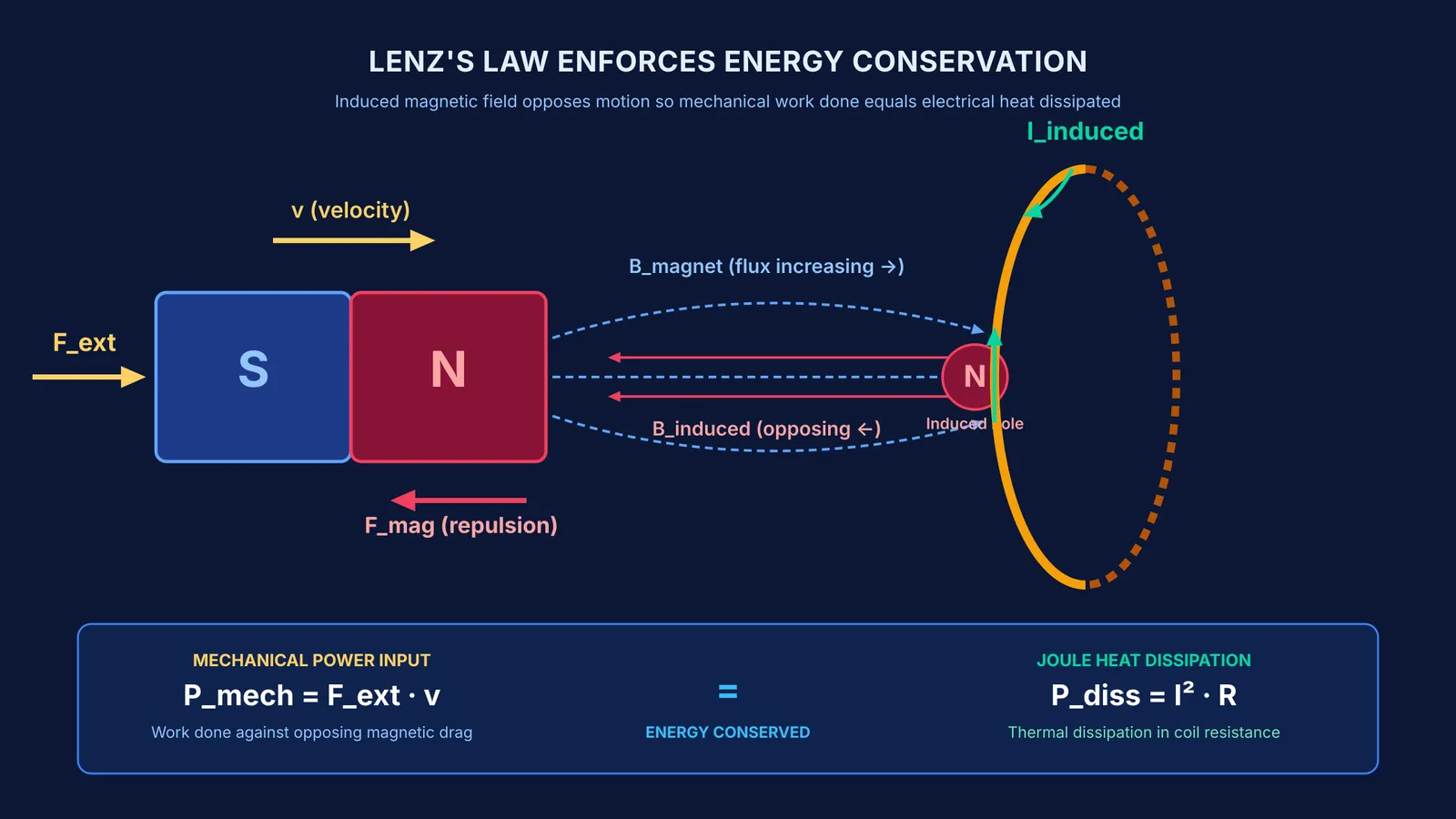
Consider what happens if Lenz's law had the opposite sign. Suppose you give the north pole of a bar magnet a gentle nudge toward a closed copper ring.
As the magnet approaches, the magnetic flux increases. If the induced current reinforced this change, the near face of the ring would become a south pole, pulling the magnet inward without further effort.
Once released, the magnet would accelerate toward the coil at an ever-increasing rate. Its kinetic energy would grow continuously while circulating current simultaneously generated electrical energy. You would get mechanical speed and electrical current from nothing. As explained in OpenStax University Physics Volume 2, this runaway positive feedback loop describes a perpetual motion machine. Because energy cannot be created from nothing, nature forbids this polarity: the facing coil face must develop a north pole, producing an opposing repulsive force.
How does mechanical work convert into Joule heat?
To maintain a steady velocity against this magnetic repulsion, you must exert an external force. The work you do is the source of the electrical energy circulating in the loop.
Consider a conducting rod of length L sliding at constant speed v along frictionless rails of resistance R across a uniform perpendicular magnetic field B. The motional electromotive force is ε = B · L · v, driving an induced current I = ε / R = (B · L · v) / R.
The magnetic field exerts an opposing Lorentz force on the moving rod: F_mag = I · L · B = (B² · L² · v) / R
To maintain constant speed, an external agent must apply an equal pushing force F_ext = F_mag. The mechanical power input supplied by this push is: P_mech = F_ext · v = (B² · L² · v²) / R
Meanwhile, the electrical energy dissipates as Joule heat: P_diss = I² · R = (B² · L² · v²) / R
As shown in OpenStax University Physics Volume 2's treatment of motional EMF, P_mech equals P_diss exactly. Mechanical work done against the magnetic drag converts directly into thermal energy in the coil. If left without an external push, that same magnetic force decelerates the rod, converting 100% of its initial kinetic energy into heat.
Why is the negative sign in Faraday's law essential?
In Faraday's law of induction, Lenz's law appears as a single minus sign: ε = − dΦ / dt
Without that minus sign, the mathematics would describe an unstable runaway system. A changing magnetic field induces a non-electrostatic electric field that circulates around magnetic flux lines, as seen in our guide to circulating electric fields inside a solenoid. When that electric field drives current around a loop, the secondary magnetic field opposes the original flux change.
Whether examining a magnet falling down a copper tube, a conducting coil entering a magnetic field, or eddy current brakes, opposition is the physical mechanism that balances nature's energy ledger.
How can you test energy balance in an induction problem?
When tackling induction problems for CBSE Class 12 or JEE Advanced, a 4-step energy audit confirms whether your current directions are physically valid:
Identify the motion: Note whether the conductor is pushed, pulled, or rotated, and whether flux increases or decreases.
Check the opposition: The induced magnetic force must oppose the motion, and the induced field must counter the flux change.
Find current direction: Apply the right-hand rule to match the opposing field. If your result causes spontaneous acceleration, reverse the sign.
Verify power balance: Confirm that mechanical power input (F_ext · v) equals electrical dissipation (I² · R).
Applying the motional EMF relations from OpenStax University Physics, consider a rod of length L = 0.50 m moving at v = 4.0 m/s across rails in a field B = 1.2 T with circuit resistance R = 2.0 Ω:
Motional EMF: ε = B · L · v = 1.2 T × 0.50 m × 4.0 m/s = 2.4 V
Induced current: I = 2.4 V / 2.0 Ω = 1.2 A
Opposing magnetic drag: F_mag = I · L · B = 1.2 A × 0.50 m × 1.2 T = 0.72 N
Mechanical power input: P_mech = F_ext · v = 0.72 N × 4.0 m/s = 2.88 W
Electrical heat dissipation: P_diss = I² · R = (1.2 A)² × 2.0 Ω = 2.88 W
The mechanical power supplied equals the thermal power dissipated (2.88 W = 2.88 W).
For students finding the induced current direction in circuit loops, checking energy balance prevents sign errors. When you work through multi-step electromagnetic induction numericals where directions and energy balances interact, the Fermi Problem Library provides worked problems with a step-by-step solver that explains the reasoning rather than printing an answer. To explore how induction fits into the wider map of field equations and thermodynamic constraints, the Fermi Concept Library covers every concept in physics, chemistry, biology, mathematics and computing, each with its own lesson and its place in the map.


