

On this page
You can know Faraday's law by heart and still draw the induced current the wrong way round. In a board exam or JEE Main, one wrong arrow costs the whole answer.
Why do students get induced current direction wrong?
You are not alone. A 2019 case study of Italian high school students, graduate students and teachers by Cavinato, Giliberti and Giliberti found that some deep misunderstandings of electromagnetic induction are common at all levels; its questionnaire went to 49 students. Zuza and colleagues note that research shows the basic ideas of induction are barely understood by students, while traditional teaching spends most of the time on rote problem-solving.
Sağlam and Millar's 2006 study of upper secondary students found confusion between change, and rate of change, of variables such as magnetic flux, as a 2025 review summarises it.
Is magnetic flux the same as magnetic field?
No. The magnetic field B is a vector at a point. Magnetic flux is one number for a whole surface: OpenStax University Physics defines it as the integral of B · n̂ dA, "a measurement of the amount of magnetic field lines through a given surface area".
Only a changing flux induces an emf, and flux changes in three ways: B, the area inside the field, or the angle between them. A strong, steady field through a still loop gives zero emf. For more, see the difference between magnetic field and magnetic flux.
Which way does the area vector point?
The area vector is perpendicular (normal) to the loop, not along its surface. That causes two common errors.
Wrong angle. If the question gives the angle between B and the plane of the loop, flux is BA sin θ, not BA cos θ. A loop of area 0.02 m² in a 0.5 T field at 30° to its plane has flux 0.5 × 0.02 × sin 30° = 0.005 Wb. Using cos 30° gives about 0.0087 Wb, which is wrong.
Wrong area. Count only the part of the loop where the field is. A loop half-way into a field region has flux B times the area inside the field.
Your choice of normal also fixes which way round the loop counts as positive (right-hand rule). Pick one and keep it.
Does Lenz's law oppose the field or the change in flux?
The change. OpenStax's statement of Lenz's law says the induced emf drives a current that will "always oppose the change in magnetic flux that causes the emf". The same page adds that the induced field opposes a flux that is increasing and reinforces one that is decreasing.
The classic mistake is to make the induced field point opposite to B every time. Bagno and Eylon (1997) noted that the usual statement of the law "might be misinterpreted as the induced current is in the opposite direction of the magnetic field that produced the change of magnetic flux", as a 2010 paper by Sağlam reports. When flux is falling, the induced field points the same way as B.
How do you find the direction of induced current every time?
Use these four steps, in this order:
Which way does B point through the loop? Draw the arrow.
Is the flux increasing or decreasing? Check B, the area inside the field and the angle. This is about the change, not the size.
Which way must the induced field point? Opposite to B if flux increases; the same as B if it decreases.
Which way does the current flow? Point your right thumb along the induced field; your fingers curl the way the current flows.
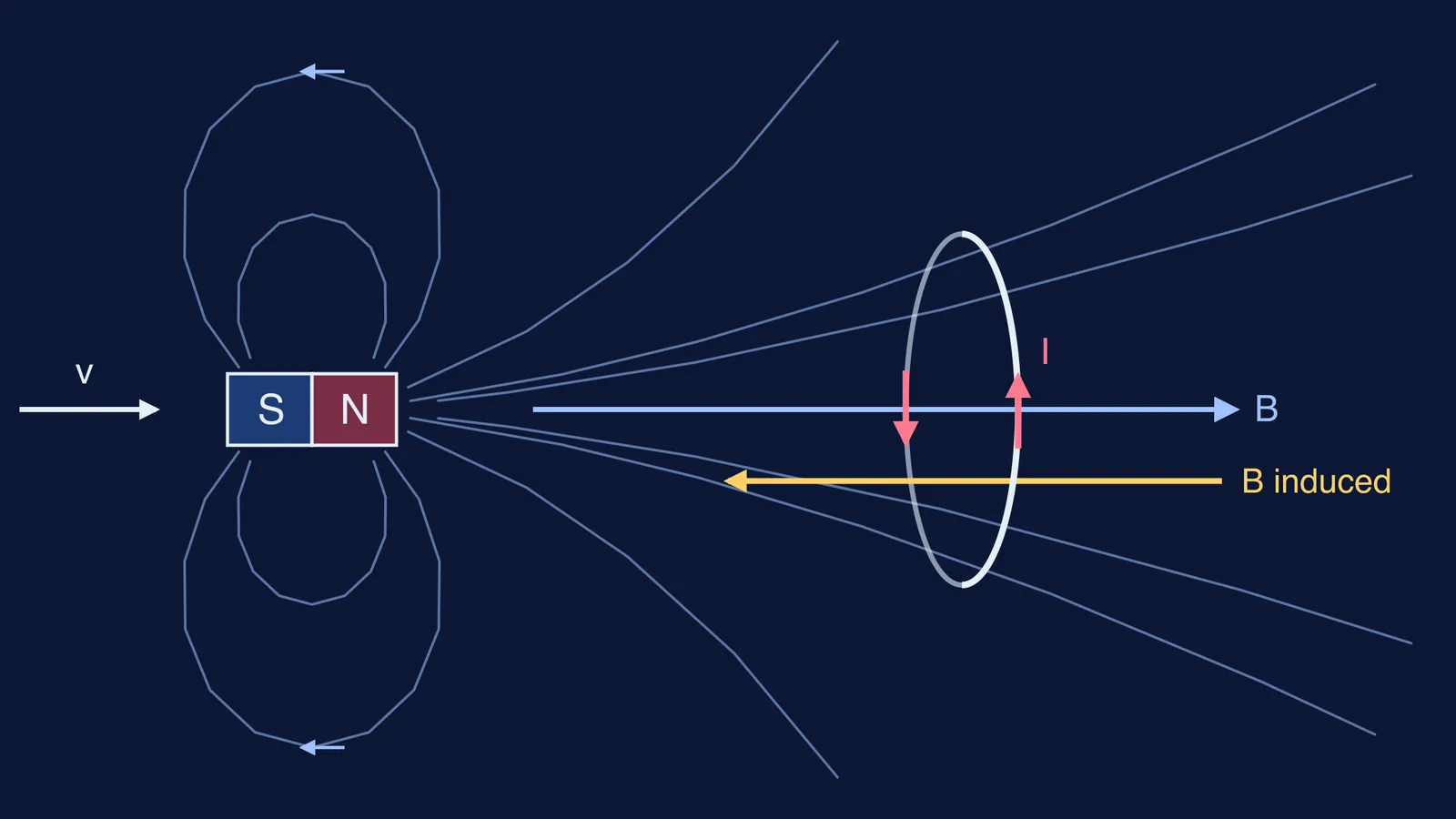
Worked example 1 (the diagram above). The N pole of a bar magnet moves towards a ring. B through the ring points away from the magnet and grows as it nears, so the induced field points back towards the magnet. Seen from the magnet's side, the current is anticlockwise, and that face of the ring acts as a north pole that pushes back.
Worked example 2. A field into the page through a square loop is decreasing. So the induced field also points into the page, making up for the loss, and the current is clockwise. Skip step 2 and you answer "anticlockwise".
How do you practise until it sticks?
Mix question types: magnets moving in and out, loops entering fields, rotating coils, fields that grow and shrink. Write the four steps before any formula, and when you slip, label the mistake: flux vs field, area vector, or field vs change. Then try finding the induced current direction with Faraday's and Lenz's laws and reading induced emf from a flux-time graph, where step 2 means reading the slope.
The Fermi Problem Library has worked problems with a step-by-step solver that explains the reasoning rather than printing an answer, so you can see where your direction went wrong. If the geometry is hard to picture, the Fermi Simulation Lab has interactive simulations for ideas that are easier to see than to read.


