

On this page
The language of electromagnetism can seem dense when you first meet it. The hardest hurdle is often telling apart closely related ideas that sound almost the same.
Two of the most frequently confused terms are magnetic field and magnetic flux. While they are intimately related, one is a property of space itself, and the other depends entirely on a surface you choose to draw.
What is the difference between magnetic field and magnetic flux?
A magnetic field (B) is a vector quantity that describes the strength and direction of magnetic influence at any single point in space. It exists whether or not there is a surface or a wire loop present. In the SI system, the magnetic field is measured in teslas (T). If you place a compass at a particular point, the magnetic field dictates which way the needle points and how strongly it is pulled.
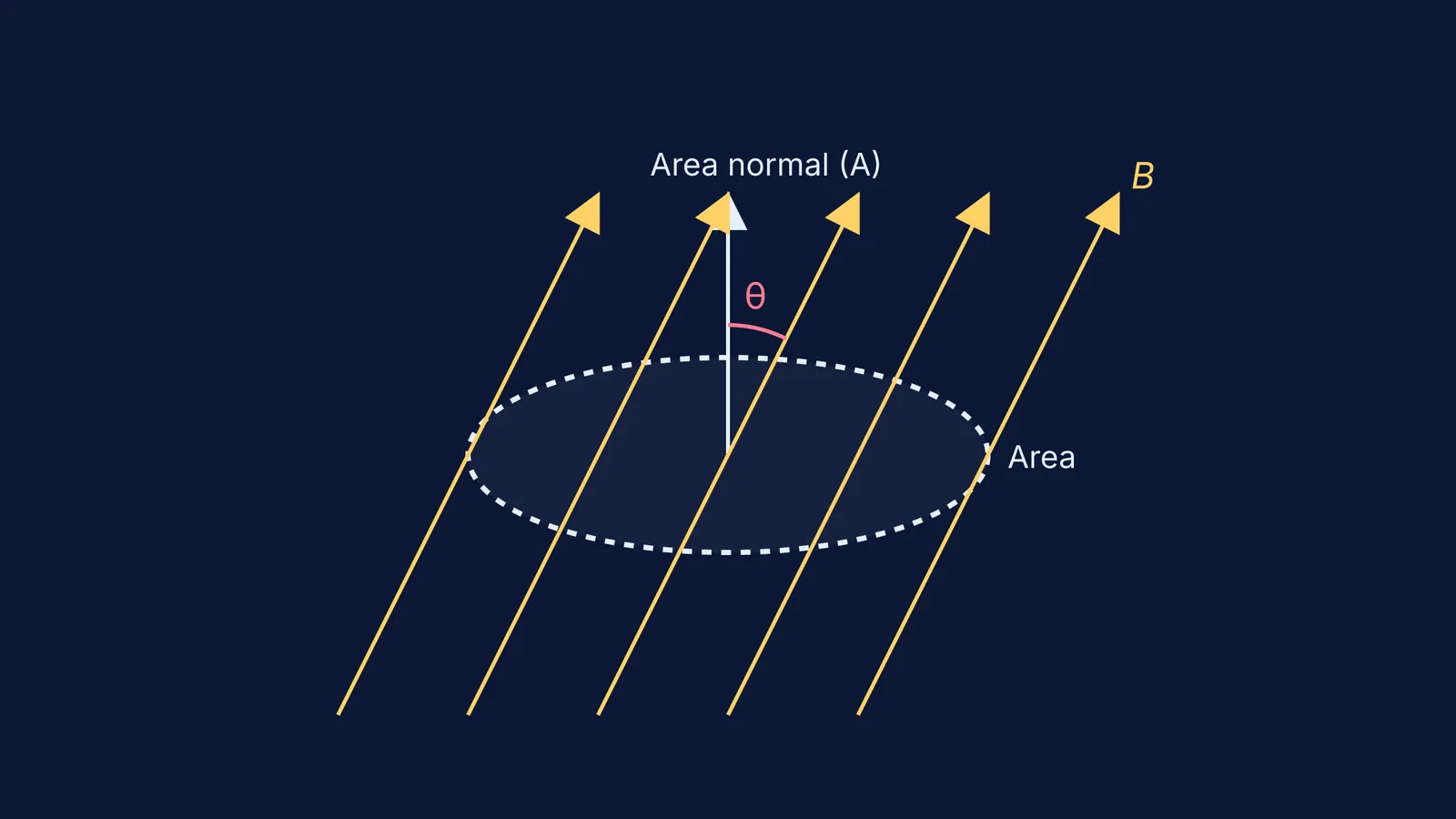
Magnetic flux (Φ), on the other hand, describes the total amount of magnetic field that passes through a specific surface area. It is not defined at a single point; it requires an area. The magnetic flux is calculated as the scalar product (dot product) of the magnetic field vector and the area vector (A):
Φ = B A cos θ
Here, θ is the angle between the magnetic field lines and the perpendicular "normal" line of the surface area.
Is magnetic flux a scalar or vector quantity?
Magnetic flux is a scalar quantity. Even though it is calculated by multiplying two vectors—the magnetic field and the area vector—their dot product yields a single number with no direction.
Because magnetic flux measures a "total amount" over an area, its unit reflects that multiplication. The SI unit of magnetic flux is the weber (Wb), and one weber is exactly equal to one tesla multiplied by one square metre (1 T·m²).
If the magnetic field is parallel to the surface (meaning it is perpendicular to the area vector, so θ = 90°), the field lines skim over the surface without crossing it. The cos 90° term becomes zero, and the magnetic flux is zero—even if the magnetic field itself is incredibly strong. If you have concept gaps when learning the rules of electromagnetism, the Fermi Concept Library has a lesson for every concept in physics and its place in the map.
How does Faraday's law use magnetic flux?
The distinction between field and flux is the whole secret behind how we generate electricity.
Faraday's law of electromagnetic induction states that an electromotive force (EMF) is induced in a circuit whenever the magnetic flux through that circuit changes over time. It is not the magnetic field that induces a current; it is the change in flux.
Because flux depends on B, A, and θ, you can induce an EMF in three different ways:
By changing the magnetic field strength (B), like pushing a bar magnet toward a coil or finding the circulating electric field inside a solenoid.
By changing the area of the loop (A), like dragging a rectangular wire frame into a magnetic field.
By changing the angle (θ), which is exactly how a power plant generator works. It spins a coil inside a constant magnetic field, constantly changing θ and thus changing the flux to generate alternating current.
When solving these problems, keeping field and flux separate makes finding the answers straightforward, whether you are calculating the induced charge from a change in flux or finding the induced current direction using Lenz's law.
A checklist for induction problems
When you face an electromagnetic induction problem in an exam, the question is usually trying to hide which variable is changing. Use this checklist to pull the problem apart:
Write down the flux formula: Write Φ = B A cos θ at the top of the page.
Identify the constant: Is the coil rigid? (Area is constant). Is the magnet stationary? (Field is constant).
Identify the change: If a coil is rotating, θ is changing with time (dθ/dt = ω). Differentiate the flux formula with respect to time to find the induced EMF.
Check the initial angle: Read carefully to see if the magnetic field is parallel to the surface (θ = 90°) or perpendicular to the surface (θ = 0°).


