

On this page
When studying electrochemistry, you quickly meet the Faraday constant (F). It is defined as the total electric charge carried by one mole of electrons. You use it in Faraday's laws of electrolysis to find out how much metal plates out on an electrode, such as in the electrolytic refining of copper.
Michael Faraday discovered the laws of electrolysis in the 1830s, long before the electron was even known. Today, the constant acts as a bridge between the macroscopic world (current and time) and the microscopic world (atoms and electrons).
How is the Faraday constant calculated?
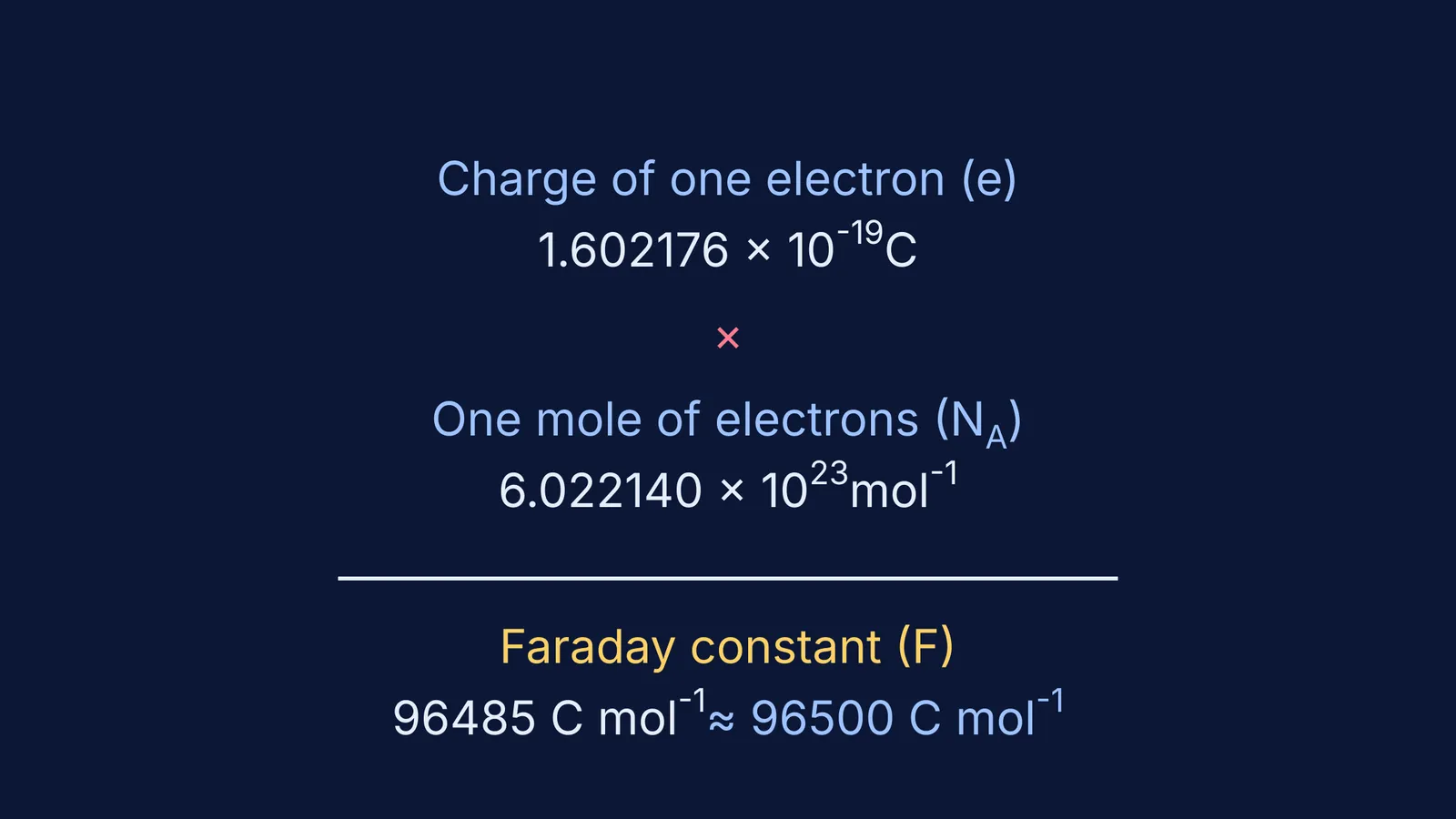
The constant is simply the product of two fundamental numbers: the charge of a single electron and the number of electrons in a mole.
The concept of a fundamental unit of electricity was proposed by George Johnstone Stoney, who named it the electron. Today, the exact value of the elementary charge (e) is fixed at 1.602176634 × 10⁻¹⁹ C (NIST).
To find the charge of a whole mole, we multiply this by Avogadro's number (N_A). Avogadro's number tells us how many particles are in one mole: exactly 6.02214076 × 10²³ mol⁻¹ (NIST).
Multiplying these two exact numbers together gives the precise value of the Faraday constant. The precise value of the Faraday constant is 96485.33212 C mol⁻¹ (NIST).
Why do we use 96500 in problems?
If the exact value is roughly 96485, why does every textbook and coaching module tell you to use 96500?
The answer is calculation speed and avoiding cognitive overload. In major Indian exams like JEE Main, JEE Advanced and NEET, calculators are strictly prohibited. Dividing a molar mass by 96485 by hand is tedious, consumes precious time, and invites arithmetic mistakes under pressure.
Many textbook publishers and exam boards standardise the value to 96500 for all numerical problems. This tiny difference is small enough that it does not change the significant figures in a multiple-choice answer, but it makes the arithmetic much cleaner. The trailing zeros allow students to cancel out terms quickly, especially when time is given in minutes and seconds that multiply into hundreds.
A worked example: Faraday's First Law
Let's look at how 96500 simplifies a classic electrochemistry problem. Faraday's First Law states that the mass (w) of a substance deposited is proportional to the total charge passed through the electrolyte (Wikipedia). The formula is w = (M × I × t) / (n × F).
Imagine you pass a current of two amperes (I) through a silver nitrate solution for 965 seconds (t). The molar mass (M) of silver is 108 grams per mole, and silver ions require one electron to reduce (n = 1).
Using the standard rounded value:
Set up the equation: w = (108 × 2 × 965) / (1 × 96500)
Notice how 965 and 96500 cancel out instantly, leaving a factor of 100 in the denominator.
The equation simplifies to w = (108 × 2) / 100
The mass deposited is 2.16 grams.
If you had used 96485, the calculation would have been a long division problem taking up minutes of your exam time.
Using it in thermodynamics
You also rely on the Faraday constant to calculate the standard Gibbs free energy change (ΔG°) for a reaction, which is a standard step when going from cell EMF to Gibbs energy.
The equation is ΔG° = −nFE°. If a reaction exchanges two moles of electrons (n = 2) and has a cell potential of 1.1 volts (Wikipedia):
ΔG° = −2 × 96500 × 1.1
Multiply the easy numbers: −2 × 1.1 = −2.2
Multiply by the constant: −2.2 × 96500 = −212300 J mol⁻¹
The final energy change is −212.3 kilojoules per mole.
Finding the right steps
When equations in physical chemistry start stacking up, it is easy to lose track of whether to multiply or divide by F. If you are unsure how to set up the calculation, the Concept Library maps out every law of electrochemistry step by step.
When you are stuck on a specific numerical problem, Fermi's AI tutor does not just give you the final answer. It holds a line of reasoning across the session, notices where you are stuck, and writes on a digital board to explain the concepts until you can solve it yourself.


