On this page
In the 1870s steelmakers had a fast new tool, the Bessemer converter, and a stubborn problem: it could not make good steel from iron that contained phosphorus. Sidney Gilchrist Thomas, a London police court clerk who studied chemistry in his spare time, worked out why and fixed it by changing what the converter was lined with. It is also a textbook case of acidic and basic oxides.
Why was phosphorus such a problem for steel?
Phosphorus makes iron brittle in the cold. According to materials-science notes from the University of Kiel, pure iron turns from tough to brittle at about -50 °C, but adding 0.6% phosphorus raises that transition to about +10 °C.
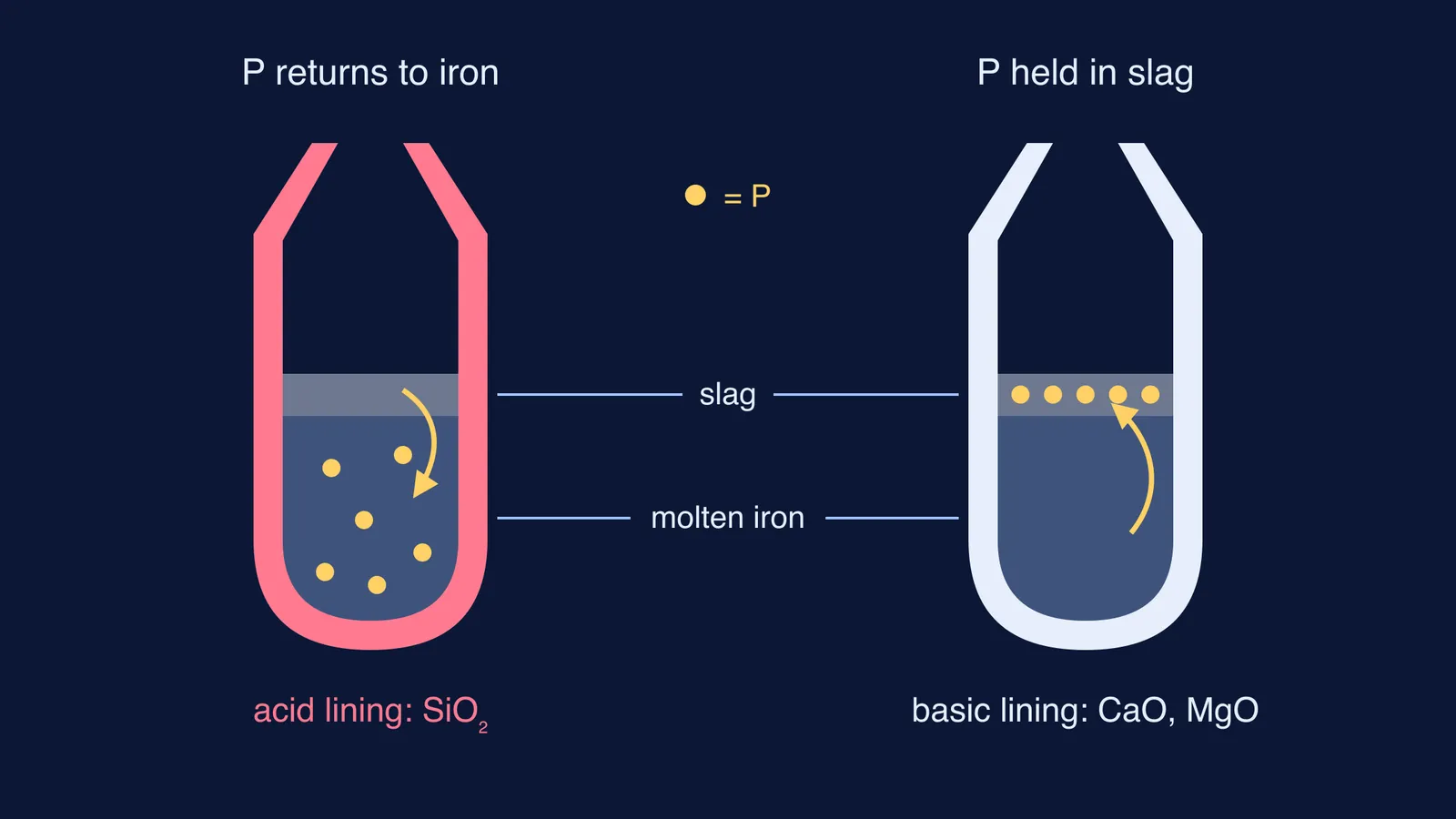
Bessemer's converter blew air through molten iron to burn out impurities. It was lined with acidic material such as clay or ganister sandstone, as the Wikipedia article on the Bessemer process describes. The Dictionary of National Biography entry on Thomas explains what went wrong: the phosphorus did oxidise, but because the slag was siliceous it was reduced back to phosphorus and returned to the metal. Bessemer and many others had tried and failed to solve this from 1860 onwards, so only non-phosphoric ores could be used for steel.
Who was Sidney Gilchrist Thomas?
Thomas was born on 16 April 1850 in Canonbury, London, and had to leave Dulwich College at 17 after his father died, according to the Dictionary of Welsh Biography. The 1911 Encyclopaedia Britannica records that he worked as a police court clerk for twelve years, until May 1879, while attending lectures at the Birkbeck Institute.
By the end of 1875 he was convinced he had the answer. He tested it with his cousin Percy Gilchrist, a chemist at the Blaenavon ironworks in Wales, helped by the works manager, Edward Martin.
What did the Gilchrist Thomas process change?
One thing: the lining. According to the Dictionary of National Biography, Thomas replaced the siliceous lining with a basic one of lime or its relatives, magnesia or magnesian limestone. The process is usually described with a lining of dolomite fired with tar, per the Wikipedia article on the Gilchrist-Thomas process.
Thomas announced in March 1878, at a meeting of the Iron and Steel Institute, that he had dephosphorised iron in the converter. The same DNB entry says the announcement was at first disregarded. Then, on 4 April 1879, large-scale trials at Bolckow, Vaughan and Co.'s Middlesbrough works succeeded. The entry gives the result: 864,700 tons of basic steel worldwide in 1884 and 2,274,552 tons in 1889. Phosphoric ores became usable for steel, and the Wikipedia article credits the process with the rapid growth of the Lorraine iron and steel industry.
Thomas died in Paris on 1 February 1885, aged 34.
How does a basic lining remove phosphorus?
Phosphorus burns to phosphorus pentoxide, which is an acidic oxide (see our explainer on why group 15 oxides turn from acidic to basic). Silica is also acidic, so it cannot hold the P2O5. Lime is basic, so it can.
Oxidation: 4P + 5O2 → 2P2O5
Neutralisation: 3CaO + P2O5 → Ca3(PO4)2
The calcium phosphate collects in the slag, which sits on top of the iron and is poured off separately.
A worked example: take 1 tonne of iron carrying 2% phosphorus, so 20 kg of phosphorus.
Moles of P: 20,000 g ÷ 30.97 g/mol ≈ 646 mol
Moles of P2O5: 646 ÷ 2 ≈ 323 mol
CaO needed: 3 × 323 ≈ 969 mol, which is 969 × 56.08 g ≈ 54 kg
Calcium phosphate formed: 323 × 310.18 g ≈ 100 kg
Real slags are messier. A 2021 study in High Temperature Materials and Processes found the phosphorus in its high-phosphorus slag as Ca5(PO4)2SiO4, not plain calcium phosphate. The slag reached as much as 14.41% P2O5, which the authors say means it can be used as a phosphate fertiliser. The idea is the same: a basic slag traps an acidic oxide.
The divide-by-two step from P to P2O5 is where many students slip. If the mole ratios feel shaky, the Fermi Problem Library has worked problems with a step-by-step solver that explains the reasoning rather than printing an answer.
How can you use this in a chemistry exam answer?
The same logic decides every flux question in extraction of metals. Run this checklist:
Name the impurity and the oxide it forms.
Decide whether that oxide is acidic (SiO2, P2O5) or basic (CaO, FeO).
Choose the opposite kind of flux or lining.
Write the slag-forming equation.
Say where the product goes: into the slag.
A model two-line answer: "Phosphorus is oxidised to P2O5, an acidic oxide. An acidic silica lining cannot fix it, but a basic lime lining reacts with it to form calcium phosphate, which leaves in the slag."
If acidic and basic oxides still blur together, the Fermi Concept Library gives each chemistry concept its own lesson and its place in the map.
For the chapter of the steel story that came before Bessemer, read how Benjamin Huntsman made crucible steel.