

On this page
In short
Around 1740, English clockmaker Benjamin Huntsman invented crucible steel by melting blister steel in clay pots at extreme temperatures. Each crucible held about 34 pounds (15 kg) of metal, producing the uniform, impurity-free steel required for precision clock springs.
Working in Handsworth near Sheffield, Huntsman sought a better material for the delicate springs and pendulums of his clocks. The steel available at the time was too inconsistent for precision engineering, prompting him to experiment with extreme heat and sealed clay pots.
Why did a clockmaker need better steel?
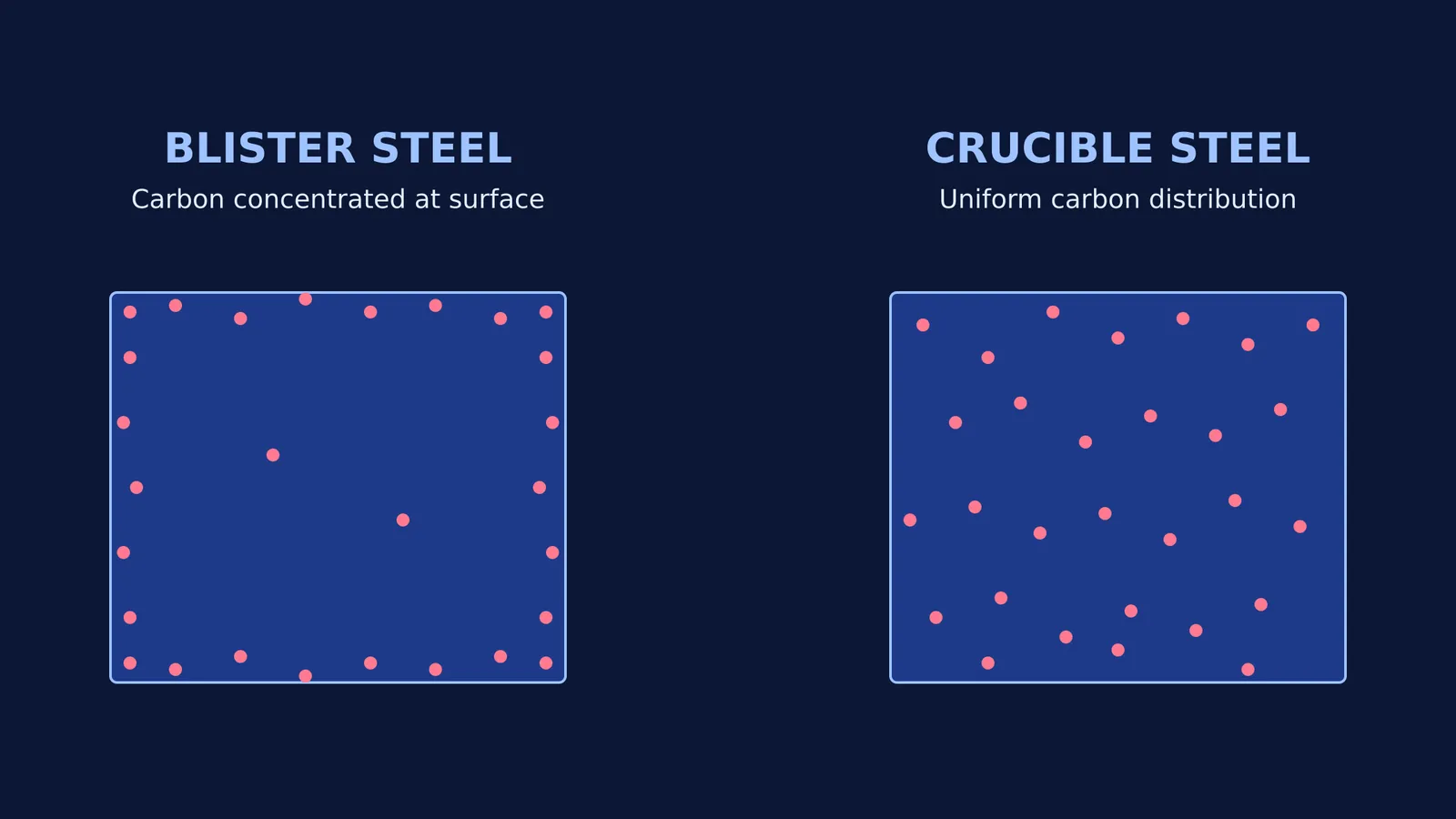
In the early 18th century, watch and clock makers relied on "blister steel" or "German steel". Blister steel was made by the cementation process: wrought iron bars were packed with charcoal and heated for days. Carbon from the charcoal slowly diffused into the solid iron.
Because the carbon diffused from the outside in, the concentration was high at the surface but low in the core. The steel was also marred by slag (glassy impurities) left over from the wrought iron. For a clockmaker like Huntsman, this inconsistency was a constant problem. A watch spring made from uneven steel might have soft spots, causing it to snap under tension or fail to keep accurate time. He needed a steel that was perfectly uniform throughout its structure.
How was crucible steel made?
Huntsman reasoned that if he could melt the blister steel completely, the carbon would distribute evenly and the slag would float to the top to be skimmed off. This was incredibly difficult because the extreme heat required to melt steel destroyed standard crucibles.
He developed a new clay mixture that could withstand the intense heat of a coke-fired furnace. Each crucible held about 34 pounds (15 kg) of blistered steel, which was heated with coke for three hours before being poured into moulds (Wikipedia). This "cast steel" emerged pure, hard, and structurally uniform—the very first crucible steel.
If you are studying the metallurgy of iron and carbon, it helps to visualise these processes rather than just memorising the differences. The Fermi Concept Library contains every concept in physics, chemistry, biology, mathematics and computing, each with its own lesson and its place in the map, helping you explore how carbon content changes the properties of an alloy.
What is the legacy of Huntsman's secret?
Huntsman's new steel was exceptionally hard. Initially, the local Sheffield cutlers refused to use it because it ruined their traditional tools. Huntsman was forced to export his entire output to France. Only when superior French cutlery began outcompeting Sheffield products did the local manufacturers finally adapt their tools to work the new metal.
Huntsman never patented his process, relying on extreme secrecy at his Attercliffe factory. Legend has it that a rival iron-founder named Samuel Walker eventually stole the secret by disguising himself as a freezing beggar to get inside the warm foundry at night. Despite the espionage, Huntsman's invention laid the foundation for Sheffield to become the world's leading centre for high-grade steel production.
From blister steel to active learning
Huntsman's problem mirrors a common issue in learning. When you study by just reading textbooks, your knowledge is like blister steel: strong on the surface, but lacking depth and uniformity in the core. You might know the definitions, but struggle when a tricky exam question tests the foundation.
To build a robust, uniform understanding, you have to "melt" the concepts together by solving rigorous problems. The Fermi Problem Library has worked problems with a step-by-step solver that explains the reasoning rather than printing an answer. When you get stuck, Fermi's AI tutor notices where a student is stuck, and decides whether to explain, ask, or show. It works out what you already know and builds a plan for the session, ensuring you forge an academic foundation as reliable as crucible steel.
For more on how materials behave and are processed, see our guides on A rod stretching under its own weight: the WL/2AY result and Extracting metals for Class 10: roasting, calcination and reduction.


