

On this page
The oxides of Group 15 (the pnictogens) provide a window into how periodic trends work 1. Because this group spans non-metals at the top and a metal at the bottom, the chemical nature of their compounds shifts dramatically.
Understanding the acidic and basic properties of these oxides is a staple of inorganic chemistry, and it regularly appears in multiple-choice questions for competitive exams. The trend is straightforward: oxides in the same oxidation state become less acidic and more basic as you move down the group.
What is the acidic character of group 15 oxides?
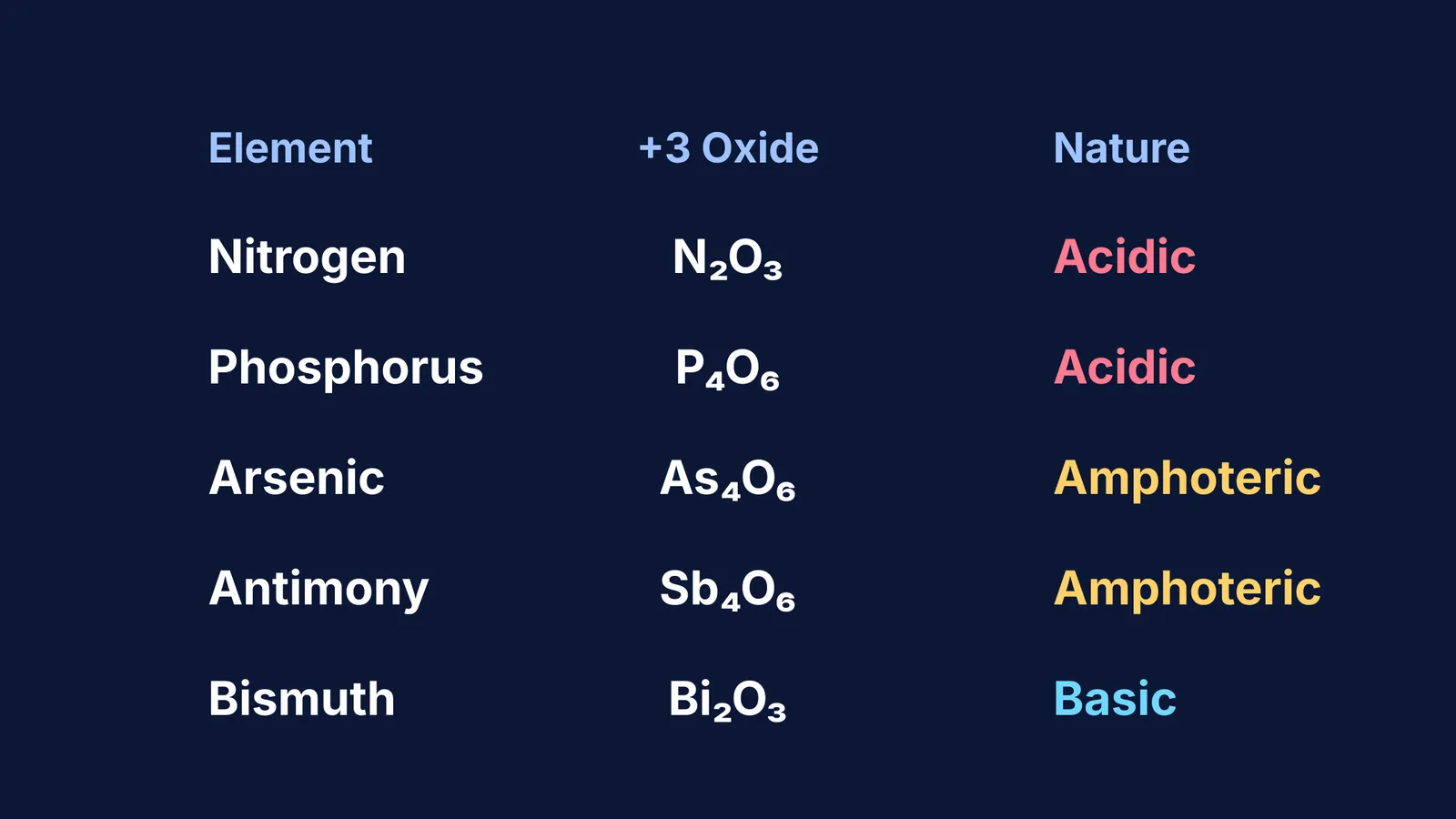
The acidic and basic properties of an oxide depend directly on the element's metallic character. As you move from nitrogen (N) down to bismuth (Bi), the atomic radius increases and the elements change from non-metals to metalloids, and finally to a post-transition metal 1.
Because non-metal oxides dissolve in water to form acids, and metal oxides form bases, the acidic character of the oxides decreases down the group.
Nitrogen and phosphorus oxides are strongly acidic 1. They react vigorously with water to form oxyacids such as nitrous acid and phosphorous acid.
Arsenic and antimony oxides are amphoteric 1. They can react with both strong acids and strong bases, sitting at the transition point of the group.
Bismuth oxide (Bi₂O₃) is predominantly basic 1. It reacts with acids to form bismuth salts but does not act as an acid itself.
Why does acidic character decrease down group 15?
The trend is driven by two competing factors: atomic size and electronegativity. Down the group, the atoms become significantly larger, and their ability to attract shared electrons drops.
When a highly electronegative non-metal like nitrogen bonds with oxygen, the bond is strongly covalent. In water, the H₂O molecule attacks the central nitrogen, leading to a reaction that ultimately releases H⁺ ions into the solution, making it acidic. You can see this covalent behaviour when you compare the bond angles of molecules like NH3 and PH3.
Conversely, at the bottom of the group, bismuth has a much lower electronegativity. The bond between bismuth and oxygen is highly ionic 1. Ionic metal-oxygen bonds break easily in water or react with aqueous acids to release hydroxide ions or consume H⁺ ions, making the behaviour basic.
Which is more acidic: N2O3 or N2O5?
When an element forms multiple oxides, the one with the central atom in the higher oxidation state is more acidic.
In N₂O₅, nitrogen is in a +5 oxidation state 1, meaning it has a higher positive charge density than the +3 nitrogen in N₂O₃. This higher positive charge strongly pulls electron density away from the oxygen atoms it bonds with. When it reacts with water, this electron-withdrawing effect weakens the oxygen-hydrogen bonds of the water molecule, forcing it to release more H⁺ ions.
Therefore, N₂O₅ (which forms the strong nitric acid) is significantly more acidic than N₂O₃.
A framework for solving oxide questions
When you face an exam question asking you to rank the acidic strength of various p-block oxides, use this three-step checklist to avoid common traps:
Check the group: Are the elements from the same group? If they are moving down a group (e.g. N, P, As), acidity decreases. N₂O₃ is more acidic than P₄O₆.
Check the period: Are the elements from the same period? Across a period from left to right, electronegativity increases, so acidity increases.
Check the oxidation state: If the element is the same, calculate the oxidation state. The higher the positive oxidation state, the more acidic the oxide. P₄O₁₀ (+5) is more acidic than P₄O₆ (+3) 1.
This pattern of decreasing acidity down a group and increasing acidity with oxidation state appears across the entire p-block. Exploring these periodic trends in the Fermi Concept Library can help you build a clear map of inorganic chemistry without rote memorisation.


