On this page
Heat a copper sulphide in air and you can end up with copper metal without adding coke or any other reducing agent. The ore reduces itself. That is the idea behind the self-reduction step in the extraction of copper from copper pyrites, and once you see why it works, the equations stop being a list to memorise.
What is copper pyrites, and why is iron the problem?
Copper pyrites is another name for chalcopyrite, a yellow copper-iron sulphide ore with the formula CuFeS2 (Vocabulary.com). Chalcopyrite is the most abundant copper ore mineral (Wikipedia: Chalcopyrite).
Every copper atom in the ore arrives with an iron atom and two sulphur atoms. So extraction is really two jobs: get rid of the iron, then get rid of the sulphur. Even after froth flotation, a chalcopyrite concentrate typically holds only 27–29% copper (Wikipedia: Copper extraction).
How is copper matte formed?
The concentrate is partly oxidised by roasting, which releases sulphur dioxide, and is then smelted (Wikipedia: Copper extraction).
Copper matte is a molten mixture of copper sulphide and iron sulphide containing 30–70% copper, depending on the smelter's process (Wikipedia: Copper extraction). In exam answers you can write it as Cu2S + FeS.
Why is iron dealt with before copper metal appears? The usual classroom answer is reactivity: iron sits above copper in the activity series in NCERT Class 10 Science, Chapter 3, so iron is the more readily oxidised of the two metals.
How is iron removed as slag?
In the converter, air is blown through the molten matte. Iron sulphide burns to iron oxide, and silica turns that oxide into iron silicate slag (Wikipedia: Copper extraction):
2FeS + 3O2 → 2FeO + 2SO2
2FeO + SiO2 → Fe2SiO4
Your book may write the second step as FeO + SiO2 → FeSiO3. Both describe the same job: iron oxide plus silica making a silicate slag that is separated from the copper sulphide melt.
How does Cu2S + Cu2O self-reduction give blister copper?
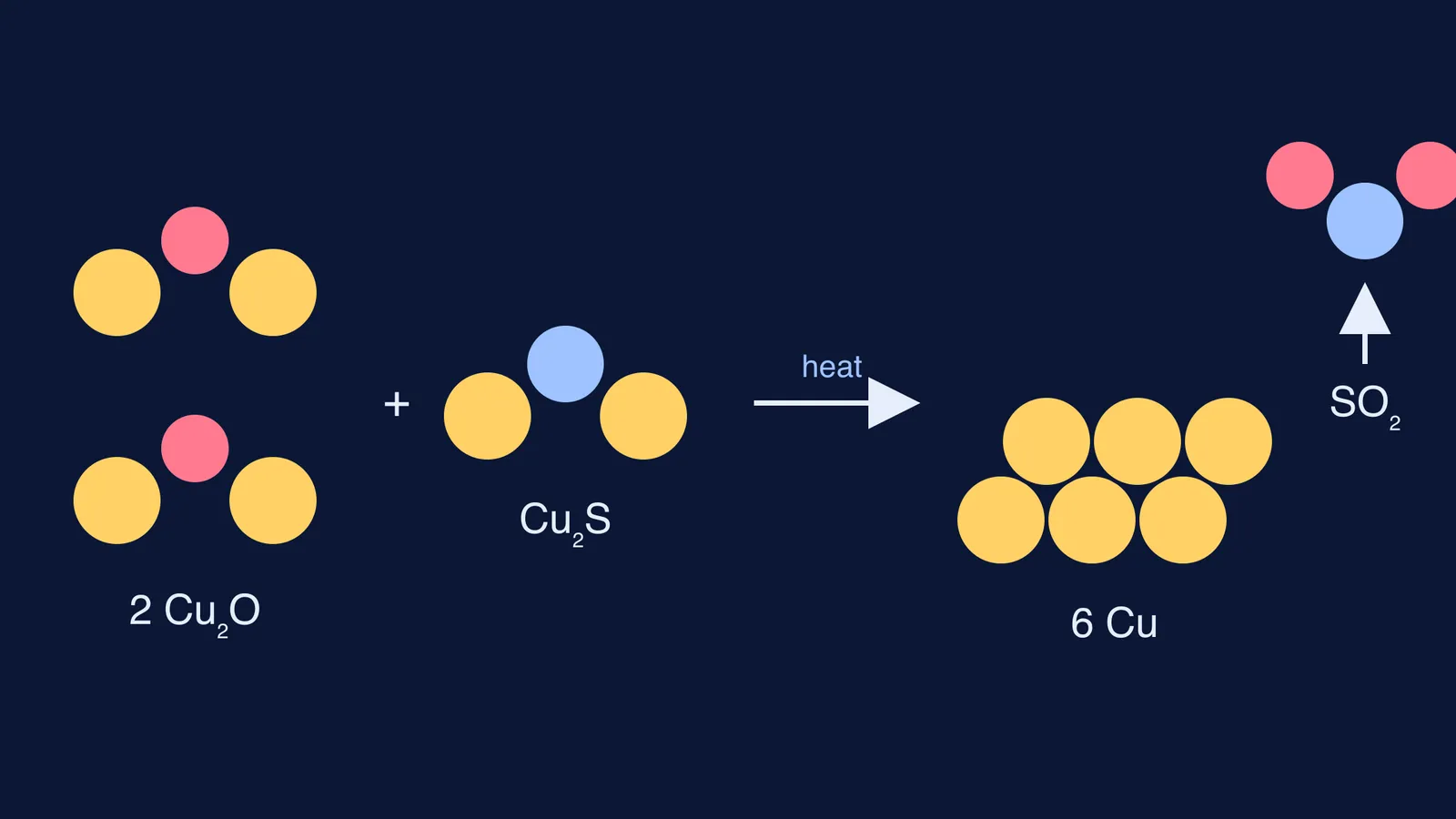
With the iron removed as slag, air blown through the melt now works on the copper sulphide. Part of the Cu2S is oxidised to Cu2O, and that oxide then reacts with the Cu2S still in the melt. NCERT Class 10 Science gives the pair of equations for copper found as Cu2S, obtained by heating in air alone:
2Cu2S + 3O2 → 2Cu2O + 2SO2
2Cu2O + Cu2S → 6Cu + SO2
Worked check: count the electrons
Take equation 2. Six copper atoms go from +1 to 0, so they gain 6 electrons in total. One sulphur atom goes from −2 in Cu2S to +4 in SO2, so it loses 6 electrons. Oxygen stays at −2 throughout. Gain equals loss, so the equation is a correct redox equation, and you can see that sulphur, not carbon, is doing the reducing.
Now add the two equations. Equation 1 plus equation 2 gives 3Cu2S + 3O2 → 6Cu + 3SO2, which simplifies to Cu2S + O2 → 2Cu + SO2. Two of every three Cu2S units are oxidised to Cu2O; the third reduces them.
The product is about 98% pure and is called blister copper because escaping sulphur dioxide leaves a broken, blistered surface as it cools (Wikipedia: Copper extraction). The same source notes that the sulphur dioxide is captured and turned into sulphuric acid, that fire refining brings the copper to about 99%, and that electrorefining gives cathode copper of 99.99%.
How do you write this answer in an exam?
Use this order, and you will rarely lose a step:
Name the ore and formula: copper pyrites, CuFeS2.
Concentrate by froth flotation, then roast partly in air.
Smelt to matte: Cu2S + FeS.
Blow air in the converter: 2FeS + 3O2 → 2FeO + 2SO2, then FeO + SiO2 → slag.
Self-reduction: 2Cu2S + 3O2 → 2Cu2O + 2SO2, then 2Cu2O + Cu2S → 6Cu + SO2.
Name the product, blister copper, and say why it blisters.
End with refining to pure copper.
If one link in the chain keeps slipping, such as why iron leaves before copper, the Fermi Concept Library has its own lesson for each chemistry concept and shows where it sits in the map. For practice, the Fermi Problem Library has worked problems with a step-by-step solver that explains the reasoning rather than printing an answer.
Try it now: close this page and write the seven steps from memory, then balance equation 2 by counting electrons.