On this page
Froth flotation is the chemistry topic where bubbles do the mining. You grind a sulphide ore, stir it in water, draw air through it, and the valuable mineral rides the bubbles to the top while sand and clay stay behind. Here is what each reagent does, why sodium cyanide holds zinc sulphide back while lead sulphide floats, and a five-step answer you can write in any exam.
What is froth flotation of sulphide ores?
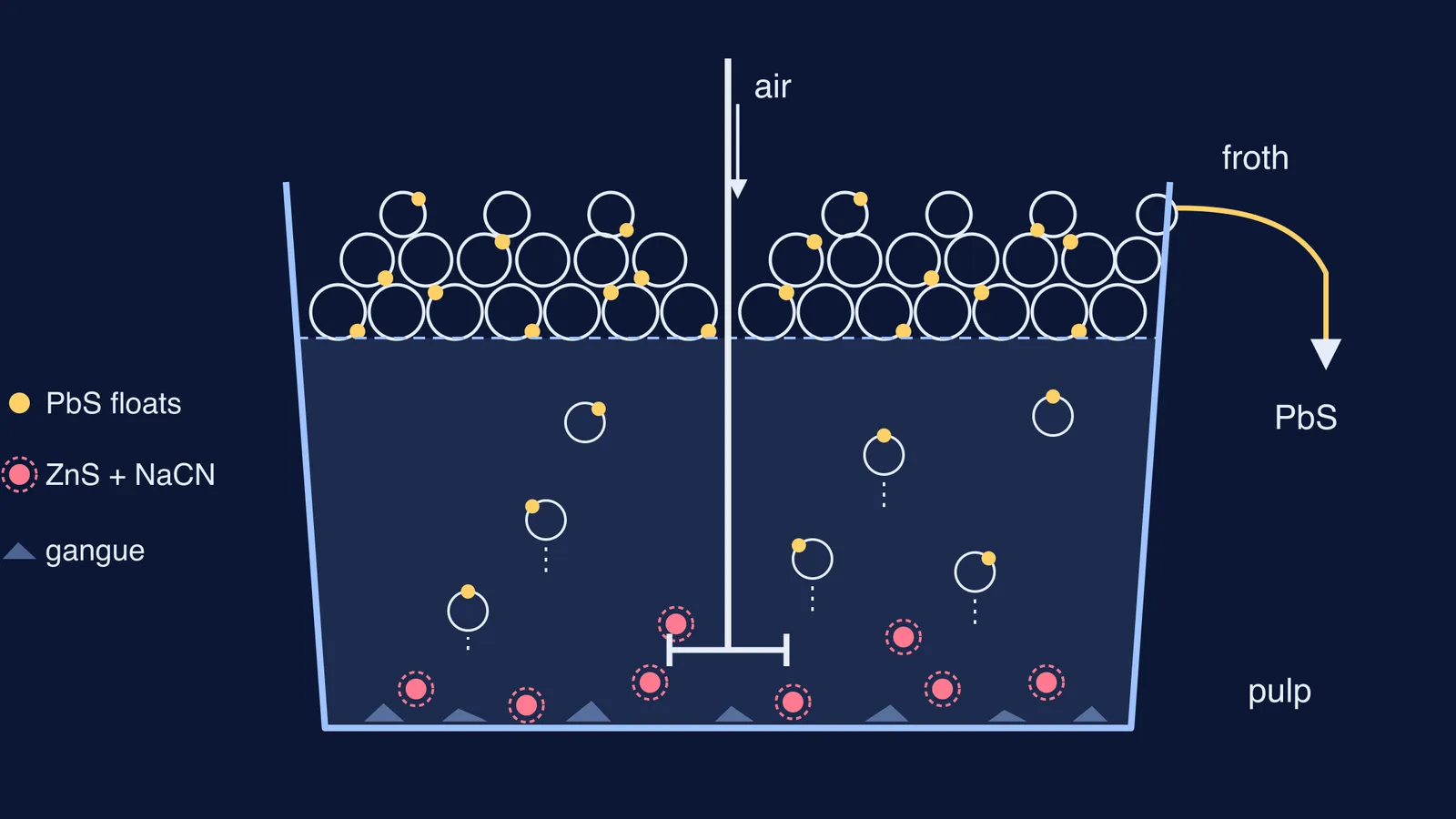
Froth flotation is a method for removing gangue, the unwanted earthy material, from sulphide ores, according to Section 6.2.3 of NCERT's Class 12 chemistry chapter on isolation of elements (2021-22 edition, archived copy). The powdered ore is made into a suspension with water, collectors and froth stabilisers are added, and a rotating paddle stirs the mixture and draws in air. The mineral particles are wetted by the oil and the gangue particles by water, so the mineral ends up in a light froth that is skimmed off and dried.
The whole method rests on one property: whether a surface prefers water or oil. Density does not decide who floats; surface chemistry does. A heavy sulphide grain coated with collector clings to an air bubble, while a lighter grain of sand stays wet and sinks.
The same NCERT chapter tells the origin story in a box called "The Innovative Washerwoman". While washing a miner's overalls, she noticed that copper-bearing compounds were caught in the soapsuds and rose to the top while sand fell to the bottom; a client the book describes as a chemist, Carrie Everson, saw that the idea could separate copper compounds from rock on a large scale.
Syllabi change from year to year, so check the current official syllabus for your board or entrance exam before you plan time for this topic.
What do collectors, froth stabilisers and depressants do?
NCERT names three kinds of reagent in Section 6.2.3:
Collectors, such as pine oils, fatty acids and xanthates, enhance the non-wettability of the mineral particles, so the mineral sticks to bubbles instead of staying in the water.
Froth stabilisers, such as cresols and aniline, stabilise the froth so it lasts long enough to be skimmed off.
Depressants stop one chosen mineral from coming to the froth, which lets two sulphide ores be separated.
One naming clash trips students up. Mining-industry references such as 911 Metallurgist's note on pine oil treat pine oil, a complex mixture of terpene derivatives, as a frother.
Why does NaCN depress ZnS but let PbS float?
For an ore containing ZnS and PbS, the depressant used is NaCN: it selectively prevents ZnS from coming to the froth but allows PbS to come with the froth, according to NCERT Section 6.2.3.
Research points to the zinc atoms on the surface of zinc blende (sphalerite, ZnS). A 2022 modelling study of the sphalerite surface by Hang Chen and colleagues found that adsorbed cyanide weakens the reactivity of the surface zinc and sulphur atoms, that shifts in zinc's orbital energies point to cyanide's strong inhibiting effect, and that cyanide can bond to surface zinc through pi-backbonding (Chen et al., Minerals, 2022).
In a simplified school picture: cyanide binds to zinc on the ZnS surface, that surface stays wettable, and ZnS stays down in the pulp with the gangue. NCERT's rule is that PbS is not held back, so it goes up with the froth.
How do you answer a froth flotation question in an exam?
Take a typical question: "An ore contains ZnS, PbS and silica. How would you obtain a PbS concentrate?" Write it in five steps:
Name the method: froth flotation, because both metal minerals are sulphides.
Make a suspension of the powdered ore in water.
Add a collector (pine oil or a xanthate), a froth stabiliser (cresol or aniline) and NaCN as the depressant.
Stir with a rotating paddle that draws in air, so PbS goes into the froth and ZnS stays in the pulp.
Skim off and dry the froth to get the PbS concentrate; silica stays behind as gangue.
Then avoid four common slips:
Calling NaCN a collector or a frother. It is a depressant.
Writing that NaCN holds back PbS. It holds back ZnS.
Using flotation for bauxite. NCERT concentrates bauxite by leaching with sodium hydroxide, in Section 6.2.4.
Explaining flotation by density. It works by wettability.
If multi-step metallurgy questions keep going wrong at the same step, the Fermi Problem Library has worked problems with a step-by-step solver that explains the reasoning rather than printing an answer. To see wettability, ligands and ore concentration as connected ideas, the Fermi Concept Library gives every chemistry concept its own lesson and its place in the map.
Try the five-step answer on a copper pyrites question next, and check whether you would still need a depressant.