

On this page
Many board and entrance-exam questions on Gibbs energy give you a small table of formation values and ask two things: is the reaction spontaneous, and how big is K? Both answers come from one subtraction.
How do you calculate ΔrG° from ΔfG° values?
The OpenStax Chemistry 2e textbook writes the rule as ΔG° = ΣνΔG°f(products) − ΣνΔG°f(reactants), where ν is each substance's coefficient in the balanced equation (OpenStax Chemistry 2e, section 16.4). It is the same bookkeeping you use for enthalpy of reaction, only with a different column of the data table.
Follow the same five steps every time:
Balance the equation and write the state symbol on every species.
Look up ΔfG° for each species in that exact state, in kJ/mol.
Multiply each value by its coefficient.
Add the products, add the reactants, then take products minus reactants.
Read the sign, and convert to K only if the question asks.
Why is ΔfG° zero for elements?
ΔfG° is the Gibbs energy change when one mole of a compound forms from its elements in their standard states. OpenStax states that ΔG°f is by definition zero for elemental substances in their standard states, just as for the enthalpy of formation (OpenStax Chemistry 2e, section 16.4). The zero applies only to the standard-state form; another form of the same element has its own entry. Our post on why the standard enthalpy of formation of elements is zero gives the reasoning, which carries over to Gibbs energy.
What does the method look like in worked examples?
All values below are at 298 K, from the OpenStax appendix of standard thermodynamic properties (OpenStax Chemistry 2e, Appendix G): NH₃(g) −16.5 kJ/mol, CH₄(g) −50.5 kJ/mol, CO₂(g) −394.36 kJ/mol, H₂O(l) −237.1 kJ/mol, and N₂(g), H₂(g), O₂(g) all 0.
Example 1: making ammonia. N₂(g) + 3H₂(g) → 2NH₃(g). Products: 2 × (−16.5) = −33.0 kJ. Reactants: 0 + 3 × 0 = 0. So ΔrG° = −33.0 kJ/mol. Negative, so the reaction is spontaneous under standard conditions.
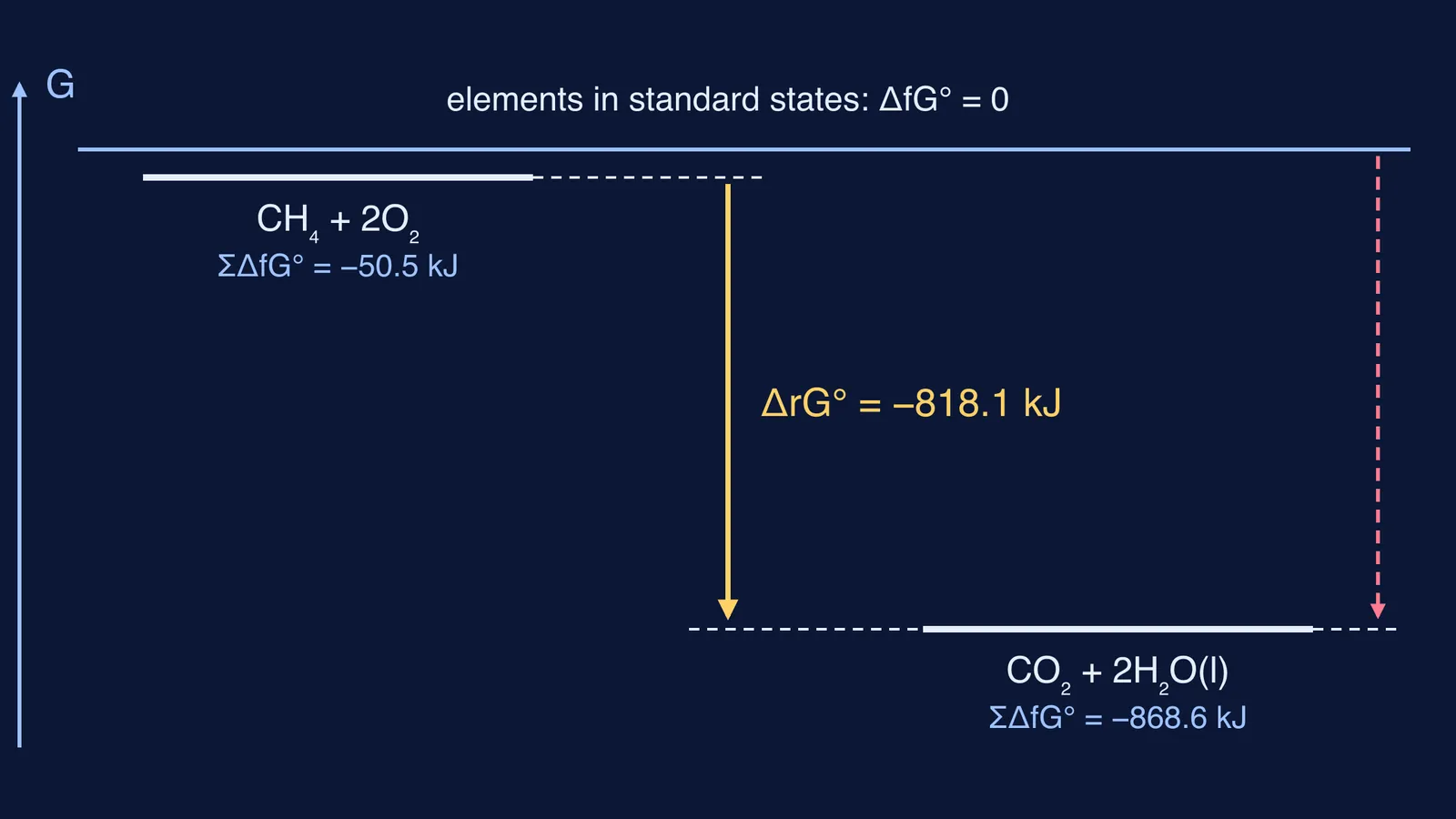
Example 2: burning methane. CH₄(g) + 2O₂(g) → CO₂(g) + 2H₂O(l). Products: −394.36 + 2 × (−237.1) = −868.56 kJ. Reactants: −50.5 + 2 × 0 = −50.5 kJ. So ΔrG° = −868.56 − (−50.5) = −818.1 kJ/mol, strongly negative.
Example 3: splitting water. 2H₂O(l) → 2H₂(g) + O₂(g). Products: 0. Reactants: 2 × (−237.1) = −474.2 kJ. So ΔrG° = 0 − (−474.2) = +474.2 kJ/mol. Positive, so it is not spontaneous under standard conditions; it runs only with a steady input of energy, such as electricity in electrolysis.
How do you get spontaneity and K from ΔrG°?
OpenStax gives the link between the two as ΔG° = −RT ln K, or K = e^(−ΔG°/RT) (OpenStax Chemistry 2e, section 16.4). With R = 8.314 J/(mol K) and T = 298.15 K, RT is about 2479 J/mol, which is 2.479 kJ/mol. The sign then tells you the size of K at a glance:
ΔrG° negative: spontaneous under standard conditions, K greater than 1, products favoured.
ΔrG° positive: not spontaneous under standard conditions, K less than 1, reactants favoured.
ΔrG° zero: K equals 1.
For ammonia, K = e^(33.0/2.479) = e^13.3, about 6 × 10⁵. For methane combustion, K is about 10¹⁴³. For water splitting, K is about 10⁻⁸³, so under standard conditions water hardly decomposes at all. For what these sizes mean in practice, see what a large or small equilibrium constant means.
One caution: the sign of ΔrG° describes standard conditions, with everything at unit activity. Under real concentrations and pressures you need ΔG = ΔG° + RT ln Q, which our post on the difference between ΔG and ΔG° explains.
Which mistakes cost marks most often?
Before you write the final answer, run through this checklist:
Forgot a coefficient. In example 1, using −16.5 instead of 2 × (−16.5) halves your answer.
Reactants minus products. This flips the sign, and with it your spontaneity verdict and whether K is above or below 1.
kJ and J mixed. R is in J/(mol K), and ΔfG° tables are in kJ/mol. Convert one before you divide.
Wrong column. ΔfH° and ΔfG° sit side by side in most tables. Check the heading.
Wrong state. Liquid and gaseous water have separate entries. Match the state symbol in your equation.
Celsius in the exponent. T in RT must be in kelvin.
If the sign or coefficients keep slipping, practise in the Fermi Problem Library. Its step-by-step solver explains the reasoning at each step instead of just printing an answer, so you can see exactly where your working went off. If the idea of spontaneity itself still feels shaky, the Fermi Concept Library has a lesson on each chemistry concept and shows where it fits in the map.


