

On this page
In a reversible reaction, the equilibrium constant K equals the ratio of product concentrations to reactant concentrations, each raised to the power of its stoichiometric coefficient. Because products occupy the numerator and reactants the denominator, the magnitude of K measures the thermodynamic extent of the reaction—how far it proceeds toward products before forward and reverse rates balance. As explained in OpenStax Chemistry 2e, calculating K indicates the equilibrium composition of the mixture at a given temperature. Knowing what the number means saves critical time when solving numerical problems and setting up ICE tables.
What does a large value of K mean for a reaction?
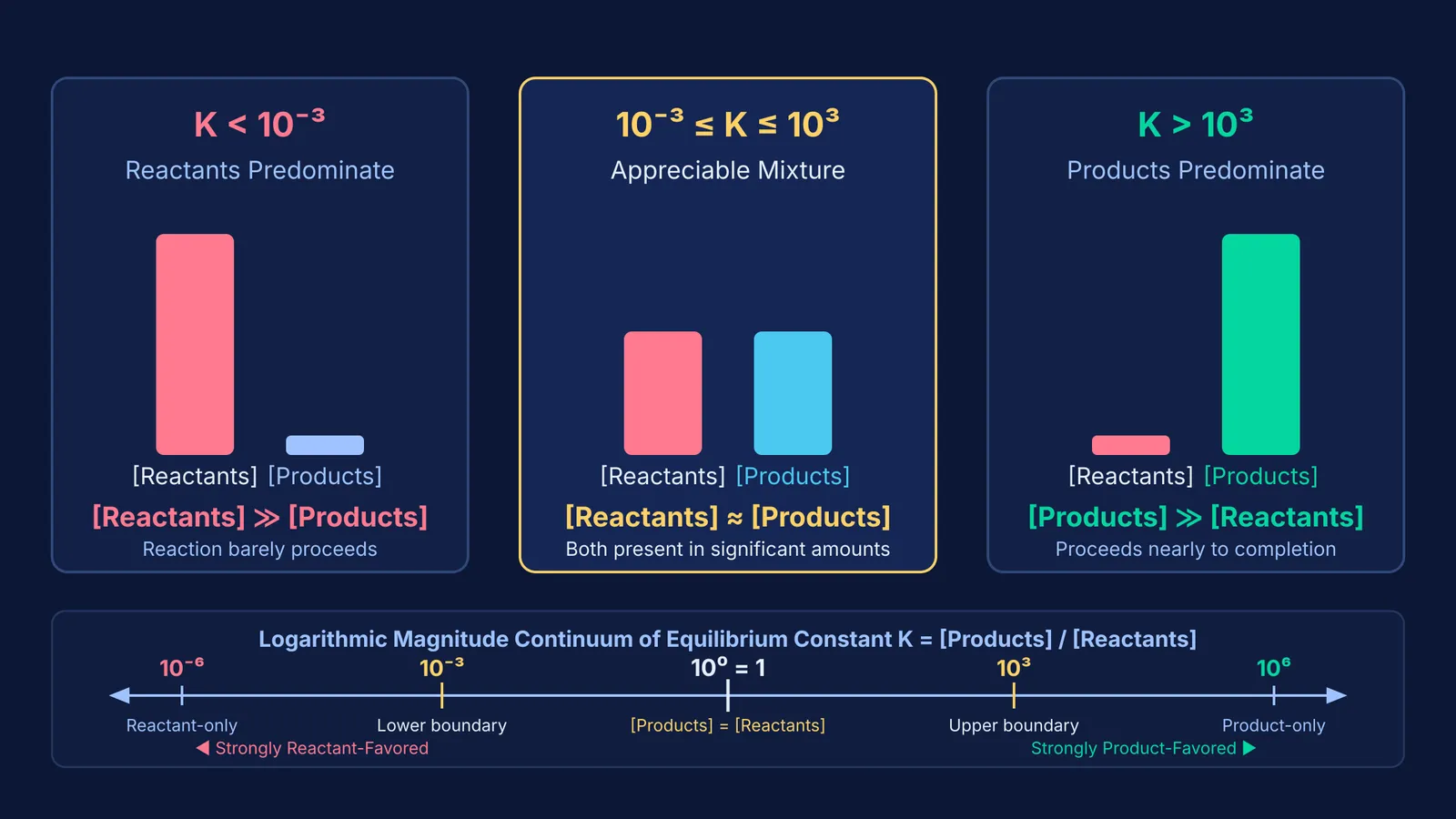
When the equilibrium constant exceeds 10³ (or 1,000), the forward reaction proceeds nearly to completion. In this range, product concentrations at equilibrium dwarf remaining reactant concentrations by multiple orders of magnitude. Thermodynamically, the forward process is strongly favored, corresponding to a large negative standard Gibbs free energy change ΔG°.
As documented in Chemistry LibreTexts/15%3A_Chemical_Equilibrium/15.03%3A_Interpreting_and_Working_with_Equilibrium_Constants), common gas-phase reactions illustrate this product-dominated behavior. The industrial synthesis of ammonia, 3H₂(g) + N₂(g) ⇌ 2NH₃(g), has an equilibrium constant K of 7 × 10⁵ at 25 °C, indicating that equilibrium heavily favors the formation of ammonia over unreacted nitrogen and hydrogen. Similarly, OpenStax Chemistry 2e notes that the formation of nitrosyl chloride, 2NO(g) + Cl₂(g) ⇌ 2NOCl(g), has a Kc of 4.6 × 10⁴ at 298 K. Because negligible starting material remains at equilibrium, chemists treat reactions with K > 10³ as practically complete for routine stoichiometry.
What does a small value of K tell you about reactants?
When K falls below 10⁻³ (or 0.001), the equilibrium lies far to the left, meaning the forward reaction barely proceeds. Reactants remain overwhelmingly dominant, and only minute trace amounts of product form before equilibrium is reached.
As shown in Chemistry LibreTexts/15%3A_Chemical_Equilibrium/15.03%3A_Interpreting_and_Working_with_Equilibrium_Constants), the reaction between atmospheric nitrogen and oxygen at 25 °C, N₂(g) + O₂(g) ⇌ 2NO(g), has an equilibrium constant K of 5 × 10⁻³¹. This extraordinarily small value explains why Earth's atmosphere does not spontaneously convert into toxic nitric oxide at room temperature. Similarly, the decomposition of water vapor into its constituent elements at 25 °C, H₂O(g) ⇌ H₂(g) + ½O₂(g), has a K of 8 × 10⁻⁴¹, demonstrating why water is exceptionally stable and does not act as a spontaneous source of oxygen gas.
In competitive examinations like JEE Main and NEET-UG, recognizing K < 10⁻³ provides a decisive problem-solving shortcut. As outlined in OpenStax Chemistry 2e, when K is extremely small, the reacted quantity x is negligible relative to the initial reactant concentration. This allows you to approximate the remaining reactant concentration as unchanged, simplifying quadratic equations into straightforward arithmetic without loss of accuracy, even when analyzing heterogeneous equilibria.
How do intermediate K values create balanced mixtures?
When K falls in the intermediate range between 10⁻³ and 10³ (or roughly 0.01 to 100 on standard textbook scales), neither side of the chemical equation is overwhelmingly favored. Appreciable, measurable concentrations of both reactants and products coexist at dynamic equilibrium.
For instance, OpenStax Chemistry 2e highlights the gas-phase dimerization of nitrogen dioxide into dinitrogen tetroxide, 2NO₂(g) ⇌ N₂O₄(g), which has a Kc of 1.6 × 10² at 25 °C. Because 160 lies in the intermediate regime, substantial quantities of brown NO₂ gas and colorless N₂O₄ gas exist simultaneously in the flask. In the high-temperature water-gas shift reaction, CO(g) + H₂O(g) ⇌ CO₂(g) + H₂(g), Kc equals 0.640 at 800 °C. Because both reactants and products remain in comparable amounts, neither quantity can be neglected, requiring full quadratic calculations.
A three-part rule helps categorize any reaction at a glance:
K > 10³: The forward reaction proceeds nearly to completion; products predominate.
10⁻³ ≤ K ≤ 10³: Significant, measurable amounts of both reactants and products coexist at equilibrium.
K < 10⁻³: The forward reaction barely proceeds; reactants predominate.
Why does equilibrium constant measure extent rather than speed?
A frequent misconception among chemistry students is confusing the magnitude of K with the speed of a reaction. As OpenStax Chemistry 2e emphasizes, the equilibrium constant is strictly thermodynamic: it defines the position where net chemical change ceases, but offers no indication of the reaction rate.
Reaction speed is determined by activation energy and chemical kinetics. As illustrated in Chemistry LibreTexts/15%3A_Chemical_Equilibrium/15.03%3A_Interpreting_and_Working_with_Equilibrium_Constants), a reaction can possess an immense equilibrium constant yet remain completely unreacted under ambient conditions. The decomposition of liquid acetic acid into water and graphite, CH₃COOH(l) ⇌ 2H₂O(l) + 2C(s), has a favorable Kc of 10¹³ at 25 °C, yet household vinegar never breaks down into charcoal because the transformation is kinetically hindered by a high activation barrier. Similarly, a mixture of hydrogen and oxygen has an enormous thermodynamic tendency to form water, yet remains stable for decades in the absence of a spark or catalyst. To predict which direction an active reaction mixture will shift to achieve equilibrium, chemists evaluate the momentary reaction quotient Q with K.
Mastering chemical equilibrium requires distinguishing thermodynamic extent from kinetic speed. The Fermi Problem Library has worked problems with a step-by-step solver that explains the reasoning rather than printing an answer. For a complete conceptual overview across chemistry, the Fermi Concept Library covers every concept with structured lessons, helping students see how equilibrium principles connect across physical chemistry.


