

On this page
Why do elements in their reference state have zero enthalpy?
In thermodynamics, absolute enthalpy cannot be measured. Defined by H = U + pV, total enthalpy includes electronic, nuclear, and vibrational energies with no absolute zero reference in chemical processes. Because calorimeters measure heat exchanged during changes, calculations rely on differences (ΔH) rather than absolute totals.
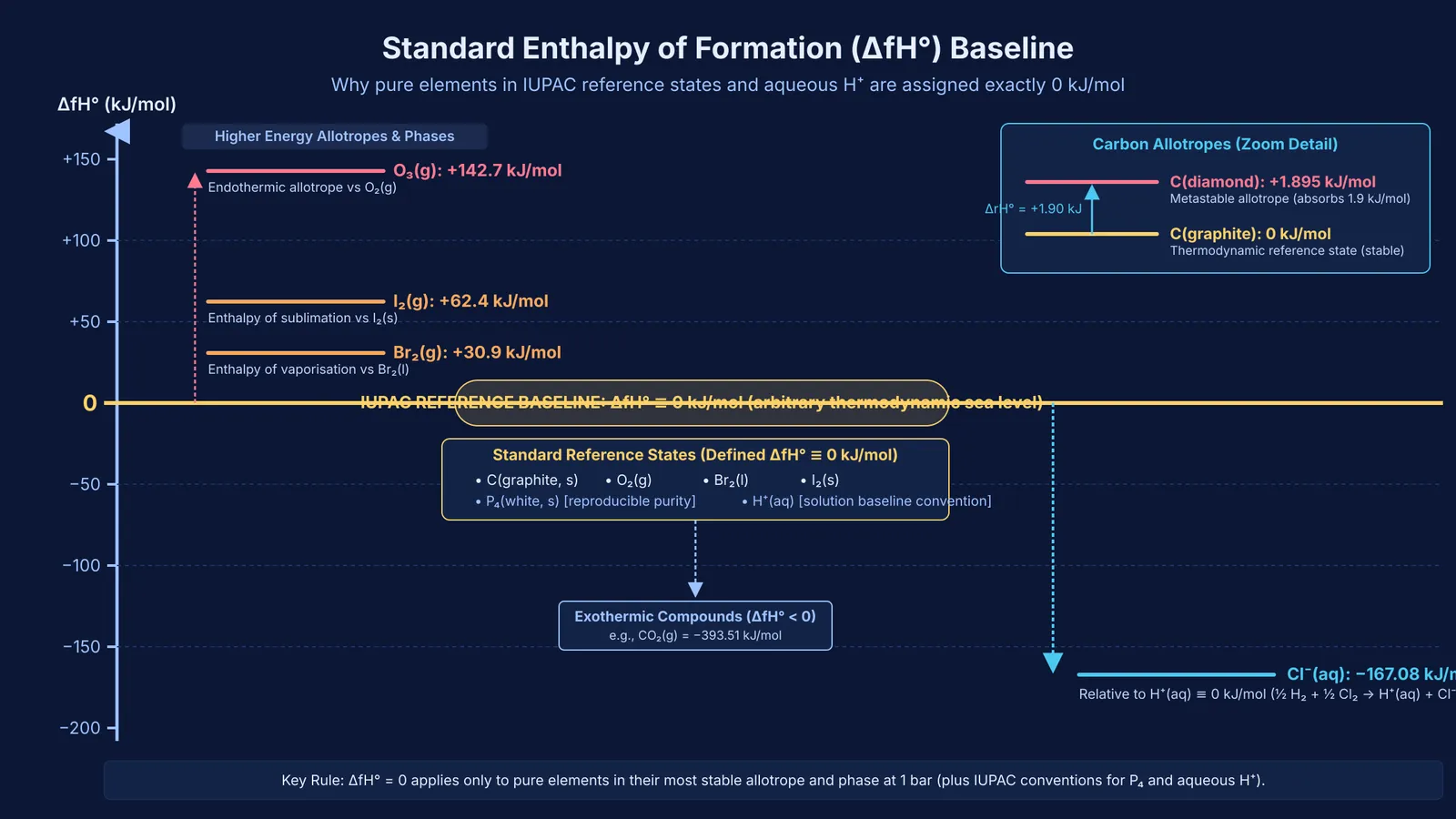
To tabulate data consistently, physical chemistry establishes an agreed baseline—the thermodynamic equivalent of measuring altitude from sea level. Under IUPAC Compendium of Chemical Terminology standards, the standard state of a substance is defined at 1 bar (100 kPa; IUPAC standard pressure). An element's reference state at a specified temperature (normally 298.15 K) is its most stable form under this pressure.
The standard enthalpy of formation (ΔfH°) is the enthalpy change when one mole of a substance forms from its constituent elements in their reference states. For an element already in its reference state—such as C(graphite) forming C(graphite)—no bonds change and no heat is exchanged, making ΔfH° identically zero. This universal baseline underpins Hess's law thermochemical cycles.
Which physical forms and allotropes count as the reference state?
A common exam pitfall is assuming that every elemental form has a standard enthalpy of formation of zero. Only the most stable allotrope and physical phase at 298.15 K and 1 bar receives a zero value. Non-reference allotropes or states require energy to form, giving them non-zero enthalpies.
According to thermochemical data in the NIST Chemistry WebBook, key reference states include:
Carbon: Graphite is the reference state (ΔfH° = 0 kJ/mol); diamond is metastable at ΔfH° = +1.895 kJ/mol (NIST Chemistry WebBook).
Oxygen: Dioxygen gas, O₂(g), is the reference state (0 kJ/mol); ozone, O₃(g), is endothermic at +142.67 kJ/mol.
Bromine: Liquid Br₂(l) is the reference state (0 kJ/mol); gaseous Br₂(g) is +30.91 kJ/mol.
Iodine: Solid I₂(s) is the reference state (0 kJ/mol); gaseous I₂(g) is +62.4 kJ/mol.
Sulfur: Rhombic sulfur (α-S₈) is zero; monoclinic sulfur (β-S) is +0.33 kJ/mol.
When mastering thermodynamic state functions, standard states, and allotrope stabilities, the Fermi Concept Library covers every concept in physics, chemistry, biology, mathematics and computing, each with its own lesson and its place in the map.
Why is the enthalpy of formation of aqueous H+ set to zero?
Aqueous solutions introduce a physical constraint: macroscopic electroneutrality. You cannot produce isolated cations without an equivalent amount of balancing negative charge. Calorimeters can only measure complete electrolytes, such as dissolving gaseous HCl in water to form H⁺(aq) and Cl⁻(aq).
Because no experiment can isolate the energy of a single ion, solution thermodynamics requires an arbitrary zero benchmark. Codified in the IUPAC Green Book (Quantities, Units and Symbols in Physical Chemistry), the standard enthalpy of formation of aqueous hydrogen ions is defined as zero at all temperatures:
ΔfH°[H⁺(aq)] = 0 kJ/mol
This convention mirrors the standard hydrogen electrode in electrochemistry. Once H⁺(aq) is fixed at zero, individual ionic enthalpies can be resolved. Forming aqueous hydrochloric acid follows:
1/2 H₂(g) + 1/2 Cl₂(g) → H⁺(aq) + Cl⁻(aq)
According to CODATA values in the NIST Chemistry WebBook, calorimetry measures this reaction enthalpy as −167.08 kJ/mol. Because H₂(g), Cl₂(g), and H⁺(aq) all have ΔfH° = 0 kJ/mol, the entire −167.08 kJ/mol is assigned to Cl⁻(aq). This benchmark connects electrolyte tables with converting internal energy changes from a bomb calorimeter and enthalpies of atomisation and phase changes.
How do you avoid common reference state traps in Hess's law?
Confusing reference states with alternative allotropes produces sign errors in thermochemical calculations. According to data in the NIST Chemistry WebBook, consider the combustion of diamond into carbon dioxide gas:
C(diamond) + O₂(g) → CO₂(g)
Given ΔfH°[CO₂(g)] = −393.51 kJ/mol and ΔfH°[C(diamond)] = +1.895 kJ/mol:
ΔrH° = −393.51 − (+1.895 + 0) = −395.41 kJ/mol
Setting diamond to zero would yield −393.51 kJ/mol (the combustion enthalpy of graphite). Diamond releases 1.90 kJ/mol more heat because it starts from a higher energy baseline.
To avoid mistakes, follow these four rules:
Check the physical phase: Liquid Br₂(l) and solid I₂(s) are zero; gaseous Br₂(g) and I₂(g) are positive.
Verify the allotrope: Graphite, dioxygen, rhombic sulfur, and white phosphorus are zero; diamond, ozone, and monoclinic sulfur are non-zero.
Separate elemental zeros from ionic conventions: Elements are zero in neutral reference states; H⁺(aq) is zero by solution convention, while gaseous H⁺(g) requires ionization enthalpy.
Note the temperature: Elemental standard enthalpies are zero at the specified temperature (normally 298.15 K); at other temperatures, heat capacities shift enthalpy above zero.
When calculating reaction enthalpies from formation data and navigating signs in thermochemical cycles, the Fermi Problem Library has worked problems with a step-by-step solver that explains the reasoning rather than printing an answer.


