On this page
The two terms are one word apart, which is why exam setters pair them. Standing crop is about living things up a food chain; standing state is about nutrients in the soil. Here is how to tell them apart, using your NCERT numbers.
What is standing crop in an ecosystem?
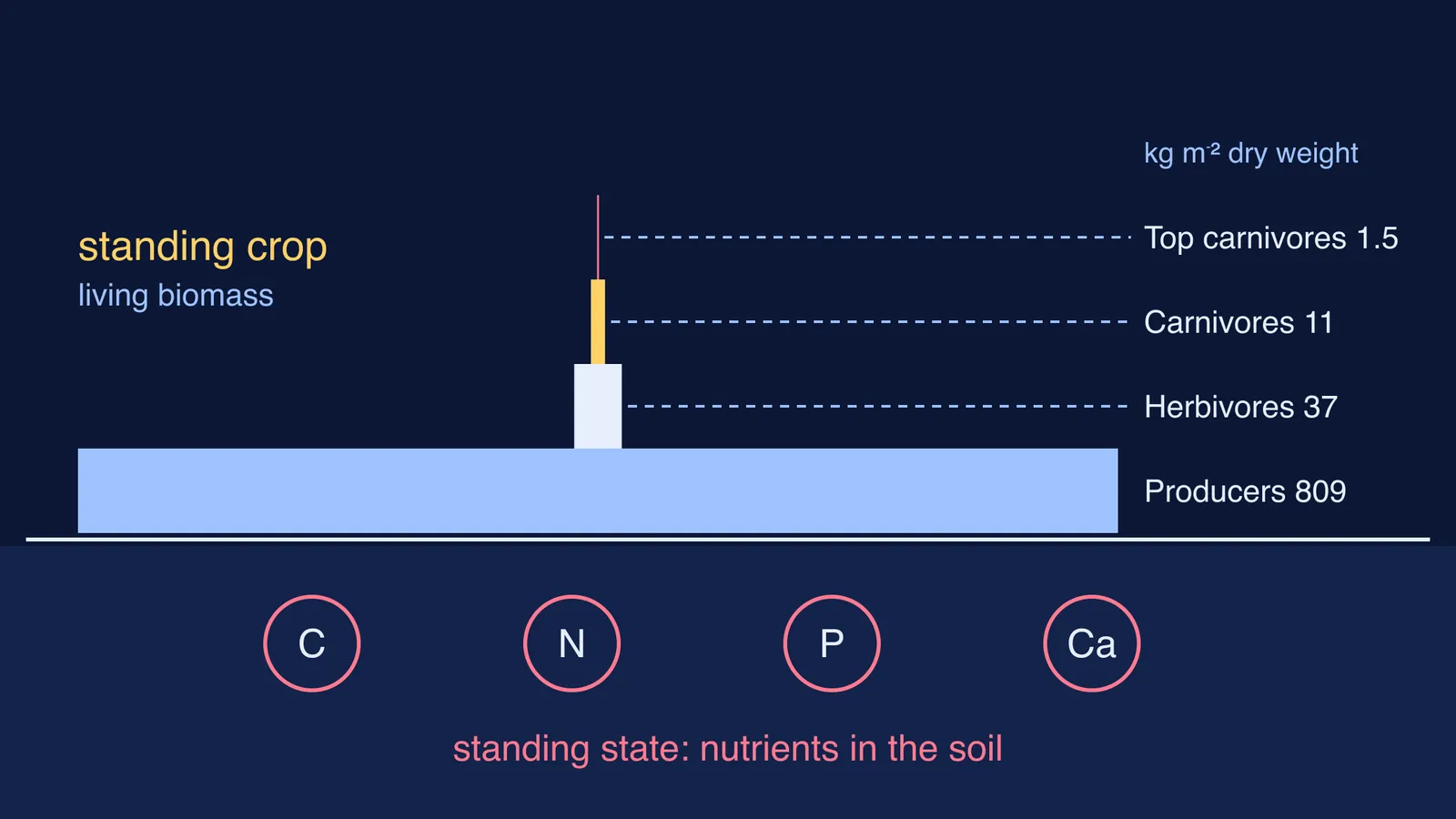
According to the current NCERT Class 12 Biology chapter on ecosystems, each trophic level has a certain mass of living material at a particular time, called the standing crop (NCERT Biology, Chapter 12: Ecosystem). It is measured as the mass of living organisms (biomass) or as the number of organisms in a unit area. The chapter adds that dry weight is more accurate than fresh weight, and asks why. A good answer: fresh weight changes with how much water an organism holds.
NCERT's pyramid of biomass for a grassland gives the standing crop at each level in dry weight: 809 kg per square metre for producers, 37 for primary consumers, 11 for secondary consumers and 1.5 for tertiary consumers (NCERT, Figure 12.4b). In the sea the picture flips. The textbook shows a small standing crop of phytoplankton (4) supporting a larger standing crop of zooplankton (21), which makes that pyramid of biomass inverted. We unpick that paradox in why the pyramid of biomass in the sea is upside down.
What is standing state?
The 2022-23 edition of the same NCERT chapter defined it in its section on nutrient cycling: the amount of nutrients, such as carbon, nitrogen, phosphorus and calcium, present in the soil at any given time is the standing state (NCERT Biology, Chapter 14: Ecosystem, 2022-23 edition, archived copy). That edition adds that the standing state varies between kinds of ecosystem and also with the season.
One thing to know before you revise: the nutrient cycling section is not in the 2026-27 reprint of the chapter, which ends at ecological pyramids, although its summary still mentions nutrient cycling (current NCERT chapter). Older question banks and past papers still use the term, so learn it, and check your current official syllabus to see whether it is examined. For the cycles themselves, read our guide to how carbon and phosphorus cycles work.
What is the difference between standing crop and standing state?
Put the two side by side (NCERT, current chapter; NCERT, 2022-23 edition):
What it is: standing crop is living material at a trophic level; standing state is nutrients in the soil.
Living or not: standing crop is biomass, so living; standing state is nutrients in the soil, so non-living.
How it is measured: standing crop as biomass (best as dry weight) or number per unit area; standing state as the amount of each nutrient in the soil.
Where it appears: standing crop in pyramids of number and biomass; standing state in nutrient cycling.
What they share is "at a given time": both are snapshots, not rates. The rate of biomass production is productivity, in g per square metre per year (NCERT, section 12.2). Our explainer on productivity and decomposition in an ecosystem covers that side.
How do exam questions test standing crop and standing state?
These three practice questions are our own, written in the styles you will meet, and use NCERT's grassland numbers (NCERT, Figure 12.4b).
Identify the term. "The amount of carbon, nitrogen, phosphorus and calcium in the soil at a given time is called: (a) standing crop (b) standing state (c) productivity (d) climax." Answer: (b). The word soil and the list of elements give it away. Standing crop is the usual wrong option.
Calculate a ratio. "In a grassland, producers have 809 kg per square metre and primary consumers 37 kg per square metre. What percentage of the producers' standing crop is the herbivores' standing crop?" Working: 37 / 809 = 0.046, so about 4.6%. From herbivores to secondary consumers it is 11 / 37, about 30%. The trap is to answer 10%: the 10 per cent law is about energy transferred between levels, not the biomass standing at each one.
True or false. "Standing crop is the rate of biomass production in an ecosystem." False. That is productivity. Standing crop is the mass present at one moment.
A 15-minute revision plan for this topic
Write both definitions from memory, then check them against the wording above.
Draw the grassland biomass pyramid with its four numbers and label it standing crop.
Draw a strip of soil under it with C, N, P and Ca, and label it standing state.
Redo the ratio question without looking, and say aloud why the answer is not 10% (NCERT, section 12.4).
If nearby terms (trophic level, biomass, detritus) keep blurring, the Fermi Concept Library gives every concept in biology its own lesson and its place in the map. If pyramid calculations are where you slip, the Fermi Problem Library has worked problems with a step-by-step solver that explains the reasoning rather than printing an answer.
Next step: draw the two-part picture from step 3 once today, and the difference will stay with you.