On this page
Most of us picture an epidemic as one disease spreading through people. Sunetra Gupta asks a different question: why does one disease, such as flu, keep coming back as a set of distinct strains, and which of those strains win? She answers it with simple mathematical models, then works with laboratory scientists to test what the models predict.
Who is Sunetra Gupta?
Gupta was born in Kolkata on 15 March 1965, took her first degree at Princeton and earned her PhD at Imperial College London in 1992, according to her Wikipedia biography. She is Professor of Theoretical Epidemiology at Oxford, and her Oxford profile describes her main interest as "the evolution of diversity in pathogens", especially those behind malaria, influenza and bacterial meningitis.
In her own words on that profile, she uses "simple mathematical models to generate new hypotheses" and works with laboratory and field scientists to test them. The Royal Society gave her its Rosalind Franklin Award in 2009, as Times Higher Education reported. She is also a novelist whose books have won the Sahitya Akademi Award, as her Battle of Ideas speaker page notes.
What is strain structure, and why do strains compete?
The classic epidemic model splits people into susceptible, infected and recovered groups; we told that story in Kermack, McKendrick and the mathematics of an epidemic. Gupta's step was to let the pathogen come in many versions, each defined by the antigens your immune system sees.
Here is the key mechanism in her models. If you recover from one strain, your memory response also gives some protection against any other strain that shares an antigen with it. So strains that share antigens compete for the same pool of unprotected people, while strains with nothing in common do not.
In 1998, Gupta, Neil Ferguson and Roy Anderson showed in Science that strong immune selection can make a pathogen population settle into distinct strains with non-overlapping antigens. At intermediate strength, the same model gave strain patterns that rise and fall in cycles or vary chaotically.
How many strains can survive? A worked example
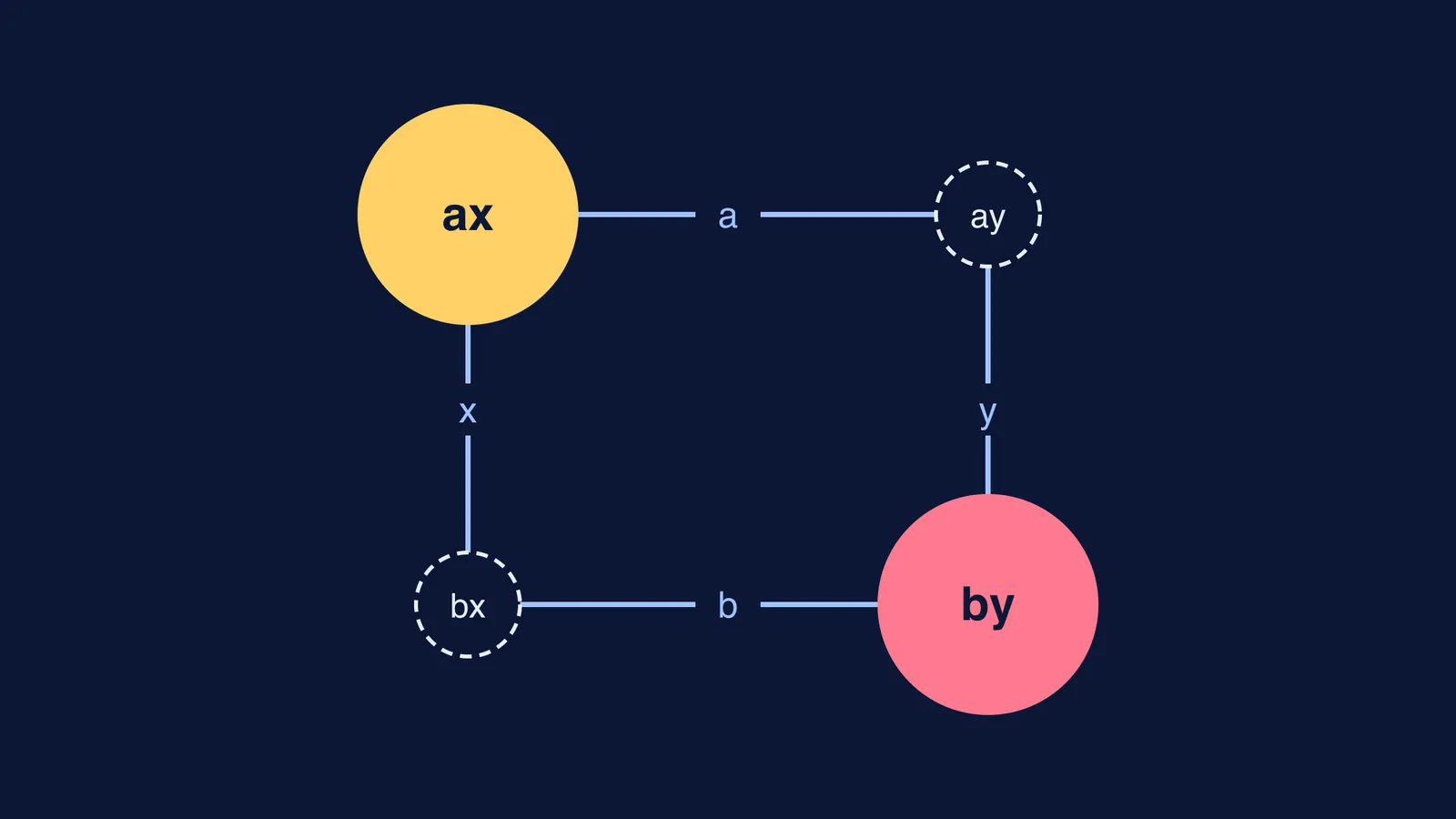
Take a toy pathogen with two antigen sites. Site 1 can be a or b; site 2 can be x or y. That gives 2 × 2 = 4 strains: ax, ay, bx and by.
List which strains overlap. ax shares a with ay and x with bx. It shares nothing with by.
Find a set where no two strains share an antigen. {ax, by} works; so does {ay, bx}. No set of three works, because any third strain must reuse a or b at site 1.
Read off the model's prediction. Under strong cross-protection, one of these non-overlapping pairs dominates and the other two strains are pushed down.
Now try it yourself. With 3 sites and 3 options at each site (a, b or c; p, q or r; x, y or z), there are 3 × 3 × 3 = 27 strains. The largest non-overlapping set has only 3 strains, because each one needs its own option at site 1. Can you write one down? (One answer: apx, bqy, crz.) It is the multiplication rule from permutations and combinations.
How did a model lead to a flu vaccine target?
If strains are organised by a few antigens that matter, there might be parts of the flu virus that are both strongly recognised by the immune system and slow to change. In 2018, Gupta's team reported in Nature Communications an epitope of this kind on the head of the H1 haemagglutinin protein. Young children showed immunity to old flu strains they had probably never met, partly because of this epitope, and mice given the epitope were protected against human H1N1 strains circulating since 1918. Oxford vaccine scientist Sarah Gilbert was one of the co-authors.
That was a preclinical result, not an approved vaccine. Her speaker page says the technology was then licensed to the US start-up Blue Water Vaccines.
How can you start thinking like a modeller?
Use this checklist on any model you meet in class:
What are the groups, and what moves people between them?
What does the model leave out on purpose?
What does it predict that you could check against data?
Which single change (stronger immunity, faster spread) flips the answer?
If the differential equations behind these models are the sticking point, the Fermi Concept Library has a lesson for each concept in mathematics and biology, with its place in the map. Some ideas are easier to see than to read, and the Fermi Simulation Lab has interactive simulations for those.
Start with the toy example above: change one rule, such as allowing three options at site 2, and work out which strains could survive.