On this page
You meet Σn³ = [n(n + 1)/2]² in Class 11 sequences and series, and again in JEE problems that hide it inside a longer sum. Deriving it takes about ten lines, and once you have done it yourself you will not mix it up with the sum-of-squares formula.
What is the formula for the sum of cubes of the first n natural numbers?
The sum of the first n cubes is 1³ + 2³ + … + n³ = [n(n + 1)/2]², the square of the sum of the first n natural numbers (Wolfram MathWorld, Nicomachus's theorem). MathWorld notes the identity is sometimes known as Nicomachus's theorem, and records that Nicomachus noticed that when the odd numbers are grouped in blocks of 1, 2, 3 and so on, each block adds up to a cube.
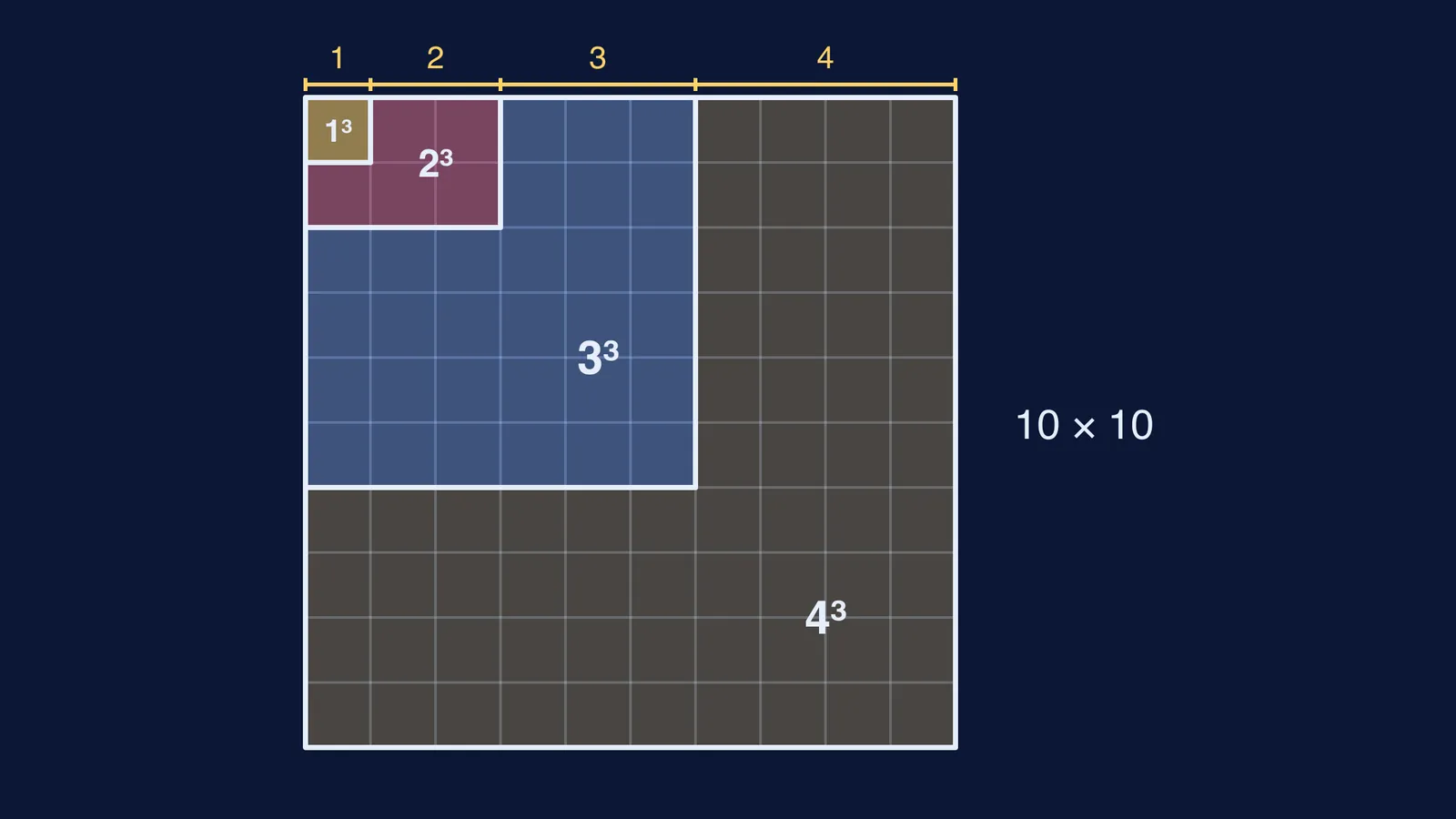
Check it on a small case first: 1³ + 2³ + 3³ = 1 + 8 + 27 = 36, and (1 + 2 + 3)² = 6² = 36. For the picture behind the identity, see the visual proof that 1³ + 2³ + 3³ + 4³ equals (1 + 2 + 3 + 4)².
How do you derive Σn³ using (k + 1)⁴ − k⁴?
The trick is to choose a difference whose biggest leftover term is the one you want. Expanding a fourth power produces a cube term, so start there. This is the telescoping route Alexander Bogomolny works through on cut-the-knot. Call the sum you want S = 1³ + 2³ + … + n³.
Expand: (k + 1)⁴ − k⁴ = 4k³ + 6k² + 4k + 1.
Write this line for k = 1, 2, 3, …, n and add all n lines.
Left side: (2⁴ − 1⁴) + (3⁴ − 2⁴) + … + ((n + 1)⁴ − n⁴). Every middle term cancels, leaving (n + 1)⁴ − 1.
Right side: 4S + 6Σk² + 4Σk + n.
Substitute Σk² = n(n + 1)(2n + 1)/6 and Σk = n(n + 1)/2: (n + 1)⁴ − 1 = 4S + n(n + 1)(2n + 1) + 2n(n + 1) + n.
Move the n across: (n + 1)⁴ − 1 − n = (n + 1)⁴ − (n + 1) = (n + 1)[(n + 1)³ − 1].
So 4S = (n + 1)[(n + 1)³ − 1 − n(2n + 1) − 2n].
Inside the bracket, (n + 1)³ − 1 = n³ + 3n² + 3n. Take away 2n² + n and then 2n, and n³ + n² = n²(n + 1) is left.
Therefore 4S = n²(n + 1)², and S = [n(n + 1)/2]².
Step 5 needs Σk² first. If you have not derived that one yet, the telescoping derivation of the sum of squares uses (k + 1)³ − k³ in exactly the same way, one power lower.
How do you find 11³ + 12³ + … + 20³?
Do not add ten cubes. Take the sum up to 20 and subtract the sum up to 10.
Sum of cubes to 20: [20 × 21/2]² = 210² = 44100.
Sum of cubes to 10: [10 × 11/2]² = 55² = 3025.
Answer: 44100 − 3025 = 41075.
Check it a second way: 210² − 55² = (210 − 55)(210 + 55) = 155 × 265 = 41075. Adding the ten cubes directly gives the same total.
The rule: to sum cubes from a to b, take S(b) − S(a − 1). Subtracting S(11) would quietly drop 11³.
Which mistakes cost marks with this formula?
Dropping the square. n(n + 1)/2 is the sum of the numbers; the sum of their cubes is that value squared.
Mixing it up with Σk² = n(n + 1)(2n + 1)/6. If your cube sum has a (2n + 1) in it, you have used the wrong formula.
The off-by-one in a range, as above: the lower limit is a − 1, not a.
Using it on cubes that are not consecutive. For 1³ + 3³ + 5³ + …, expand (2k − 1)³ and combine Σk³, Σk² and Σk, as in this step-by-step guide to summing series with Σn, Σn² and Σn³.
If a line of your own working does not match, the Fermi Problem Library has worked problems with a step-by-step solver that explains the reasoning rather than printing an answer, so you can compare each step with yours and find where you went off.
A 10-minute practice plan
Derive Σk² from (k + 1)³ − k³ without notes.
Derive Σk³ from (k + 1)⁴ − k⁴, factoring out (n + 1) at step 6.
Test it at n = 4: you should get 100.
Try 21³ + 22³ + … + 30³ on your own. Self-check: S(30) − S(20) = 465² − 210² = 216225 − 44100 = 172125.
To revise the sums of k and k² this rests on, the Fermi Concept Library covers every concept in mathematics, each with its own lesson and its place in the map.