On this page
Calculate the first few cubes: 1³ + 2³ + 3³ + 4³ = 1 + 8 + 27 + 64 = 100.
Now, add the base numbers together: 1 + 2 + 3 + 4 = 10.
Square that sum: 10² = 100.
This relationship is not a coincidence. Nicomachus's theorem, named after the ancient mathematician Nicomachus of Gerasa, states that the sum of the first n cubes is always equal to the square of the nth triangular number (source). While you can prove it using mathematical induction, looking at the algebra alone often leaves students wondering why it is true.
Why do we use a visual proof?
A "proof without words" or visual proof translates an abstract equation into a geometric picture. A visual proof can provide valuable intuitions to the viewer that help them formulate or better understand a true proof (source). Instead of memorising formulas, you can literally see the equality by counting areas. When you shift from symbols to shapes, the logic clicks into place. If you ever forget the formula during an exam, you can redraw the picture to find it.
How do you build the squares?
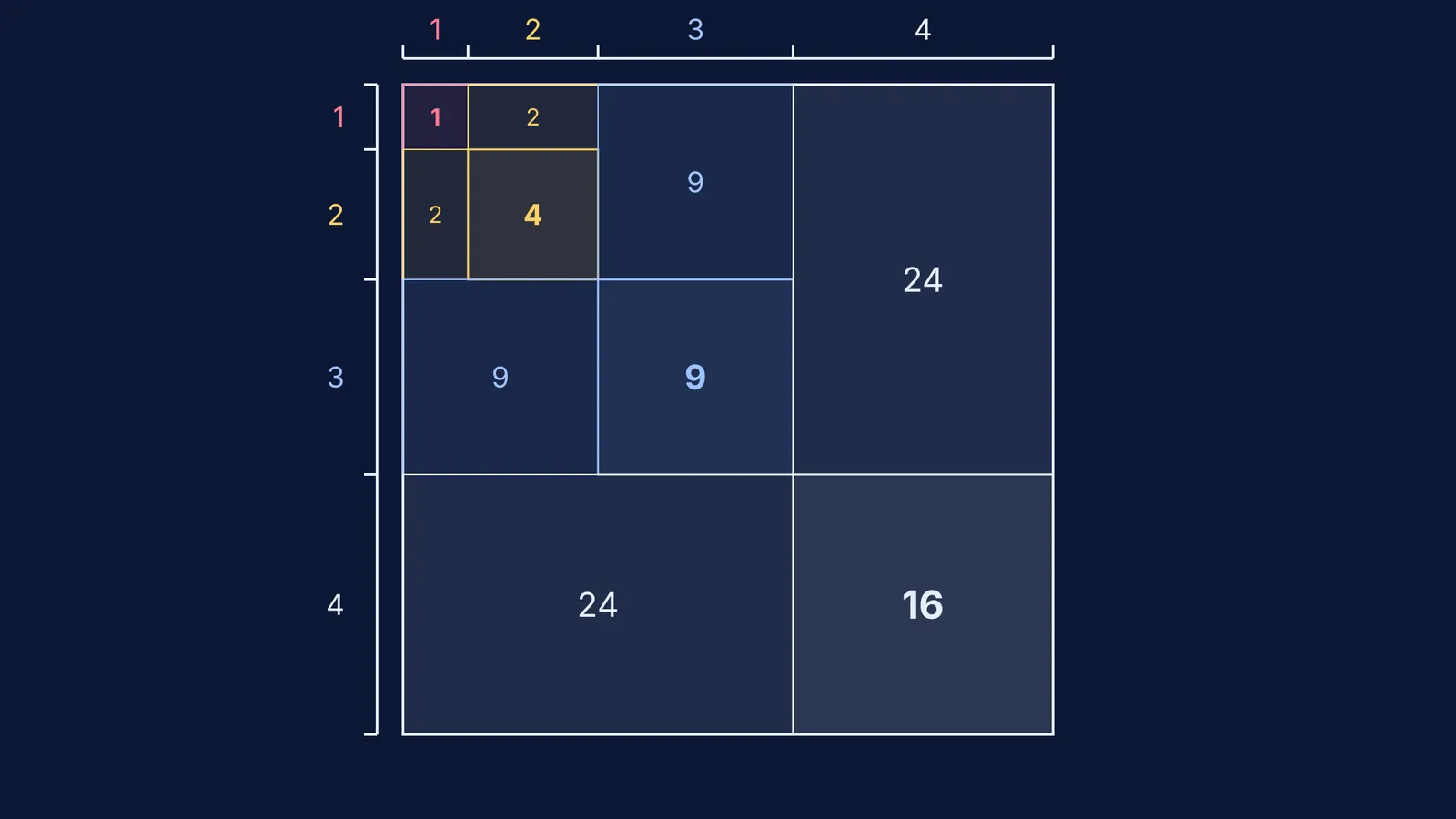
Let's build a square with a side length of 10. We will split its sides into segments of lengths 1, 2, 3 and 4. The total area of this square is 10 × 10 = 100. Our goal is to show that this area of 100 is exactly made up of the cubes: 1³, 2³, 3³ and 4³.
Imagine building it block by block from the top left corner:
The first block (1³): We start with a 1 × 1 square. Its area is 1. This matches 1³.
The second block (2³): We add an L-shaped boundary (a gnomon) to grow our square from 1 × 1 to 3 × 3. This new addition consists of a 2 × 2 square in the corner, and two 1 × 2 rectangles. The total area of this addition is 4 + 2 + 2 = 8. This exactly matches 2³.
The third block (3³): We add another boundary to grow from 3 × 3 to 6 × 6. This addition uses a 3 × 3 square, and two 3 × 3 rectangles. The area added is 9 + 9 + 9 = 27. This exactly matches 3³.
The fourth block (4³): We add the final boundary to reach 10 × 10. This requires a 4 × 4 square in the corner, and two 4 × 6 rectangles. The area is 16 + 24 + 24 = 64. This exactly matches 4³.
Each time we expand the square, the area we add is exactly the next perfect cube. By the time we finish, the entire square of (1 + 2 + 3 + 4)² is filled perfectly by the cubes.
What is the algebra behind the picture?
While the picture proves the case for 4³, the real power of a visual proof is that it generalises to any number n. Let us break down the mathematics of that L-shaped boundary we add in each step.
When you expand the main square to include the next number n, you add three distinct rectangular areas:
A square in the new corner, which has side length n and area n².
Two identical rectangles connecting that corner square to the rest of the shape. Each rectangle has a width of n and a length equal to the side of the previous large square (which is the sum of all numbers up to n − 1).
The area of those two rectangles is 2 × (n × sum of previous numbers). The sum of the first n − 1 numbers is given by the formula n(n − 1)/2.
Therefore, the area of the two rectangles simplifies to n²(n − 1), which expands to n³ − n².
When you add the n² area from the corner square, the n² terms cancel out. You are left with exactly n³. This means every time you expand the square's side by n, you increase its total area by exactly n³.
How can I use this to study better?
Rote memorisation works until the pressure of a major exam makes you second-guess an exponent. In mathematics and physics, visualising the problem builds a much stronger, more resilient memory because it forces you to engage with the underlying logic.
If you find yourself stuck on abstract patterns and unable to picture them, you might need a different angle. This is where the Fermi Simulation Lab helps; it turns static equations into interactive models you can manipulate. Seeing how variables behave on screen is often faster than reading another page of theory.
When you sit down to tackle a difficult mathematics assignment, try this three-step approach:
Draw the problem: Can you turn the equation into a shape, a graph or a physical model?
Check small cases: Does the rule hold for n = 1, 2 and 3? Testing simple numbers grounds the algebra, much like breaking down sums like 9 + 99 + 999.
Ask why: If a formula seems magical, there is usually a geometric or physical reason behind it.
The next time you face a tough series or a tricky algebra step—like recovering aₙ from a formula for Sₙ or inserting arithmetic and geometric means—try to sketch it first. Understanding the picture is the first step to mastering the mathematical proof.