

On this page
Most "find the sum to n terms" questions reward one habit: write the general term first, then let three standard formulas do the adding. Here is the method on three series, quick checks, and a practice set.
What are the formulas for Σn, Σn² and Σn³?
For the first n natural numbers, the three results are these, as given on Wolfram MathWorld's power sum page:
Σk = 1 + 2 + … + n = n(n+1)/2
Σk² = 1² + 2² + … + n² = n(n+1)(2n+1)/6
Σk³ = 1³ + 2³ + … + n³ = [n(n+1)/2]²
The sum of the first n cubes equals the square of the sum of the first n natural numbers, a result known as Nicomachus's theorem (MathWorld). Add a fourth you will need all the time: Σ1 = n, because adding 1 to itself n times gives n.
Are these sums in the JEE and CBSE syllabus?
The JEE (Advanced) 2026 Information Brochure lists "sum of the first n natural numbers, sums of squares and cubes of the first n natural numbers" in its mathematics syllabus. The JEE (Main) 2027 syllabus posted by NTA lists progressions, inserting means and the A.M.–G.M. relation under Sequence and Series, without naming these special sums. The CBSE Class XI mathematics curriculum for 2026-27 also covers progressions and means only. Syllabi change, so check the current official document for your exam. For the wider chapter, see our guide to sequences and series for JEE.
How do you sum a series using Σn² and Σn³?
Four steps, every time:
Find the kth term. Look at each factor on its own: in 1·2 + 2·3 + 3·4, the first factors run 1, 2, 3 (so k) and the second run 2, 3, 4 (so k + 1).
Expand the kth term into powers of k.
Split the sum: Σ(ak³ + bk² + ck + d) = aΣk³ + bΣk² + cΣk + dn.
Substitute the formulas, take out the common factor and simplify.
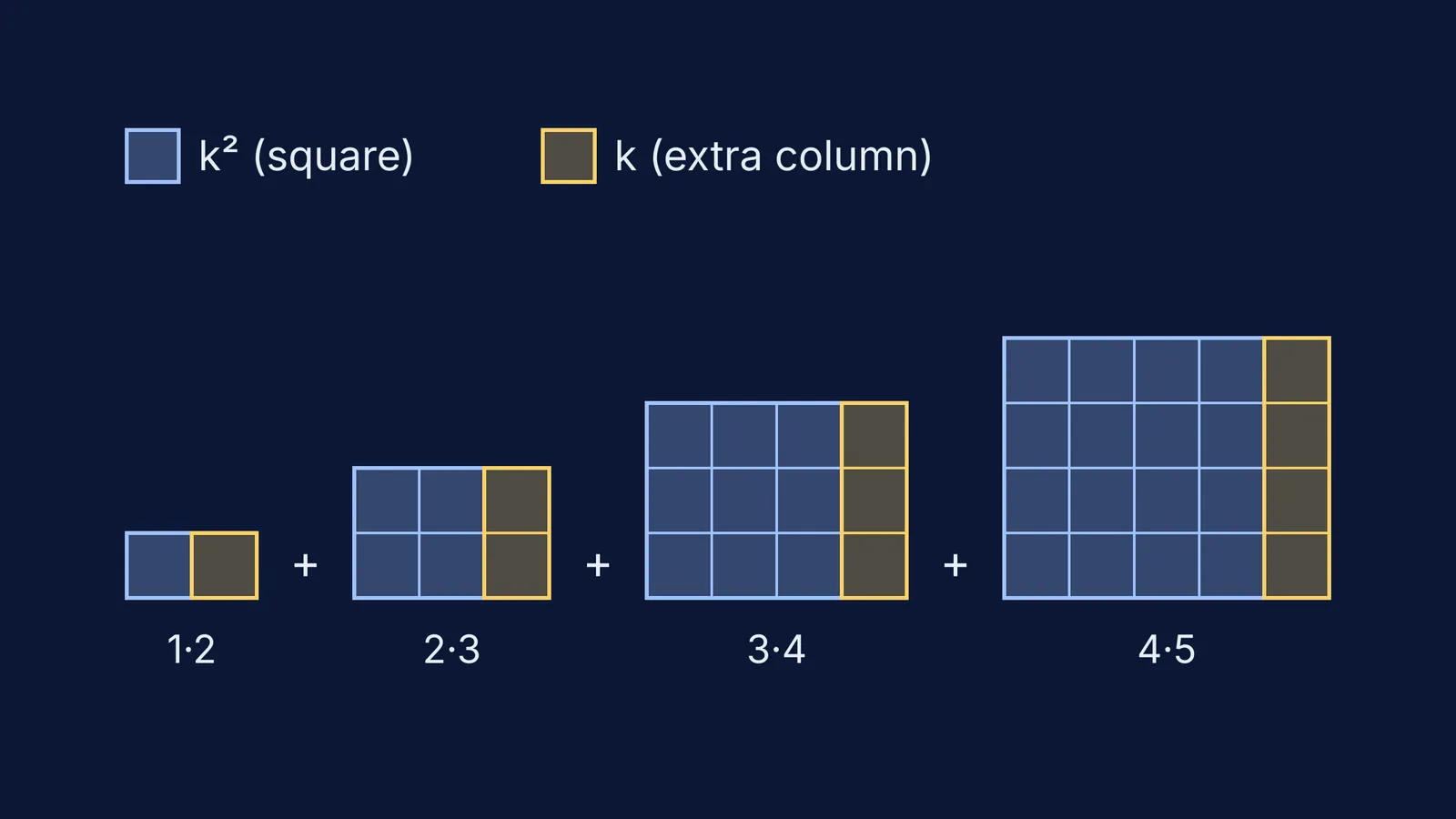
Example 1: 1·2 + 2·3 + 3·4 + … to n terms. The kth term is k(k + 1) = k² + k.
So the sum is Σk² + Σk = n(n+1)(2n+1)/6 + n(n+1)/2.
Take out n(n+1)/6: the sum is n(n+1)/6 × (2n + 1 + 3) = n(n+1)(2n+4)/6 = n(n+1)(n+2)/3.
That means 1·2 + 2·3 + … + 20·21 = 20·21·22/3 = 3080.
Example 2: 1·2·3 + 2·3·4 + … to n terms. The kth term is k(k+1)(k+2) = k³ + 3k² + 2k.
The sum is [n(n+1)/2]² + 3·n(n+1)(2n+1)/6 + 2·n(n+1)/2.
Take out n(n+1)/4: the sum is n(n+1)/4 × [n(n+1) + 2(2n+1) + 4] = n(n+1)(n² + 5n + 6)/4 = n(n+1)(n+2)(n+3)/4.
Example 3: 1² + 3² + 5² + … to n terms. The bases are odd numbers, so the kth term is (2k − 1)² = 4k² − 4k + 1. Watch the constant 1: it sums to n, not 1.
The sum is 4·n(n+1)(2n+1)/6 − 4·n(n+1)/2 + n = n/3 × (4n² + 6n + 2 − 6n − 6 + 3) = n(4n² − 1)/3 = n(2n − 1)(2n + 1)/3.
When the term is a fraction like 1/(k(k+1)), these formulas don't apply; use the method of differences for summing series instead.
How do you check your answer quickly?
Put small values of n into your final formula and compare with the series itself:
n = 1 must give the first term. Example 1: 1·2·3/3 = 2, and the first term is 1·2 = 2.
n = 2 must give the first two terms added. Example 2: 2·3·4·5/4 = 30, and 6 + 24 = 30.
Example 3 with n = 3: 3·5·7/3 = 35, and 1 + 9 + 25 = 35.
The slips these checks catch most often:
A shifted index: in 2·5 + 3·6 + 4·7 + …, the kth term is (k + 1)(k + 4), not k(k + 3).
A dropped constant: Σ1 is n.
Mixing up n (how many terms) and k (which term): in 1·2 + … + 30·31, n is 30.
If a question gives you the sum and asks for the term instead, work backwards with our explainer on finding the nth term from Sn.
A 15-minute practice set
Write the kth term first, then sum to n terms. Check each answer at n = 1 and n = 2 before looking.
1·3 + 2·4 + 3·5 + … (answer: n(n+1)(2n+7)/6)
2² + 4² + 6² + … (answer: 2n(n+1)(2n+1)/3)
1·2² + 2·3² + 3·4² + … (answer: n(n+1)(n+2)(3n+5)/12)
If an answer keeps failing the n = 2 check and you can't see why, the Fermi Problem Library has worked problems with a step-by-step solver that explains the reasoning rather than printing an answer. If the formulas themselves feel shaky, the Fermi Concept Library gives every mathematics concept its own lesson and its place in the map.


