

On this page
Mathematics is built on structure, not rote memorisation. When you are faced with finding the sum of the first n squares—written as Σk² = 1² + 2² + 3² + … + n²—it is tempting to just memorise the result. However, deriving the formula yourself is a much more durable strategy.
In a landmark 2014 meta-analysis of 225 studies published in the Proceedings of the National Academy of Sciences (PNAS), Scott Freeman and his colleagues found that active learning methods in STEM disciplines increase examination scores by an average of 6%. Deriving formulas from scratch forces you to engage with the underlying algebra, turning a passive memory task into an active proof.
If you struggle to recall derivations or see the algebra unfold, Fermi's AI tutor works out what you already know and builds a plan for the session, teaching you mathematical methods step by step rather than just giving you the answer.
How do you derive the sum of squares formula using a telescoping sum?
An elegant way to find the sum of squares is to use a method of differences, creating what is known as a telescoping series. In a telescoping sum, consecutive intermediate terms cancel each other out, much like a collapsible hand-held telescope sliding into itself.
To find the sum of squares (k²), we start one power higher by expanding the binomial cube (k + 1)³:
(k + 1)³ = k³ + 3k² + 3k + 1
Subtract k³ from both sides to isolate the difference:
(k + 1)³ - k³ = 3k² + 3k + 1
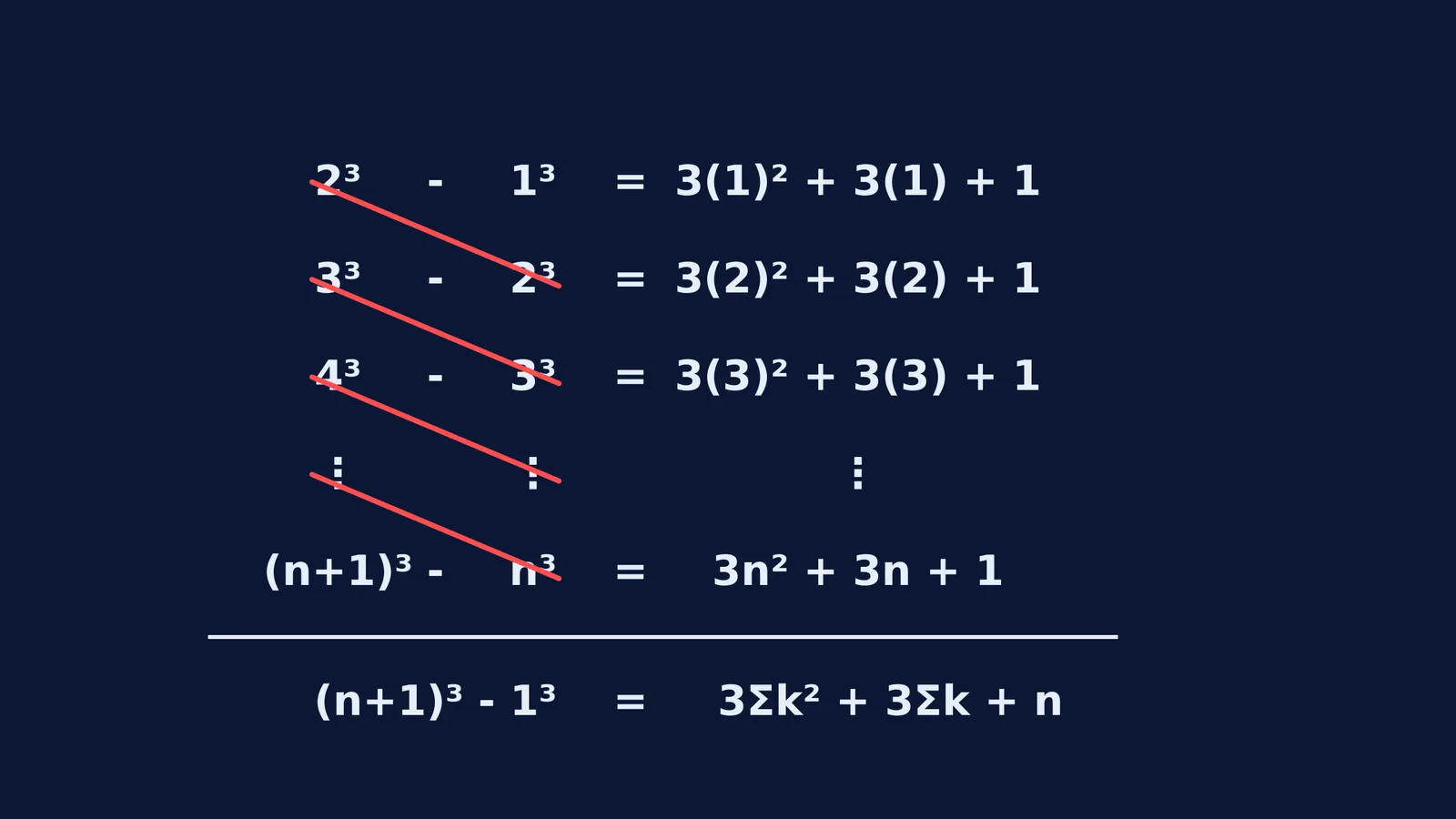
Next, we write out this identity for every integer from k = 1 up to k = n, and sum both sides of the equations:
For k = 1: 2³ - 1³ = 3(1)² + 3(1) + 1 For k = 2: 3³ - 2³ = 3(2)² + 3(2) + 1 For k = 3: 4³ - 3³ = 3(3)² + 3(3) + 1 ... For k = n: (n + 1)³ - n³ = 3(n)² + 3(n) + 1
When you add the left column together, a massive cancellation happens. The positive 2³ in the first row cancels with the negative 2³ in the second row. The 3³ cancels with the -3³, and so on. Only the very last (n + 1)³ and the very first -1³ survive.
(n + 1)³ - 1³ = 3(Σk²) + 3(Σk) + Σ1
This trick of subtracting terms or restructuring sequences is a recurring theme in mathematics—similar to rewriting Sums like 9 + 99 + 999 + … as a geometric progression, or recovering aₙ from a formula for Sₙ using the subtraction trick.
Why does the (k + 1)³ - k³ trick work?
We now have an equation containing our target, Σk², alongside two simpler sums we already know: the sum of the first n integers (Σk = n(n + 1)/2) and the sum of n ones (Σ1 = n).
Substitute those knowns into the right side:
(n + 1)³ - 1 = 3(Σk²) + 3n(n + 1)/2 + n
Expand the left side ((n + 1)³ - 1 = n³ + 3n² + 3n) and isolate the 3(Σk²) term:
n³ + 3n² + 3n - n = 3(Σk²) + (3n² + 3n)/2
n³ + 3n² + 2n = 3(Σk²) + (3n² + 3n)/2
Multiply the entire equation by 2 to clear the fraction:
2n³ + 6n² + 4n = 6(Σk²) + 3n² + 3n
Subtract 3n² + 3n from both sides:
2n³ + 3n² + n = 6(Σk²)
Factor out an n:
n(2n² + 3n + 1) = 6(Σk²)
Finally, factor the quadratic to reveal the standard formula:
Σk² = n(n + 1)(2n + 1) / 6
For a wider look at algebraic structures, check out the Fermi Concept Library, or explore patterns like Sums of binomial coefficients.
Where did the sum of squares formula come from?
Long before algebraic identities were formalised, ancient mathematicians needed the sum of squares to solve physical and geometric problems.
In his treatise *On Spirals* (c. 225 BC), the Greek mathematician Archimedes used the sum of squares to calculate the area bounded by the first turn of an Archimedean spiral. Because the radius of the spiral grows linearly, calculating the area of sectors required summing the squares of those radii. Using a geometric method of exhaustion, Archimedes proved limits that are mathematically equivalent to the modern formula.
Today, this algebraic method of differences acts as a bridge to integral calculus, proving that summation and differencing are inverse operations.


