On this page
The Symbiosis Entrance Test (SET) is the common computer-based test for undergraduate programmes at the institutes of Symbiosis International (Deemed University). Your SET score gets you onto each institute's shortlist and then counts again in the final merit list, alongside a Personal Interaction. The facts below come from the official SET 2026 bulletin. Rules can change each year, so check set-test.org for the new bulletin before you register.
What is the SET exam pattern?
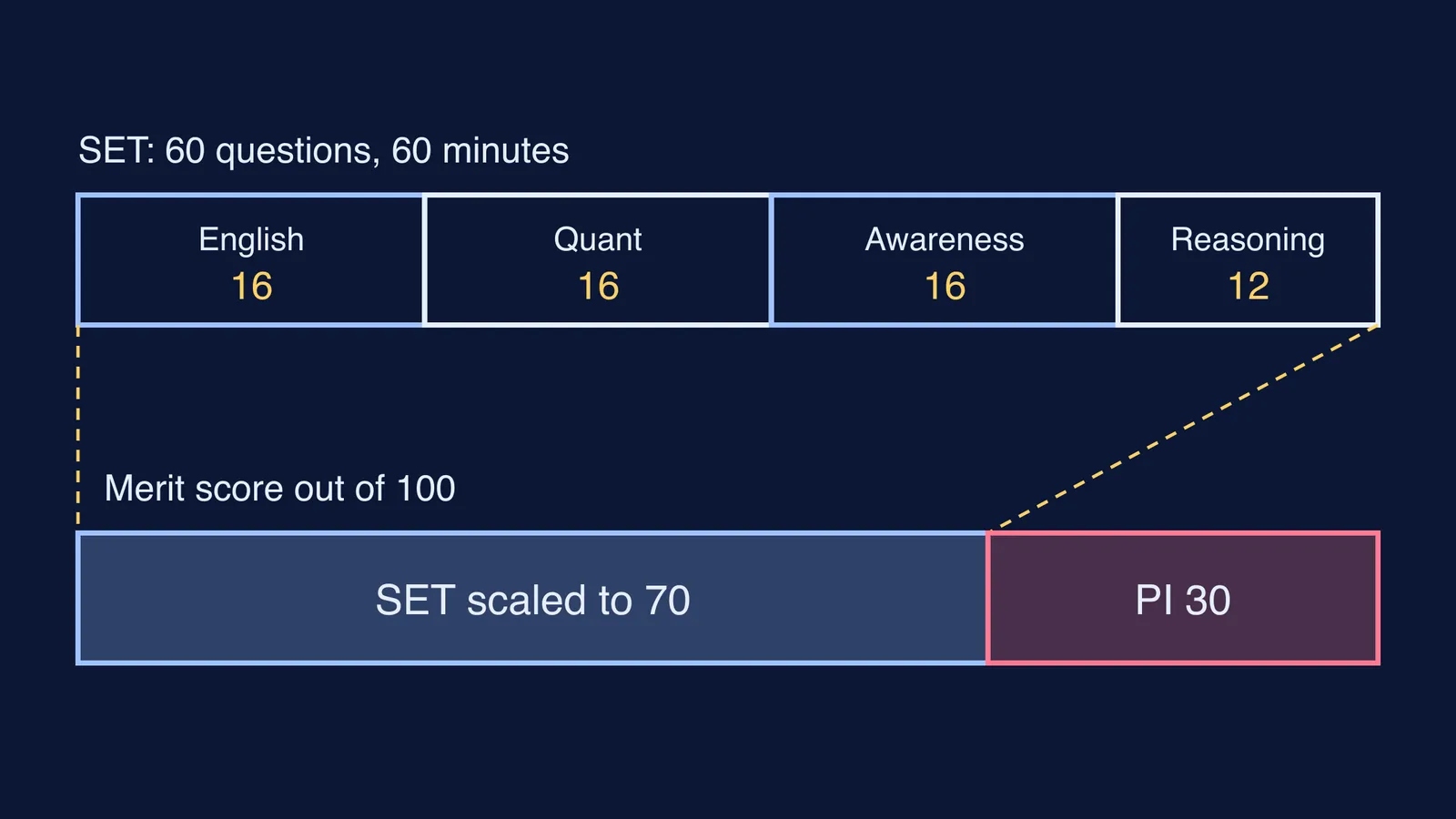
SET has 60 questions worth 60 marks in 60 minutes, with no negative marking for wrong answers (SET 2026 structure). All four sections are compulsory:
General English: 16 questions
Quantitative: 16 questions
General Awareness: 16 questions
Analytical and Logical Reasoning: 12 questions
You may attempt the sections in any order, according to the SET 2026 bulletin. In 2026 you could sit SET on two dates, 2 May and 10 May, and only the higher score counted. Two things follow. With no negative marking, leave no question blank. And sixty questions in sixty minutes is about one minute each, so a question that eats three minutes costs you two others.
B.Tech is different: the Symbiosis Institute of Technology admits through its own test, SITEEE, or through JEE Main or a state engineering entrance, as the same bulletin explains.
Which programmes use SET and the Personal Interaction?
The 2026 bulletin's merit table lists 13 institutes that admit through SET, among them the five SCMS campuses, SICSR, SCMC, the School of Economics and the School for Liberal Arts (SET 2026 bulletin). Their programmes include the BBA, BCA, BBA (IT), BA (Mass Communication), BSc (Economics), BSc (Applied Statistics and Data Science), Liberal Arts, Sport and Exercise Science, Artificial Intelligence and Hospitality.
For every one of them, the 2026 merit table scaled your SET marks to 70 and added a Personal Interaction score out of 30, for a total of 100. Some programmes, including design, nursing, paramedical, culinary arts and visual arts, do not need SET.
One step people miss: in 2026 you paid INR 2,250 per SET test and a separate INR 1,000 for each programme, plus government taxes (SET 2026 bulletin). Without the programme fee, your score is not considered for that programme at all.
What happens at the PI-WAT stage?
The second round is often called “PI-WAT”, but the bulletin is more careful: each institute's process “may include any or all of” a Writing Ability Test (WAT), Group Discussion, Studio Test and Personal Interview, with weightages that may vary (SET 2026 bulletin). Check your institute's page for which parts it uses. Missing any one part takes you out of selection.
For 2026, SCMS Pune described only an online Personal Interaction with a panel of experts from industry and academia, looking at general awareness, extracurricular activities, academics, your field of interest and communication skills (SCMS Pune FAQ).
Prepare three one-minute answers out loud, each built as point, example, link to the programme:
Why this programme? One thing in the course you want, and one thing you have done that led you to it.
What do you do outside class? One activity and one specific moment from it, not a list.
What is happening in your field? One recent story and your own view on it.
Rehearse with a partner, or try the method in how to practise a college or scholarship interview with AI. If your institute lists a WAT, write one short timed opinion piece on a news topic each week.
How should you prepare for SET in four weeks?
This plan is built around the 60-question, 60-minute paper on the official SET structure page.
Week 1, find your baseline. Take one timed practice paper and note your score in each section. Fermi's AI tutor can work out what you already know and build a plan for the session, so each day starts with a clear next step.
Week 2, quantitative and reasoning. Work 20 quant questions a day on percentages, ratios and averages, plus 10 reasoning puzzles. When a method keeps going wrong, the Fermi Problem Library has worked problems with a step-by-step solver that explains the reasoning rather than printing an answer.
Week 3, English and general awareness. Read one editorial a day; note five new words and two news facts. Write one practice WAT piece.
Week 4, full papers and the interview. Take two timed papers and review each with the 60-minute mock test review routine. Rehearse your three answers and keep your Class 12 mark sheet and any category certificate in one folder.
Sitting other management entrances too? Our NMIMS NPAT exam pattern guide shows where the sections overlap.
Start this week with one timed paper. Its four section scores will tell you where the next three weeks should go.