On this page
Uniport, symport and antiport are three words for one idea: a carrier protein moving molecules across a membrane. The difference is how many kinds of molecule it carries and which way each one goes. Learn that, attach one plant example to each word, and the NEET-UG style question "which of these is an antiport?" is quick to answer.
What is the difference between symport, antiport and uniport?
OpenStax Biology 2e gives the definitions in three sentences (OpenStax, Biology 2e, section 5.3):
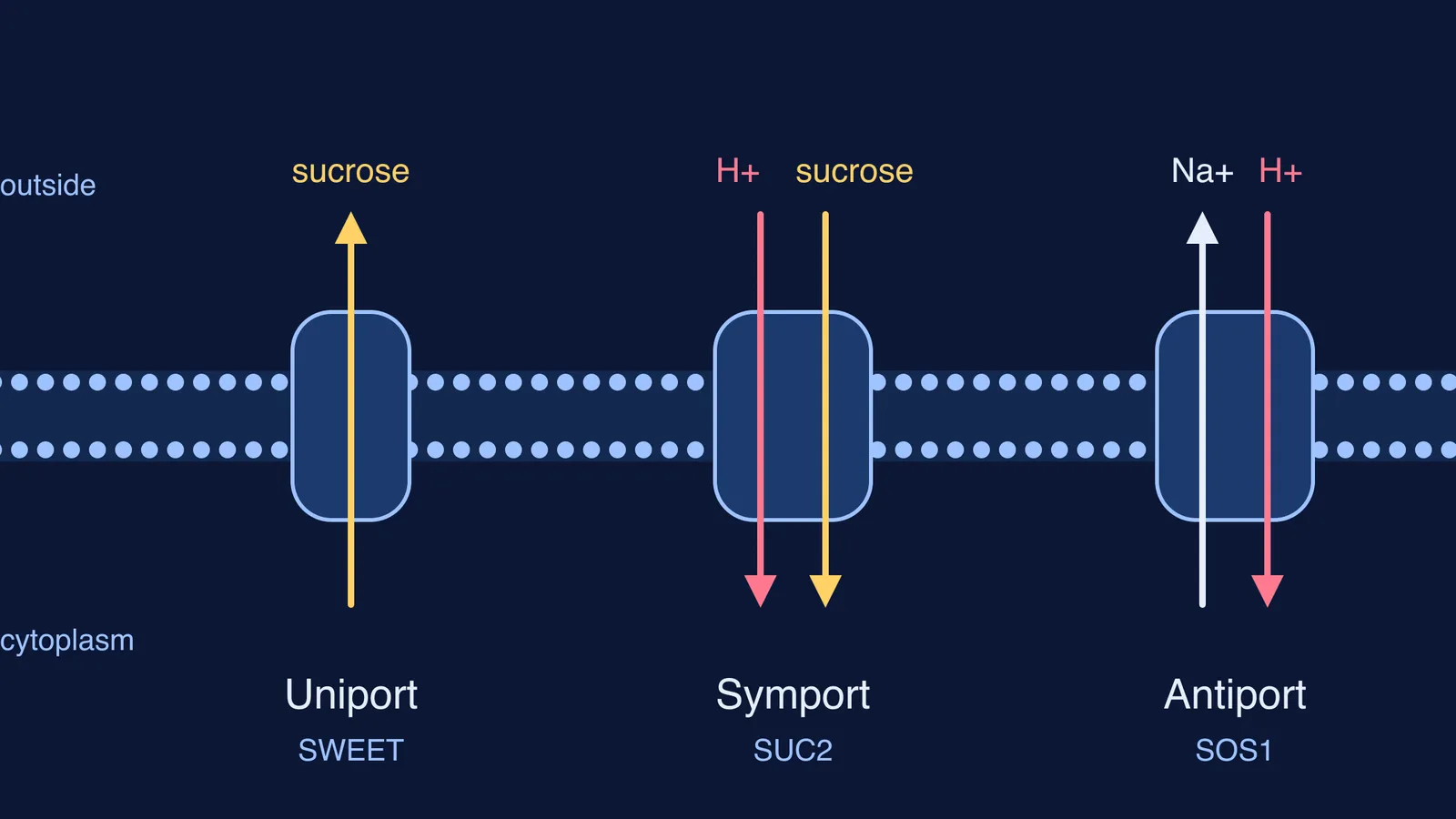
Uniport: a uniporter carries one specific ion or molecule.
Symport: a symporter carries two different ions or molecules, both in the same direction.
Antiport: an antiporter carries two different ions or molecules, but in different directions.
The words describe direction, not energy. Energy is a separate question, and it is where most mistakes happen. More on that below.
How do plant cells use each kind of carrier?
The clearest plant examples come from two jobs: moving sugar out of leaves and coping with salt.
Uniport: SWEET lets sucrose out of leaf cells
In 2012, Li-Qing Chen and colleagues identified the SWEET family of transporters, which carry sucrose out of leaf cells; when the transporters were disabled, sucrose built up in the leaves (Chen et al., Science, 2012). A later review by Chen explains that SWEETs appear to work as uniporters, letting sugars diffuse across cell membranes, and that they probably move sucrose out of phloem parenchyma cells into the cell wall space next to the phloem (Chen, New Phytologist). One molecule, one direction, downhill: a uniporter.
Symport: SUC2 pulls sucrose into the phloem with H+
Next, the sucrose has to get into the phloem, where its concentration is already high. In Arabidopsis, sucrose released by SWEETs is taken up by SUT1/SUC2 sucrose/H+ symporters (Bezrutczyk et al., New Phytologist, 2018). The same study found that maize plants with three leaf SWEET genes knocked out were severely stunted and their leaves held high levels of sugars and starch. This loading step is what builds the pressure in the pressure flow hypothesis of phloem transport.
Antiport: Na+/H+ exchangers keep salt out of the cytoplasm
The Arabidopsis salt-tolerance gene SOS1 codes for a putative Na+/H+ antiporter: its membrane region has significant sequence similarity to the plasma membrane Na+/H+ antiporters of bacteria and fungi, and sos1 mutations make plants more sensitive to growth inhibition by high Na+ (Shi et al., PNAS, 2000). Inside the cell, a vacuolar Na+/H+ antiport can lock sodium away in the vacuole. Arabidopsis plants that overproduced the vacuolar antiport AtNHX1 kept growing in soil watered with up to 200 millimolar sodium chloride (Apse et al., Science, 1999).
Is symport active or passive transport?
Usually symport is secondary active transport. OpenStax describes secondary active transport as movement that does not directly use ATP but runs on an electrochemical gradient set up by primary active transport (OpenStax, Biology 2e, section 5.3).
In animal cells that gradient is often made of Na+. Plants use H+ instead. The plasma membrane H+-ATPase uses ATP to push protons out of the cytoplasm, and the resulting proton gradient drives the secondary transport of many compounds (Michalak, Wdowikowska and Janicka, Cells, 2022). So SUC2 spends no ATP itself. H+ flows back in down its gradient, and sucrose comes along uphill.
Compare the sodium-potassium pump, which moves 3 Na+ out and 2 K+ in. OpenStax counts it as an antiporter, because its two ions go in opposite directions (OpenStax, Biology 2e, section 5.3). But it splits ATP itself, so it is primary active transport, not secondary.
How do you classify any transporter in an exam?
Ask three questions, in this order:
How many different substances does it carry? One means uniport.
If two, do they go the same way (symport) or opposite ways (antiport)?
Does the protein split ATP itself? If yes, it is a primary pump. If no, find the substance going down its gradient: that is the driver, and the other one is being carried uphill.
Try it on these four before reading the answers:
Sucrose leaves a phloem parenchyma cell through SWEET, and nothing else moves with it.
Sucrose and H+ enter a companion cell together through SUC2.
Na+ leaves a root cell through SOS1 while H+ enters.
The Na+/K+-ATPase moves Na+ out and K+ in.
Answers: (1) uniport, passive; (2) symport, secondary active, driven by H+; (3) antiport, secondary active, driven by H+ moving into the cell; (4) antiport too, but primary active, because the pump splits ATP itself.
If the energy side still feels shaky, the Fermi Concept Library gives every biology concept its own lesson and shows its place in the map, so you can see how the proton pump, symport and phloem loading connect. To see the same carrier ideas at work in roots, read active vs passive absorption of water by roots.