On this page
If you have ever wondered how sugar made in a leaf ends up in a mango or a potato, the answer most textbooks give is the pressure flow hypothesis. Here is the mechanism in four steps, the evidence behind it, and a way to write it up without losing marks.
What is the pressure flow hypothesis?
The pressure flow hypothesis, introduced by Ernst Münch in 1930, says that osmotically generated pressure differences drive sugars through the sieve tubes of the phloem (Knoblauch et al., eLife 2016). It is also called the mass flow or bulk flow hypothesis, because the whole solution moves together, not one sugar molecule at a time.
Two words do most of the work. A source is a part of the plant that produces sugars, such as a leaf; a sink is where sugars are delivered, such as roots, young shoots and developing seeds (OpenStax Biology 2e). Moving sugar from source to sink through the phloem is called translocation.
How does phloem translocation work, step by step?
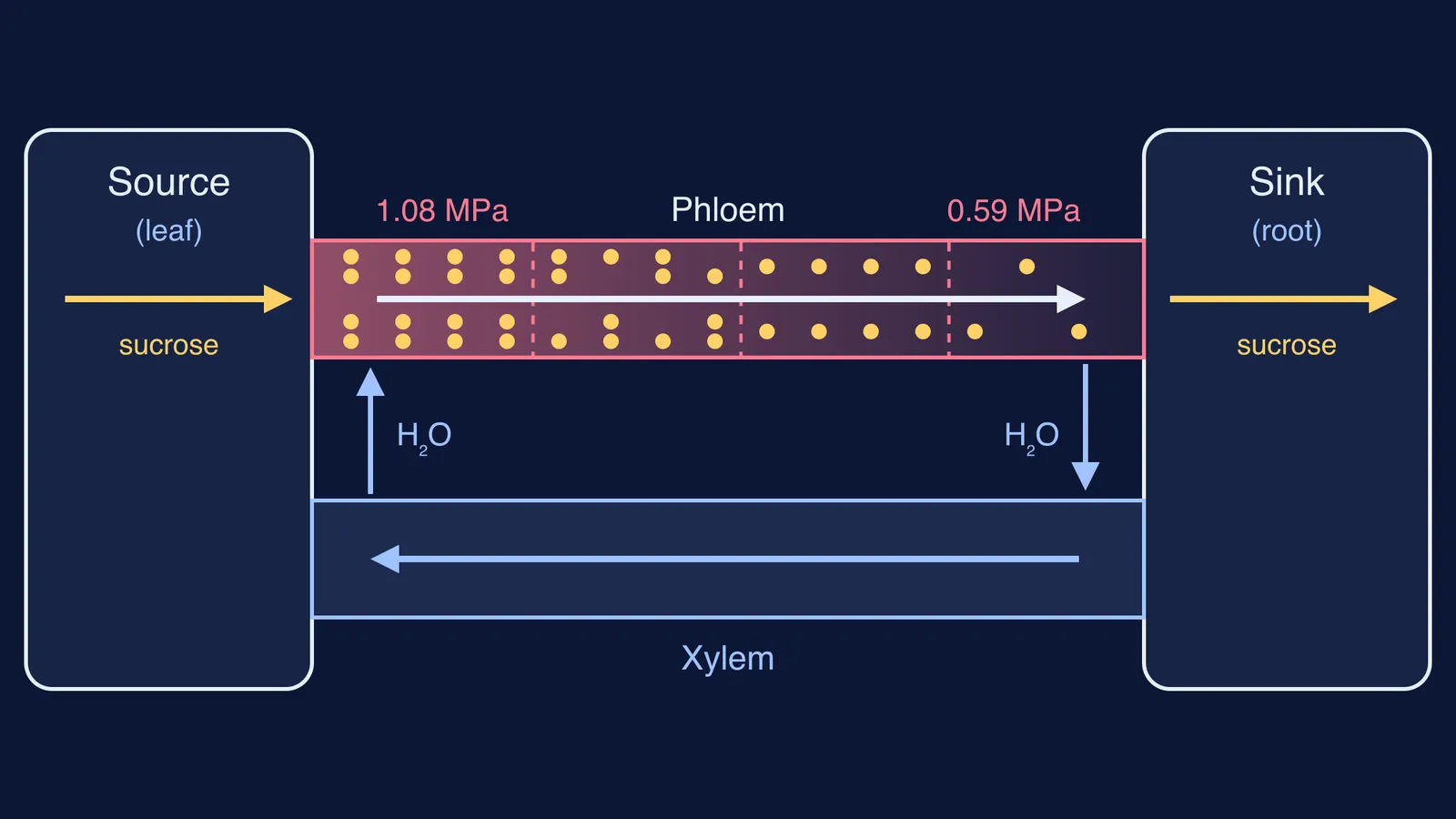
Follow the diagram at the top of this page from left to right. The four steps below follow the OpenStax Biology 2e section on transport in plants.
Loading at the source. Sucrose made in the leaf's mesophyll cells is actively transported into the sieve tube elements against its concentration gradient, using ATP and a sucrose-H+ symporter. Companion cells beside the sieve tubes help supply the energy.
Water enters. The high sugar concentration lowers the water potential inside the sieve tube, so water moves in by osmosis from the neighbouring xylem.
Pressure pushes the sap. The incoming water raises the pressure at the source end. The sap, which can be up to 30 percent sugar, flows in bulk towards the lower-pressure sink end.
Unloading at the sink. Sucrose leaves the phloem at the sink by diffusion or active transport. Water follows by osmosis and is transpired or carried back in the xylem.
Notice the loop: water travels in the xylem, crosses into the phloem at the source, moves with the sugar, and returns to the xylem at the sink. Energy is spent on loading and, in some sinks, unloading. The flow along the tube itself is pushed by pressure.
Is there evidence that pressure flow really happens?
For decades the hypothesis faced a serious objection: were sieve tubes, with their porous sieve plates, conductive enough for pressure to push sap over long distances? In 2016, Michael Knoblauch and colleagues tested this in morning glory (Ipomoea nil) vines, the longest of them 17.5 metres long (Knoblauch et al., eLife 2016).
In a 7.5 metre plant, what they measured fits Münch's picture:
Sieve tube turgor in source leaves averaged 1.08 MPa, while turgor in root cortex cells at the sink was 0.59 MPa.
Sap moved down the stem at an average of 123 micrometres per second.
In longer plants, sieve tube conductivity and turgor increased dramatically as the distance between source and sink grew. The authors say their results provide strong support for the Münch hypothesis. The plants adjusted their plumbing so that pressure flow still worked when the trip got longer.
How fast does phloem sap move?
Using the Knoblauch study's measurements makes the idea concrete:
Pressure difference: 1.08 MPa minus 0.59 MPa is 0.49 MPa, higher at the source and lower at the sink. The authors conclude this gap could account for pressure flow in that plant.
Speed: 123 µm/s multiplied by 3,600 seconds is about 0.44 metres per hour. If that speed held all day, sap would travel roughly 10.6 metres.
How do you answer a pressure flow question in an exam?
A five-mark answer plan:
Define source and sink, with one example of each.
Loading: sucrose is actively loaded into sieve tubes, with companion cells helping supply ATP.
Water enters from the xylem by osmosis, so pressure rises at the source.
Sap moves by bulk flow from high to low pressure along the sieve tube.
Unloading at the sink, and water returns to the xylem. Draw the loop with labelled arrows.
Mistakes that cost marks:
Saying sugar diffuses along the phloem. Along the tube, the whole solution moves by bulk flow under pressure.
Leaving out the xylem. Without water entering from it, no pressure builds.
Assuming phloem always flows downwards. Sinks include roots and young shoots, so sap can go down or up from a leaf.
Calling loading passive. In the textbook account it uses ATP.
If a step keeps slipping, the gap is often in the ideas underneath, such as osmosis or water potential. The Fermi Concept Library has a lesson for every concept in biology, each with its place in the map, so you can see how those ideas feed into translocation. For practice, the Fermi Problem Library has worked problems with a step-by-step solver that explains the reasoning rather than printing an answer.
Next time the question comes up, draw the loop first, then write the four steps around it.